جدیدترین مطالب

China’s Rejection of US Sanctions; Strengthening Iran’s Geopolitical Leverage

SCFR Online – Opinion: Concurrent with the official commencement of the United States’ economic war against our country, focusing on sanctions instruments, isolation, and economic pressure, what has now become increasingly important is the lack of alignment of other major global powers, especially China, with this policy.

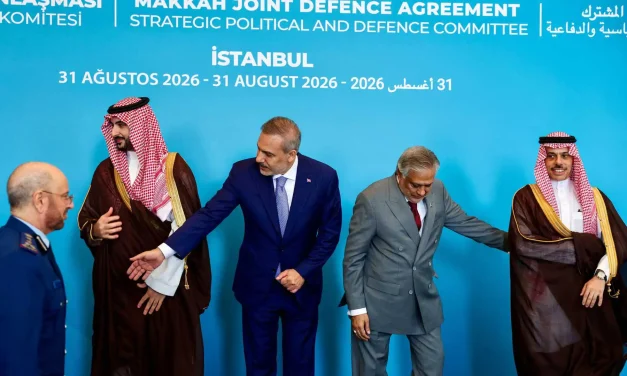
The Makkah Pact; Reasons for its Formation and Challenges Ahead

SCFR Online – Opinion: The Makkah Pact, signed between Saudi Arabia, Pakistan, and Turkey under the motto “an attack on one is an attack on all,” is viewed by some analysts less as a full-fledged military coalition and more as an attempt to reduce security dependence on an external power and to establish a regional security mechanism.

Implications of the US-Saudi Nuclear Agreement

SCFR Online – Opinion: The new US-Saudi nuclear agreement, despite legal and political ambiguities, could alter previous non-proliferation standards in West Asia and intensify nuclear competition, ushering it into a new phase.

An Analysis of Recent Turkey-Israeli Regime Tensions

SCFR Online – Opinion: Recent developments in Syria indicate an intensification of strategic rivalry between Turkey and the Israeli regime, but mutual considerations and the role of the United States have limited the likelihood of direct war.

Loading

Liberal Democrat

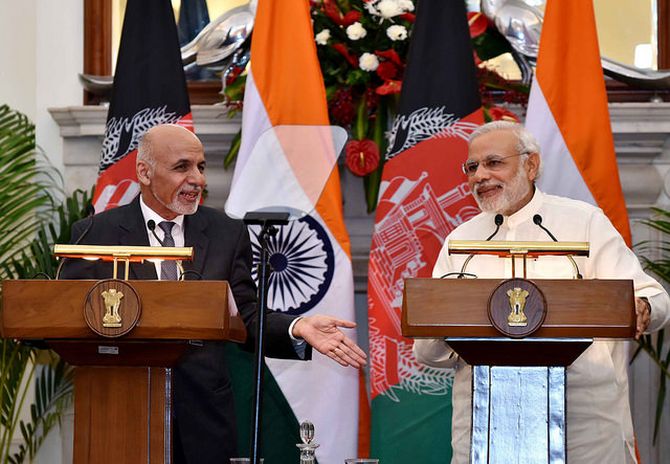
The future of Afghanistan and India’s ambiguous relations with it

The future of Afghanistan and India’s ambiguous relations with it

Strategic Council Online—Opinion: If for any reason, the Taliban are successful, either through political means and negotiations or military action, to possess maximum power in Afghanistan, and the two other parties—the North Front and the Liberal Democrats—are consequently placed in the weakness position, India would be definitely a loser as the Taliban’s view is ideological and therefore considers groups such as Lashkar-e-Taiba, Jaish-e-Mohammed and Hizb-ul-Mujahideen against India in Keshmir as its own allies. Therefore, if the Taliban are placed in the position of strength and power in Afghanistan, they would provide such groups with operational bases and India can no longer play a significant role in that country.
Pirmohammad Mollazehi—Expert of the subcontinent

أحدث الوظائف

China’s Rejection of US Sanctions; Strengthening Iran’s Geopolitical Leverage

SCFR Online – Opinion: Concurrent with the official commencement of the United States’ economic war against our country, focusing on sanctions instruments, isolation, and economic pressure, what has now become increasingly important is the lack of alignment of other major global powers, especially China, with this policy.

The Makkah Pact; Reasons for its Formation and Challenges Ahead

SCFR Online – Opinion: The Makkah Pact, signed between Saudi Arabia, Pakistan, and Turkey under the motto “an attack on one is an attack on all,” is viewed by some analysts less as a full-fledged military coalition and more as an attempt to reduce security dependence on an external power and to establish a regional security mechanism.

Implications of the US-Saudi Nuclear Agreement

SCFR Online – Opinion: The new US-Saudi nuclear agreement, despite legal and political ambiguities, could alter previous non-proliferation standards in West Asia and intensify nuclear competition, ushering it into a new phase.

An Analysis of Recent Turkey-Israeli Regime Tensions

SCFR Online – Opinion: Recent developments in Syria indicate an intensification of strategic rivalry between Turkey and the Israeli regime, but mutual considerations and the role of the United States have limited the likelihood of direct war.

Loading

Liberal Democrat

The future of Afghanistan and India’s ambiguous relations with it

The future of Afghanistan and India’s ambiguous relations with it

Strategic Council Online—Opinion: If for any reason, the Taliban are successful, either through political means and negotiations or military action, to possess maximum power in Afghanistan, and the two other parties—the North Front and the Liberal Democrats—are consequently placed in the weakness position, India would be definitely a loser as the Taliban’s view is ideological and therefore considers groups such as Lashkar-e-Taiba, Jaish-e-Mohammed and Hizb-ul-Mujahideen against India in Keshmir as its own allies. Therefore, if the Taliban are placed in the position of strength and power in Afghanistan, they would provide such groups with operational bases and India can no longer play a significant role in that country.
Pirmohammad Mollazehi—Expert of the subcontinent

Liberal Democrat

The future of Afghanistan and India’s ambiguous relations with it

The future of Afghanistan and India’s ambiguous relations with it

Strategic Council Online—Opinion: If for any reason, the Taliban are successful, either through political means and negotiations or military action, to possess maximum power in Afghanistan, and the two other parties—the North Front and the Liberal Democrats—are consequently placed in the weakness position, India would be definitely a loser as the Taliban’s view is ideological and therefore considers groups such as Lashkar-e-Taiba, Jaish-e-Mohammed and Hizb-ul-Mujahideen against India in Keshmir as its own allies. Therefore, if the Taliban are placed in the position of strength and power in Afghanistan, they would provide such groups with operational bases and India can no longer play a significant role in that country.
Pirmohammad Mollazehi—Expert of the subcontinent

LATEST CONTENT

China’s Rejection of US Sanctions; Strengthening Iran’s Geopolitical Leverage

SCFR Online – Opinion: Concurrent with the official commencement of the United States’ economic war against our country, focusing on sanctions instruments, isolation, and economic pressure, what has now become increasingly important is the lack of alignment of other major global powers, especially China, with this policy.

The Makkah Pact; Reasons for its Formation and Challenges Ahead

SCFR Online – Opinion: The Makkah Pact, signed between Saudi Arabia, Pakistan, and Turkey under the motto “an attack on one is an attack on all,” is viewed by some analysts less as a full-fledged military coalition and more as an attempt to reduce security dependence on an external power and to establish a regional security mechanism.

Implications of the US-Saudi Nuclear Agreement

SCFR Online – Opinion: The new US-Saudi nuclear agreement, despite legal and political ambiguities, could alter previous non-proliferation standards in West Asia and intensify nuclear competition, ushering it into a new phase.

An Analysis of Recent Turkey-Israeli Regime Tensions

SCFR Online – Opinion: Recent developments in Syria indicate an intensification of strategic rivalry between Turkey and the Israeli regime, but mutual considerations and the role of the United States have limited the likelihood of direct war.

Loading

Liberal Democrat

The future of Afghanistan and India’s ambiguous relations with it

The future of Afghanistan and India’s ambiguous relations with it

Strategic Council Online—Opinion: If for any reason, the Taliban are successful, either through political means and negotiations or military action, to possess maximum power in Afghanistan, and the two other parties—the North Front and the Liberal Democrats—are consequently placed in the weakness position, India would be definitely a loser as the Taliban’s view is ideological and therefore considers groups such as Lashkar-e-Taiba, Jaish-e-Mohammed and Hizb-ul-Mujahideen against India in Keshmir as its own allies. Therefore, if the Taliban are placed in the position of strength and power in Afghanistan, they would provide such groups with operational bases and India can no longer play a significant role in that country.
Pirmohammad Mollazehi—Expert of the subcontinent

ÚLTIMAS PUBLICACIONES

China’s Rejection of US Sanctions; Strengthening Iran’s Geopolitical Leverage

SCFR Online – Opinion: Concurrent with the official commencement of the United States’ economic war against our country, focusing on sanctions instruments, isolation, and economic pressure, what has now become increasingly important is the lack of alignment of other major global powers, especially China, with this policy.

The Makkah Pact; Reasons for its Formation and Challenges Ahead

SCFR Online – Opinion: The Makkah Pact, signed between Saudi Arabia, Pakistan, and Turkey under the motto “an attack on one is an attack on all,” is viewed by some analysts less as a full-fledged military coalition and more as an attempt to reduce security dependence on an external power and to establish a regional security mechanism.

Implications of the US-Saudi Nuclear Agreement

SCFR Online – Opinion: The new US-Saudi nuclear agreement, despite legal and political ambiguities, could alter previous non-proliferation standards in West Asia and intensify nuclear competition, ushering it into a new phase.

An Analysis of Recent Turkey-Israeli Regime Tensions

SCFR Online – Opinion: Recent developments in Syria indicate an intensification of strategic rivalry between Turkey and the Israeli regime, but mutual considerations and the role of the United States have limited the likelihood of direct war.

Loading

Liberal Democrat

The future of Afghanistan and India’s ambiguous relations with it

The future of Afghanistan and India’s ambiguous relations with it

Strategic Council Online—Opinion: If for any reason, the Taliban are successful, either through political means and negotiations or military action, to possess maximum power in Afghanistan, and the two other parties—the North Front and the Liberal Democrats—are consequently placed in the weakness position, India would be definitely a loser as the Taliban’s view is ideological and therefore considers groups such as Lashkar-e-Taiba, Jaish-e-Mohammed and Hizb-ul-Mujahideen against India in Keshmir as its own allies. Therefore, if the Taliban are placed in the position of strength and power in Afghanistan, they would provide such groups with operational bases and India can no longer play a significant role in that country.
Pirmohammad Mollazehi—Expert of the subcontinent

ÚLTIMAS PUBLICACIONES

China’s Rejection of US Sanctions; Strengthening Iran’s Geopolitical Leverage

SCFR Online – Opinion: Concurrent with the official commencement of the United States’ economic war against our country, focusing on sanctions instruments, isolation, and economic pressure, what has now become increasingly important is the lack of alignment of other major global powers, especially China, with this policy.

The Makkah Pact; Reasons for its Formation and Challenges Ahead

SCFR Online – Opinion: The Makkah Pact, signed between Saudi Arabia, Pakistan, and Turkey under the motto “an attack on one is an attack on all,” is viewed by some analysts less as a full-fledged military coalition and more as an attempt to reduce security dependence on an external power and to establish a regional security mechanism.

Implications of the US-Saudi Nuclear Agreement

SCFR Online – Opinion: The new US-Saudi nuclear agreement, despite legal and political ambiguities, could alter previous non-proliferation standards in West Asia and intensify nuclear competition, ushering it into a new phase.

An Analysis of Recent Turkey-Israeli Regime Tensions

SCFR Online – Opinion: Recent developments in Syria indicate an intensification of strategic rivalry between Turkey and the Israeli regime, but mutual considerations and the role of the United States have limited the likelihood of direct war.

Loading

Liberal Democrat

The future of Afghanistan and India’s ambiguous relations with it

The future of Afghanistan and India’s ambiguous relations with it

Strategic Council Online—Opinion: If for any reason, the Taliban are successful, either through political means and negotiations or military action, to possess maximum power in Afghanistan, and the two other parties—the North Front and the Liberal Democrats—are consequently placed in the weakness position, India would be definitely a loser as the Taliban’s view is ideological and therefore considers groups such as Lashkar-e-Taiba, Jaish-e-Mohammed and Hizb-ul-Mujahideen against India in Keshmir as its own allies. Therefore, if the Taliban are placed in the position of strength and power in Afghanistan, they would provide such groups with operational bases and India can no longer play a significant role in that country.
Pirmohammad Mollazehi—Expert of the subcontinent

ÚLTIMAS PUBLICACIONES

China’s Rejection of US Sanctions; Strengthening Iran’s Geopolitical Leverage

SCFR Online – Opinion: Concurrent with the official commencement of the United States’ economic war against our country, focusing on sanctions instruments, isolation, and economic pressure, what has now become increasingly important is the lack of alignment of other major global powers, especially China, with this policy.

The Makkah Pact; Reasons for its Formation and Challenges Ahead

SCFR Online – Opinion: The Makkah Pact, signed between Saudi Arabia, Pakistan, and Turkey under the motto “an attack on one is an attack on all,” is viewed by some analysts less as a full-fledged military coalition and more as an attempt to reduce security dependence on an external power and to establish a regional security mechanism.

Implications of the US-Saudi Nuclear Agreement

SCFR Online – Opinion: The new US-Saudi nuclear agreement, despite legal and political ambiguities, could alter previous non-proliferation standards in West Asia and intensify nuclear competition, ushering it into a new phase.

An Analysis of Recent Turkey-Israeli Regime Tensions

SCFR Online – Opinion: Recent developments in Syria indicate an intensification of strategic rivalry between Turkey and the Israeli regime, but mutual considerations and the role of the United States have limited the likelihood of direct war.

Loading

Liberal Democrat

The future of Afghanistan and India’s ambiguous relations with it

The future of Afghanistan and India’s ambiguous relations with it

Strategic Council Online—Opinion: If for any reason, the Taliban are successful, either through political means and negotiations or military action, to possess maximum power in Afghanistan, and the two other parties—the North Front and the Liberal Democrats—are consequently placed in the weakness position, India would be definitely a loser as the Taliban’s view is ideological and therefore considers groups such as Lashkar-e-Taiba, Jaish-e-Mohammed and Hizb-ul-Mujahideen against India in Keshmir as its own allies. Therefore, if the Taliban are placed in the position of strength and power in Afghanistan, they would provide such groups with operational bases and India can no longer play a significant role in that country.
Pirmohammad Mollazehi—Expert of the subcontinent

ÚLTIMAS PUBLICACIONES

China’s Rejection of US Sanctions; Strengthening Iran’s Geopolitical Leverage

SCFR Online – Opinion: Concurrent with the official commencement of the United States’ economic war against our country, focusing on sanctions instruments, isolation, and economic pressure, what has now become increasingly important is the lack of alignment of other major global powers, especially China, with this policy.

The Makkah Pact; Reasons for its Formation and Challenges Ahead

SCFR Online – Opinion: The Makkah Pact, signed between Saudi Arabia, Pakistan, and Turkey under the motto “an attack on one is an attack on all,” is viewed by some analysts less as a full-fledged military coalition and more as an attempt to reduce security dependence on an external power and to establish a regional security mechanism.

Implications of the US-Saudi Nuclear Agreement

SCFR Online – Opinion: The new US-Saudi nuclear agreement, despite legal and political ambiguities, could alter previous non-proliferation standards in West Asia and intensify nuclear competition, ushering it into a new phase.

An Analysis of Recent Turkey-Israeli Regime Tensions

SCFR Online – Opinion: Recent developments in Syria indicate an intensification of strategic rivalry between Turkey and the Israeli regime, but mutual considerations and the role of the United States have limited the likelihood of direct war.

Loading