جدیدترین مطالب

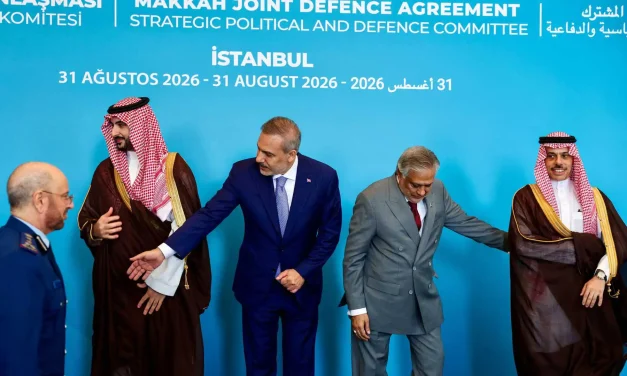
The Makkah Pact; Reasons for its Formation and Challenges Ahead

SCFR Online – Opinion: The Makkah Pact, signed between Saudi Arabia, Pakistan, and Turkey under the motto “an attack on one is an attack on all,” is viewed by some analysts less as a full-fledged military coalition and more as an attempt to reduce security dependence on an external power and to establish a regional security mechanism.

Implications of the US-Saudi Nuclear Agreement

SCFR Online – Opinion: The new US-Saudi nuclear agreement, despite legal and political ambiguities, could alter previous non-proliferation standards in West Asia and intensify nuclear competition, ushering it into a new phase.

An Analysis of Recent Turkey-Israeli Regime Tensions

SCFR Online – Opinion: Recent developments in Syria indicate an intensification of strategic rivalry between Turkey and the Israeli regime, but mutual considerations and the role of the United States have limited the likelihood of direct war.

Increasing criticism of the extensive Zionist lobby network

SCFR Online – Opinion: An examination of the mechanisms of the Israeli regime’s influence in the United States depicts a complex picture of shared interests, strategic dependencies, and the limitations of this relationship.

Realities of the Tripartite Makkah Pact

SCFR Online – Interview: The signing of the Makkah agreement between Saudi Arabia, Pakistan, and Turkey has raised questions about the future of the region’s security structure and the position of these countries in West Asian equations. Can this agreement become a genuine collective defense mechanism, or does it have more of a political and deterrent function than creating new military capacity?

Strategic Implications of the Reduction of US Weapons Stockpiles

SCFR Online – Opinion: The continuation of the US war against Iran, in addition to increasing operational costs, has called into question the actual capacity of the American arsenal to simultaneously fulfill security commitments on multiple fronts; an issue that affects deterrence, defense production capacity, and Washington’s resource prioritization.

Loading

Disarmament

The Security Equation of Southern Lebanon for the Zionist Regime

The Security Equation of Southern Lebanon for the Zionist Regime

Strategic Council Online – Opinion: American-Zionist objectives in the region are not limited to weakening Hezbollah. Efforts to disarm Iraqi resistance groups such as Kata’ib Hezbollah and the Popular Mobilization Forces are also part of their subsequent plans.

Consequences of the “Lebanon Minus Resistance” Scenario

Consequences of the “Lebanon Minus Resistance” Scenario

Strategic Council Online – Interview: An expert on Arab world affairs said: One of the Zionist regime’s primary motives for insisting on disarming Hezbollah is to create a security vacuum in Lebanon so that, if needed, the possibility of attacking it again is provided. Today, Lebanon is witnessing one of its most sensitive political junctures in recent years; the Lebanese cabinet, in its recent session chaired by Najib Mikati, the country’s Prime Minister, approved the content of the US proposal for disarming Hezbollah and monopolizing weapons in the hands of the army, despite opposition from some ministers. The US proposal, which has faced firm opposition from the Hezbollah, was brought to Beirut by Thomas Barrack, the US Special Envoy, and with a paternalistic approach, considers disarming the Hezbollah a precondition for starting any dialogue and border demarcation, explicitly stating that this plan must either be entirely accepted or Lebanon must accept the consequences of its rejection.

Barriers to Resolving the Korean Peninsula Crisis

Barriers to Resolving the Korean Peninsula Crisis

Strategic Council Online: Recently, news broke out that the United States is seeking to resume talks with North Korea. According to the White House National Security Advisor Robert O’Brien “it’s a positive sign that North Korean leader Kim Jong Un had not delivered on a warning of a Christmas gift.” However, there is still a long and winding road to resolving the crisis on the Korean Peninsula and according to current trends there is no positive prospect of resolving it until at least the end of Donald Trump’s presidency.
Mohammad Zare: China and Asia affairs expert

North Korea, a case of the US unreliability

Strategic Council online – Less than three months have passed since the historic summit of the US President Donald Trump and the North Korean leader Kim Jong Un took place on Sentosa Island in Singapore and yet the talks have more or less stopped as the two sides have a series of expectations from each other that have not been met.

أحدث الوظائف

The Makkah Pact; Reasons for its Formation and Challenges Ahead

SCFR Online – Opinion: The Makkah Pact, signed between Saudi Arabia, Pakistan, and Turkey under the motto “an attack on one is an attack on all,” is viewed by some analysts less as a full-fledged military coalition and more as an attempt to reduce security dependence on an external power and to establish a regional security mechanism.

Implications of the US-Saudi Nuclear Agreement

SCFR Online – Opinion: The new US-Saudi nuclear agreement, despite legal and political ambiguities, could alter previous non-proliferation standards in West Asia and intensify nuclear competition, ushering it into a new phase.

An Analysis of Recent Turkey-Israeli Regime Tensions

SCFR Online – Opinion: Recent developments in Syria indicate an intensification of strategic rivalry between Turkey and the Israeli regime, but mutual considerations and the role of the United States have limited the likelihood of direct war.

Increasing criticism of the extensive Zionist lobby network

SCFR Online – Opinion: An examination of the mechanisms of the Israeli regime’s influence in the United States depicts a complex picture of shared interests, strategic dependencies, and the limitations of this relationship.

Realities of the Tripartite Makkah Pact

SCFR Online – Interview: The signing of the Makkah agreement between Saudi Arabia, Pakistan, and Turkey has raised questions about the future of the region’s security structure and the position of these countries in West Asian equations. Can this agreement become a genuine collective defense mechanism, or does it have more of a political and deterrent function than creating new military capacity?

Strategic Implications of the Reduction of US Weapons Stockpiles

SCFR Online – Opinion: The continuation of the US war against Iran, in addition to increasing operational costs, has called into question the actual capacity of the American arsenal to simultaneously fulfill security commitments on multiple fronts; an issue that affects deterrence, defense production capacity, and Washington’s resource prioritization.

Loading

Disarmament

The Security Equation of Southern Lebanon for the Zionist Regime

The Security Equation of Southern Lebanon for the Zionist Regime

Strategic Council Online – Opinion: American-Zionist objectives in the region are not limited to weakening Hezbollah. Efforts to disarm Iraqi resistance groups such as Kata’ib Hezbollah and the Popular Mobilization Forces are also part of their subsequent plans.

Consequences of the “Lebanon Minus Resistance” Scenario

Consequences of the “Lebanon Minus Resistance” Scenario

Strategic Council Online – Interview: An expert on Arab world affairs said: One of the Zionist regime’s primary motives for insisting on disarming Hezbollah is to create a security vacuum in Lebanon so that, if needed, the possibility of attacking it again is provided. Today, Lebanon is witnessing one of its most sensitive political junctures in recent years; the Lebanese cabinet, in its recent session chaired by Najib Mikati, the country’s Prime Minister, approved the content of the US proposal for disarming Hezbollah and monopolizing weapons in the hands of the army, despite opposition from some ministers. The US proposal, which has faced firm opposition from the Hezbollah, was brought to Beirut by Thomas Barrack, the US Special Envoy, and with a paternalistic approach, considers disarming the Hezbollah a precondition for starting any dialogue and border demarcation, explicitly stating that this plan must either be entirely accepted or Lebanon must accept the consequences of its rejection.

Barriers to Resolving the Korean Peninsula Crisis

Barriers to Resolving the Korean Peninsula Crisis

Strategic Council Online: Recently, news broke out that the United States is seeking to resume talks with North Korea. According to the White House National Security Advisor Robert O’Brien “it’s a positive sign that North Korean leader Kim Jong Un had not delivered on a warning of a Christmas gift.” However, there is still a long and winding road to resolving the crisis on the Korean Peninsula and according to current trends there is no positive prospect of resolving it until at least the end of Donald Trump’s presidency.
Mohammad Zare: China and Asia affairs expert

North Korea, a case of the US unreliability

Strategic Council online – Less than three months have passed since the historic summit of the US President Donald Trump and the North Korean leader Kim Jong Un took place on Sentosa Island in Singapore and yet the talks have more or less stopped as the two sides have a series of expectations from each other that have not been met.

Disarmament

The Security Equation of Southern Lebanon for the Zionist Regime

The Security Equation of Southern Lebanon for the Zionist Regime

Strategic Council Online – Opinion: American-Zionist objectives in the region are not limited to weakening Hezbollah. Efforts to disarm Iraqi resistance groups such as Kata’ib Hezbollah and the Popular Mobilization Forces are also part of their subsequent plans.

Consequences of the “Lebanon Minus Resistance” Scenario

Consequences of the “Lebanon Minus Resistance” Scenario

Strategic Council Online – Interview: An expert on Arab world affairs said: One of the Zionist regime’s primary motives for insisting on disarming Hezbollah is to create a security vacuum in Lebanon so that, if needed, the possibility of attacking it again is provided. Today, Lebanon is witnessing one of its most sensitive political junctures in recent years; the Lebanese cabinet, in its recent session chaired by Najib Mikati, the country’s Prime Minister, approved the content of the US proposal for disarming Hezbollah and monopolizing weapons in the hands of the army, despite opposition from some ministers. The US proposal, which has faced firm opposition from the Hezbollah, was brought to Beirut by Thomas Barrack, the US Special Envoy, and with a paternalistic approach, considers disarming the Hezbollah a precondition for starting any dialogue and border demarcation, explicitly stating that this plan must either be entirely accepted or Lebanon must accept the consequences of its rejection.

Barriers to Resolving the Korean Peninsula Crisis

Barriers to Resolving the Korean Peninsula Crisis

Strategic Council Online: Recently, news broke out that the United States is seeking to resume talks with North Korea. According to the White House National Security Advisor Robert O’Brien “it’s a positive sign that North Korean leader Kim Jong Un had not delivered on a warning of a Christmas gift.” However, there is still a long and winding road to resolving the crisis on the Korean Peninsula and according to current trends there is no positive prospect of resolving it until at least the end of Donald Trump’s presidency.
Mohammad Zare: China and Asia affairs expert

North Korea, a case of the US unreliability

Strategic Council online – Less than three months have passed since the historic summit of the US President Donald Trump and the North Korean leader Kim Jong Un took place on Sentosa Island in Singapore and yet the talks have more or less stopped as the two sides have a series of expectations from each other that have not been met.

LATEST CONTENT

The Makkah Pact; Reasons for its Formation and Challenges Ahead

SCFR Online – Opinion: The Makkah Pact, signed between Saudi Arabia, Pakistan, and Turkey under the motto “an attack on one is an attack on all,” is viewed by some analysts less as a full-fledged military coalition and more as an attempt to reduce security dependence on an external power and to establish a regional security mechanism.

Implications of the US-Saudi Nuclear Agreement

SCFR Online – Opinion: The new US-Saudi nuclear agreement, despite legal and political ambiguities, could alter previous non-proliferation standards in West Asia and intensify nuclear competition, ushering it into a new phase.

An Analysis of Recent Turkey-Israeli Regime Tensions

SCFR Online – Opinion: Recent developments in Syria indicate an intensification of strategic rivalry between Turkey and the Israeli regime, but mutual considerations and the role of the United States have limited the likelihood of direct war.

Increasing criticism of the extensive Zionist lobby network

SCFR Online – Opinion: An examination of the mechanisms of the Israeli regime’s influence in the United States depicts a complex picture of shared interests, strategic dependencies, and the limitations of this relationship.

Realities of the Tripartite Makkah Pact

SCFR Online – Interview: The signing of the Makkah agreement between Saudi Arabia, Pakistan, and Turkey has raised questions about the future of the region’s security structure and the position of these countries in West Asian equations. Can this agreement become a genuine collective defense mechanism, or does it have more of a political and deterrent function than creating new military capacity?

Strategic Implications of the Reduction of US Weapons Stockpiles

SCFR Online – Opinion: The continuation of the US war against Iran, in addition to increasing operational costs, has called into question the actual capacity of the American arsenal to simultaneously fulfill security commitments on multiple fronts; an issue that affects deterrence, defense production capacity, and Washington’s resource prioritization.

Loading

Disarmament

The Security Equation of Southern Lebanon for the Zionist Regime

The Security Equation of Southern Lebanon for the Zionist Regime

Strategic Council Online – Opinion: American-Zionist objectives in the region are not limited to weakening Hezbollah. Efforts to disarm Iraqi resistance groups such as Kata’ib Hezbollah and the Popular Mobilization Forces are also part of their subsequent plans.

Consequences of the “Lebanon Minus Resistance” Scenario

Consequences of the “Lebanon Minus Resistance” Scenario

Strategic Council Online – Interview: An expert on Arab world affairs said: One of the Zionist regime’s primary motives for insisting on disarming Hezbollah is to create a security vacuum in Lebanon so that, if needed, the possibility of attacking it again is provided. Today, Lebanon is witnessing one of its most sensitive political junctures in recent years; the Lebanese cabinet, in its recent session chaired by Najib Mikati, the country’s Prime Minister, approved the content of the US proposal for disarming Hezbollah and monopolizing weapons in the hands of the army, despite opposition from some ministers. The US proposal, which has faced firm opposition from the Hezbollah, was brought to Beirut by Thomas Barrack, the US Special Envoy, and with a paternalistic approach, considers disarming the Hezbollah a precondition for starting any dialogue and border demarcation, explicitly stating that this plan must either be entirely accepted or Lebanon must accept the consequences of its rejection.

Barriers to Resolving the Korean Peninsula Crisis

Barriers to Resolving the Korean Peninsula Crisis

Strategic Council Online: Recently, news broke out that the United States is seeking to resume talks with North Korea. According to the White House National Security Advisor Robert O’Brien “it’s a positive sign that North Korean leader Kim Jong Un had not delivered on a warning of a Christmas gift.” However, there is still a long and winding road to resolving the crisis on the Korean Peninsula and according to current trends there is no positive prospect of resolving it until at least the end of Donald Trump’s presidency.
Mohammad Zare: China and Asia affairs expert

North Korea, a case of the US unreliability

Strategic Council online – Less than three months have passed since the historic summit of the US President Donald Trump and the North Korean leader Kim Jong Un took place on Sentosa Island in Singapore and yet the talks have more or less stopped as the two sides have a series of expectations from each other that have not been met.

ÚLTIMAS PUBLICACIONES

The Makkah Pact; Reasons for its Formation and Challenges Ahead

SCFR Online – Opinion: The Makkah Pact, signed between Saudi Arabia, Pakistan, and Turkey under the motto “an attack on one is an attack on all,” is viewed by some analysts less as a full-fledged military coalition and more as an attempt to reduce security dependence on an external power and to establish a regional security mechanism.

Implications of the US-Saudi Nuclear Agreement

SCFR Online – Opinion: The new US-Saudi nuclear agreement, despite legal and political ambiguities, could alter previous non-proliferation standards in West Asia and intensify nuclear competition, ushering it into a new phase.

An Analysis of Recent Turkey-Israeli Regime Tensions

SCFR Online – Opinion: Recent developments in Syria indicate an intensification of strategic rivalry between Turkey and the Israeli regime, but mutual considerations and the role of the United States have limited the likelihood of direct war.

Increasing criticism of the extensive Zionist lobby network

SCFR Online – Opinion: An examination of the mechanisms of the Israeli regime’s influence in the United States depicts a complex picture of shared interests, strategic dependencies, and the limitations of this relationship.

Realities of the Tripartite Makkah Pact

SCFR Online – Interview: The signing of the Makkah agreement between Saudi Arabia, Pakistan, and Turkey has raised questions about the future of the region’s security structure and the position of these countries in West Asian equations. Can this agreement become a genuine collective defense mechanism, or does it have more of a political and deterrent function than creating new military capacity?

Strategic Implications of the Reduction of US Weapons Stockpiles

SCFR Online – Opinion: The continuation of the US war against Iran, in addition to increasing operational costs, has called into question the actual capacity of the American arsenal to simultaneously fulfill security commitments on multiple fronts; an issue that affects deterrence, defense production capacity, and Washington’s resource prioritization.

Loading

Disarmament

The Security Equation of Southern Lebanon for the Zionist Regime

The Security Equation of Southern Lebanon for the Zionist Regime

Strategic Council Online – Opinion: American-Zionist objectives in the region are not limited to weakening Hezbollah. Efforts to disarm Iraqi resistance groups such as Kata’ib Hezbollah and the Popular Mobilization Forces are also part of their subsequent plans.

Consequences of the “Lebanon Minus Resistance” Scenario

Consequences of the “Lebanon Minus Resistance” Scenario

Strategic Council Online – Interview: An expert on Arab world affairs said: One of the Zionist regime’s primary motives for insisting on disarming Hezbollah is to create a security vacuum in Lebanon so that, if needed, the possibility of attacking it again is provided. Today, Lebanon is witnessing one of its most sensitive political junctures in recent years; the Lebanese cabinet, in its recent session chaired by Najib Mikati, the country’s Prime Minister, approved the content of the US proposal for disarming Hezbollah and monopolizing weapons in the hands of the army, despite opposition from some ministers. The US proposal, which has faced firm opposition from the Hezbollah, was brought to Beirut by Thomas Barrack, the US Special Envoy, and with a paternalistic approach, considers disarming the Hezbollah a precondition for starting any dialogue and border demarcation, explicitly stating that this plan must either be entirely accepted or Lebanon must accept the consequences of its rejection.

Barriers to Resolving the Korean Peninsula Crisis

Barriers to Resolving the Korean Peninsula Crisis

Strategic Council Online: Recently, news broke out that the United States is seeking to resume talks with North Korea. According to the White House National Security Advisor Robert O’Brien “it’s a positive sign that North Korean leader Kim Jong Un had not delivered on a warning of a Christmas gift.” However, there is still a long and winding road to resolving the crisis on the Korean Peninsula and according to current trends there is no positive prospect of resolving it until at least the end of Donald Trump’s presidency.
Mohammad Zare: China and Asia affairs expert

North Korea, a case of the US unreliability

Strategic Council online – Less than three months have passed since the historic summit of the US President Donald Trump and the North Korean leader Kim Jong Un took place on Sentosa Island in Singapore and yet the talks have more or less stopped as the two sides have a series of expectations from each other that have not been met.

ÚLTIMAS PUBLICACIONES

The Makkah Pact; Reasons for its Formation and Challenges Ahead

SCFR Online – Opinion: The Makkah Pact, signed between Saudi Arabia, Pakistan, and Turkey under the motto “an attack on one is an attack on all,” is viewed by some analysts less as a full-fledged military coalition and more as an attempt to reduce security dependence on an external power and to establish a regional security mechanism.

Implications of the US-Saudi Nuclear Agreement

SCFR Online – Opinion: The new US-Saudi nuclear agreement, despite legal and political ambiguities, could alter previous non-proliferation standards in West Asia and intensify nuclear competition, ushering it into a new phase.

An Analysis of Recent Turkey-Israeli Regime Tensions

SCFR Online – Opinion: Recent developments in Syria indicate an intensification of strategic rivalry between Turkey and the Israeli regime, but mutual considerations and the role of the United States have limited the likelihood of direct war.

Increasing criticism of the extensive Zionist lobby network

SCFR Online – Opinion: An examination of the mechanisms of the Israeli regime’s influence in the United States depicts a complex picture of shared interests, strategic dependencies, and the limitations of this relationship.

Realities of the Tripartite Makkah Pact

SCFR Online – Interview: The signing of the Makkah agreement between Saudi Arabia, Pakistan, and Turkey has raised questions about the future of the region’s security structure and the position of these countries in West Asian equations. Can this agreement become a genuine collective defense mechanism, or does it have more of a political and deterrent function than creating new military capacity?

Strategic Implications of the Reduction of US Weapons Stockpiles

SCFR Online – Opinion: The continuation of the US war against Iran, in addition to increasing operational costs, has called into question the actual capacity of the American arsenal to simultaneously fulfill security commitments on multiple fronts; an issue that affects deterrence, defense production capacity, and Washington’s resource prioritization.

Loading

Disarmament

The Security Equation of Southern Lebanon for the Zionist Regime

The Security Equation of Southern Lebanon for the Zionist Regime

Strategic Council Online – Opinion: American-Zionist objectives in the region are not limited to weakening Hezbollah. Efforts to disarm Iraqi resistance groups such as Kata’ib Hezbollah and the Popular Mobilization Forces are also part of their subsequent plans.

Consequences of the “Lebanon Minus Resistance” Scenario

Consequences of the “Lebanon Minus Resistance” Scenario

Strategic Council Online – Interview: An expert on Arab world affairs said: One of the Zionist regime’s primary motives for insisting on disarming Hezbollah is to create a security vacuum in Lebanon so that, if needed, the possibility of attacking it again is provided. Today, Lebanon is witnessing one of its most sensitive political junctures in recent years; the Lebanese cabinet, in its recent session chaired by Najib Mikati, the country’s Prime Minister, approved the content of the US proposal for disarming Hezbollah and monopolizing weapons in the hands of the army, despite opposition from some ministers. The US proposal, which has faced firm opposition from the Hezbollah, was brought to Beirut by Thomas Barrack, the US Special Envoy, and with a paternalistic approach, considers disarming the Hezbollah a precondition for starting any dialogue and border demarcation, explicitly stating that this plan must either be entirely accepted or Lebanon must accept the consequences of its rejection.

Barriers to Resolving the Korean Peninsula Crisis

Barriers to Resolving the Korean Peninsula Crisis

Strategic Council Online: Recently, news broke out that the United States is seeking to resume talks with North Korea. According to the White House National Security Advisor Robert O’Brien “it’s a positive sign that North Korean leader Kim Jong Un had not delivered on a warning of a Christmas gift.” However, there is still a long and winding road to resolving the crisis on the Korean Peninsula and according to current trends there is no positive prospect of resolving it until at least the end of Donald Trump’s presidency.
Mohammad Zare: China and Asia affairs expert

North Korea, a case of the US unreliability

Strategic Council online – Less than three months have passed since the historic summit of the US President Donald Trump and the North Korean leader Kim Jong Un took place on Sentosa Island in Singapore and yet the talks have more or less stopped as the two sides have a series of expectations from each other that have not been met.

ÚLTIMAS PUBLICACIONES

The Makkah Pact; Reasons for its Formation and Challenges Ahead

SCFR Online – Opinion: The Makkah Pact, signed between Saudi Arabia, Pakistan, and Turkey under the motto “an attack on one is an attack on all,” is viewed by some analysts less as a full-fledged military coalition and more as an attempt to reduce security dependence on an external power and to establish a regional security mechanism.

Implications of the US-Saudi Nuclear Agreement

SCFR Online – Opinion: The new US-Saudi nuclear agreement, despite legal and political ambiguities, could alter previous non-proliferation standards in West Asia and intensify nuclear competition, ushering it into a new phase.

An Analysis of Recent Turkey-Israeli Regime Tensions

SCFR Online – Opinion: Recent developments in Syria indicate an intensification of strategic rivalry between Turkey and the Israeli regime, but mutual considerations and the role of the United States have limited the likelihood of direct war.

Increasing criticism of the extensive Zionist lobby network

SCFR Online – Opinion: An examination of the mechanisms of the Israeli regime’s influence in the United States depicts a complex picture of shared interests, strategic dependencies, and the limitations of this relationship.

Realities of the Tripartite Makkah Pact

SCFR Online – Interview: The signing of the Makkah agreement between Saudi Arabia, Pakistan, and Turkey has raised questions about the future of the region’s security structure and the position of these countries in West Asian equations. Can this agreement become a genuine collective defense mechanism, or does it have more of a political and deterrent function than creating new military capacity?

Strategic Implications of the Reduction of US Weapons Stockpiles

SCFR Online – Opinion: The continuation of the US war against Iran, in addition to increasing operational costs, has called into question the actual capacity of the American arsenal to simultaneously fulfill security commitments on multiple fronts; an issue that affects deterrence, defense production capacity, and Washington’s resource prioritization.

Loading

Disarmament

The Security Equation of Southern Lebanon for the Zionist Regime

The Security Equation of Southern Lebanon for the Zionist Regime

Strategic Council Online – Opinion: American-Zionist objectives in the region are not limited to weakening Hezbollah. Efforts to disarm Iraqi resistance groups such as Kata’ib Hezbollah and the Popular Mobilization Forces are also part of their subsequent plans.

Consequences of the “Lebanon Minus Resistance” Scenario

Consequences of the “Lebanon Minus Resistance” Scenario

Strategic Council Online – Interview: An expert on Arab world affairs said: One of the Zionist regime’s primary motives for insisting on disarming Hezbollah is to create a security vacuum in Lebanon so that, if needed, the possibility of attacking it again is provided. Today, Lebanon is witnessing one of its most sensitive political junctures in recent years; the Lebanese cabinet, in its recent session chaired by Najib Mikati, the country’s Prime Minister, approved the content of the US proposal for disarming Hezbollah and monopolizing weapons in the hands of the army, despite opposition from some ministers. The US proposal, which has faced firm opposition from the Hezbollah, was brought to Beirut by Thomas Barrack, the US Special Envoy, and with a paternalistic approach, considers disarming the Hezbollah a precondition for starting any dialogue and border demarcation, explicitly stating that this plan must either be entirely accepted or Lebanon must accept the consequences of its rejection.

Barriers to Resolving the Korean Peninsula Crisis

Barriers to Resolving the Korean Peninsula Crisis

Strategic Council Online: Recently, news broke out that the United States is seeking to resume talks with North Korea. According to the White House National Security Advisor Robert O’Brien “it’s a positive sign that North Korean leader Kim Jong Un had not delivered on a warning of a Christmas gift.” However, there is still a long and winding road to resolving the crisis on the Korean Peninsula and according to current trends there is no positive prospect of resolving it until at least the end of Donald Trump’s presidency.
Mohammad Zare: China and Asia affairs expert

North Korea, a case of the US unreliability

Strategic Council online – Less than three months have passed since the historic summit of the US President Donald Trump and the North Korean leader Kim Jong Un took place on Sentosa Island in Singapore and yet the talks have more or less stopped as the two sides have a series of expectations from each other that have not been met.

ÚLTIMAS PUBLICACIONES

The Makkah Pact; Reasons for its Formation and Challenges Ahead

SCFR Online – Opinion: The Makkah Pact, signed between Saudi Arabia, Pakistan, and Turkey under the motto “an attack on one is an attack on all,” is viewed by some analysts less as a full-fledged military coalition and more as an attempt to reduce security dependence on an external power and to establish a regional security mechanism.

Implications of the US-Saudi Nuclear Agreement

SCFR Online – Opinion: The new US-Saudi nuclear agreement, despite legal and political ambiguities, could alter previous non-proliferation standards in West Asia and intensify nuclear competition, ushering it into a new phase.

An Analysis of Recent Turkey-Israeli Regime Tensions

SCFR Online – Opinion: Recent developments in Syria indicate an intensification of strategic rivalry between Turkey and the Israeli regime, but mutual considerations and the role of the United States have limited the likelihood of direct war.

Increasing criticism of the extensive Zionist lobby network

SCFR Online – Opinion: An examination of the mechanisms of the Israeli regime’s influence in the United States depicts a complex picture of shared interests, strategic dependencies, and the limitations of this relationship.

Realities of the Tripartite Makkah Pact

SCFR Online – Interview: The signing of the Makkah agreement between Saudi Arabia, Pakistan, and Turkey has raised questions about the future of the region’s security structure and the position of these countries in West Asian equations. Can this agreement become a genuine collective defense mechanism, or does it have more of a political and deterrent function than creating new military capacity?

Strategic Implications of the Reduction of US Weapons Stockpiles

SCFR Online – Opinion: The continuation of the US war against Iran, in addition to increasing operational costs, has called into question the actual capacity of the American arsenal to simultaneously fulfill security commitments on multiple fronts; an issue that affects deterrence, defense production capacity, and Washington’s resource prioritization.

Loading