
Barsam Mohammadi – Regional Affairs Expert
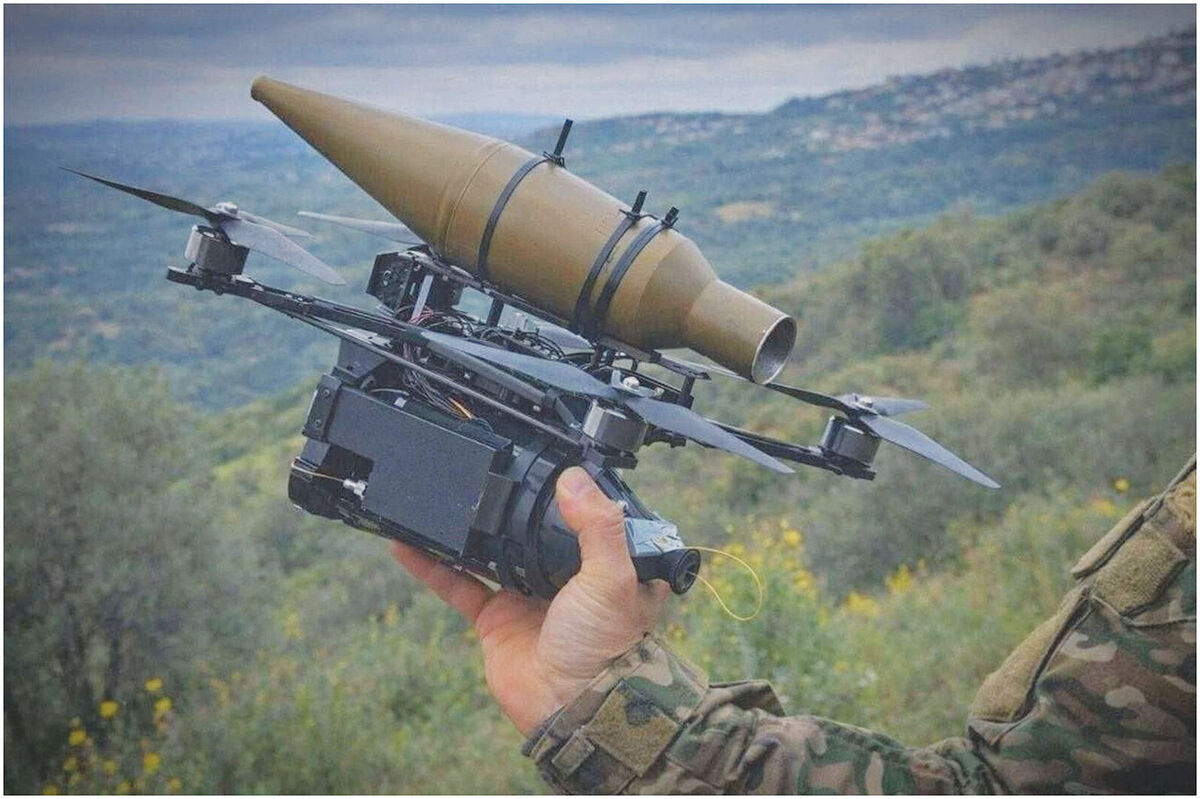
According to field reports, since the commencement of hostilities on the northern front of occupied Palestine and southern Lebanon, more than 500 Hezbollah drones—many of which are suicide-type and equipped with fiber-optic guidance—have been launched toward Zionist targets. Due to their wired guidance, these drones emit no electronic signals, rendering the Zionist regime’s electronic warfare systems, radars, and sophisticated jammers ineffective against them.
The primary response of the Zionist regime’s military—or more precisely, its most fundamental solution for countering these drones—has been the installation of metal nets over tanks and shelters. This measure has been described as the most absurd form of “active defense.” According to Hebrew-language media, over 158,000 square meters of netting have thus far been distributed among military personnel, and this process continues. This very image speaks to the depth of the crisis: a military that has spent billions of dollars on David’s Sling, Arrow, and Iron Dome systems has been compelled to protect its soldiers with nets and metal umbrellas.
An important point here concerns the implications of the presence of such drones on the battlefield against the Zionist regime. In this regard, the most significant strategic consequence of the emergence of Hezbollah’s low-cost drones must be understood as the rupture of the traditional cost-benefit equation. Each fiber-optic FPV drone produced by Hezbollah costs between $300 and $500, whereas a Merkava Mk-4 tank is valued at approximately $5 million. Put simply, Hezbollah destroys the Zionist regime’s most expensive military equipment at a cost lower than that of a conventional anti-tank missile.
Furthermore, Iron Dome—designed to counter ballistic missiles—has proven practically ineffective in detecting these small, electromagnetically silent aerial vehicles. This reality challenges the Zionist regime’s technological superiority and demonstrates that tactical innovation can neutralize vast power disparities.
Through this simple yet creative weapon, Hezbollah has succeeded in imposing a “new behavioral framework” upon the Zionist regime’s military. Any armored bulldozer entering the vicinity of villages in southern Lebanon is targeted and destroyed by an FPV drone within minutes. The 155mm artillery pieces that until yesterday bombarded residential areas have now themselves become fixed targets. A Zionist official has explicitly acknowledged that “Hezbollah has transformed the entire southern Lebanon region into a no-go zone for our heavy equipment.”
The range of these drones, which challenges the Zionist regime’s initial estimates, varies from 20 to 50 kilometers. This means that all bases and facilities of the regime in Haifa and the occupied Galilee region lie within the direct range of these low-cost weapons. Moreover, asymmetric warfare has entered a phase in which a non-state actor with a limited budget can delineate its red lines deep within enemy territory.
In response to Hezbollah’s drones, Tel Aviv’s strategic confusion has deepened to such an extent that the Zionist regime’s cabinet recently approved a $700 million budget to counter the threat posed by these drones and even ordered the establishment of a mass-production FPV drone factory within the military—a move that effectively signifies imitation of Hezbollah Lebanon and an official admission of inability to achieve defensive superiority. Meanwhile, Netanyahu acknowledged in a cabinet session that countering Hezbollah’s fiber-optic drones requires patience and time, which implies nothing other than defeat and deadlock in confronting Hezbollah.
However, the developments in northern occupied Palestine and Hezbollah’s new type of asymmetric warfare convey three key messages:
First, pure technological superiority no longer guarantees victory on the battlefield. Not only Islamic Resistance, but henceforth any country exposed to aggression by the United States and the Zionist regime can readily reduce power disparities through innovation and the use of low-cost technologies.
Second, the cost equation in modern warfare has changed significantly—a realm in which a few-hundred-dollar drone can disable equipment worth millions of dollars.
Third, the proliferation of such technologies will steer the pattern of future wars toward asymmetric, low-cost conflicts based on tactical creativity.
In summary, what has unfolded in recent months in southern Lebanon and northern occupied Palestine transcends a new military tactic; it fundamentally represents the collapse of a technological myth and the disintegration of the belief in the Zionist regime’s absolute air superiority in the region. A military that has spent hundreds of billions of dollars on billion-dollar defense systems and fifth-generation fighter jets has been exhausted by $300 drones with fiber-optic guidance.
The future battlefield will belong less to complex, expensive weaponry and more to tactical creativity, the utilization of simple yet effective technologies, and a correct understanding of the new cost equation. Hezbollah, with a cheap, simple, yet creative weapon, has permanently altered the power equation on the northern borders of occupied Palestine—an equation that increasingly confronts the Zionist regime’s existence with more profound strategic threats.









0 Comments