
Hamid Khoshayand – Expert on regional affairs
This pact, the product of nearly two years and eight months of negotiation, has been concluded amidst the most extensive regional crisis in recent decades and following the large-scale attacks by the Israeli regime and the United States against Iran, apparently as a pragmatic response to the security vacuum and the realignment of coalitions. To put it more simply, the developments of recent months and the warmongering of the United States and the Israeli regime in the region have played a highly effective role in accelerating and facilitating the process of forming the aforementioned defense pact.
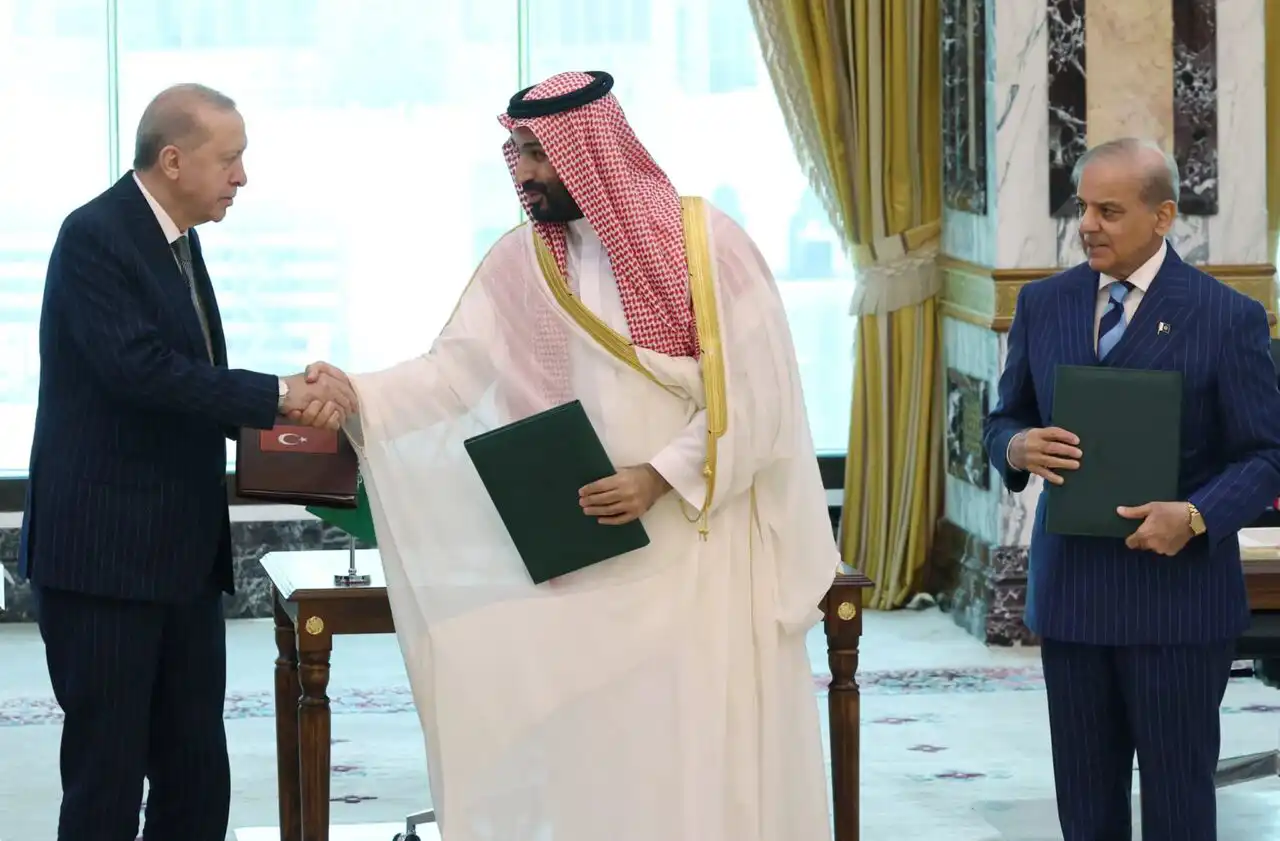
The Makkah Pact, drafted in continuity with previous Riyadh-Islamabad cooperation, brings together three countries with unique characteristics: Saudi Arabia with extensive financial capability, Turkey with an army on par with NATO, and Pakistan as the sole possessor of nuclear weapons in the Islamic world.
This is the first time that the leading powers of the Islamic world have come together within the framework of a formal defense structure. However, one should not overlook the technical and political complexities of coordination between a NATO member, a Persian Gulf kingdom, and a republic with an indigenous military structure, because linking these heterogeneous capabilities, beyond the signing of political protocols, requires precise operational mechanisms.
Here a fundamental question arises: should this pact be regarded as a full-fledged treaty, or is it a temporary reaction to current crises? Hakan Fidan, Turkey’s Minister of Foreign Affairs, has described the commitments of this pact as “technically similar to NATO Article 5” and has reported that other countries have expressed interest in joining, calling Egypt a “natural partner” for the next stage. However, the field and historical reality indicates that this mechanism is more a response to the security vacuum caused by uncertainty regarding US commitments than an integrated military coalition. Ambiguity in the unified command structure, a joint budget, and, more importantly, disagreement over the “nature of the threat” among the three countries are serious obstacles to the realization of a stable coalition.
The capacity to create and expand comprehensive regional cooperation
Nevertheless, one should not overlook the positive horizons of this pact. The most important distinguishing feature of this agreement is its potential capacity to become a framework for comprehensive regional cooperation. If the main focus of this pact is to counter the Israeli regime’s aggressions against Islamic countries and its expansionism, it could certainly be met with the welcome and cooperation of other governments and, beyond them, the peoples of the region, who are exasperated by the crimes, genocide, and warmongering of the Israeli regime and the United States.
The declaratory approach of Turkish officials that this agreement is “not against any particular country” opens the door to cooperation with all actors concerned about instability. The welcome extended by the Organization of Islamic Cooperation to this move also indicates the pact’s capacity to become a platform for defense and intelligence cooperation and the laying of foundations for an indigenous security order independent of extra-regional powers.
Some believe that this agreement will create an obstacle to the response of Iran’s military forces to potential US aggressions using bases that some regional countries have placed at its disposal – views that are in complete contradiction with the Islamic Republic of Iran’s macro-policies regarding countering elements that threaten its national security. The Islamic Republic of Iran has always emphasized the principle that regional security must be ensured by the countries of the region themselves. Iranian officials have explicitly declared that any miscalculation or incorrect action will be met with a decisive response.
It is important to note that the Makkah Pact cannot and should not be considered an obstacle to Iran’s legitimate and authoritative defensive responses to potential US aggressions. Historical experience has shown that Iran’s armed forces, in the face of any threat, will target bases placed at the disposal of aggressors on the basis of the legitimate right of self-defense. This matter has been clearly communicated to regional officials that these defensive responses should not be construed as attacks on their territory or interests. Iran has always emphasized the strengthening of cooperation with neighboring countries, and its approach toward this pact is also based on the same logic of regional cooperation and convergence.
Conclusion
The Makkah Pact, in the first instance, indicates the end of the era of the region’s countries “solely relying” on extra-regional guarantors. Its measure of success, however, will be determined not by the signing ceremony in Makkah, but by its targeting and practical outcomes.
If this pact focuses on confronting common regional threats, especially the expansionism of the Israeli regime, it could become the starting point for the formation of a new security order in West Asia. However, such a development requires clarification regarding executive mechanisms and its intelligent and measured management.








0 Comments