
Seyed Cyrus Abbasi – Expert on International Affairs
For more than four centuries, maritime power has been defined by one fundamental principle: any country capable of dominating the seas would also control global trade, energy flows, and ultimately the international order. From the British Empire to the United States, this logic constituted the cornerstone of maritime geopolitics. The well-known theory of Alfred Thayer Mahan was likewise developed on this basis, identifying maritime supremacy as the essential prerequisite for global supremacy.
Recent developments, however, indicate that this historical pattern is on the verge of a fundamental transformation. The war in Ukraine, the tensions in the Red Sea, the competition over the South China Sea, the Taiwan Strait crisis, and, ultimately, the recent war against Iran all convey a common message. The era of absolute command of the seas is drawing to a close and is giving way to a period in which preventing an adversary from achieving dominance has become more important than exercising complete maritime control.
This transformation is not merely a military change; rather, it reflects a profound shift in the international political economy. Maritime security is no longer confined solely to protecting naval fleets. Instead, it has become inseparably linked to safeguarding supply chains, energy transportation routes, commercial networks, and the critical infrastructure of the global economy. From this perspective, future competition among major powers will be determined at sea more than ever before.
The End of the Era of Absolute Maritime Dominance
Throughout the twentieth century, the United States Navy symbolized the concept of “sea control.” The presence of American aircraft carriers in every corner of the world created the perception that Washington could guarantee freedom of navigation and neutralize any threat before it materialized.
However, advances in missile technology, naval drones, smart mines, anti-ship systems, and satellite reconnaissance networks have altered this equation. Today, the complete destruction of an opposing naval fleet is no longer necessary. It is sufficient to increase the cost of its deployment to such an extent that it loses its operational freedom.
Researchers at Singapore’s S. Rajaratnam School of International Studies (RSIS) describe this situation as the “maritime denial trap.” Under this model, regional powers do not seek to obtain complete control of the sea; rather, they seek to prevent major powers from making unrestricted use of it.
This shift represents one of the most significant strategic transformations of the present century. Whereas the principal objective in the past was to dominate the seas, today the primary objective is to prevent rivals from achieving such dominance.
Maritime Chokepoints as the Principal Arena of Geopolitical Competition
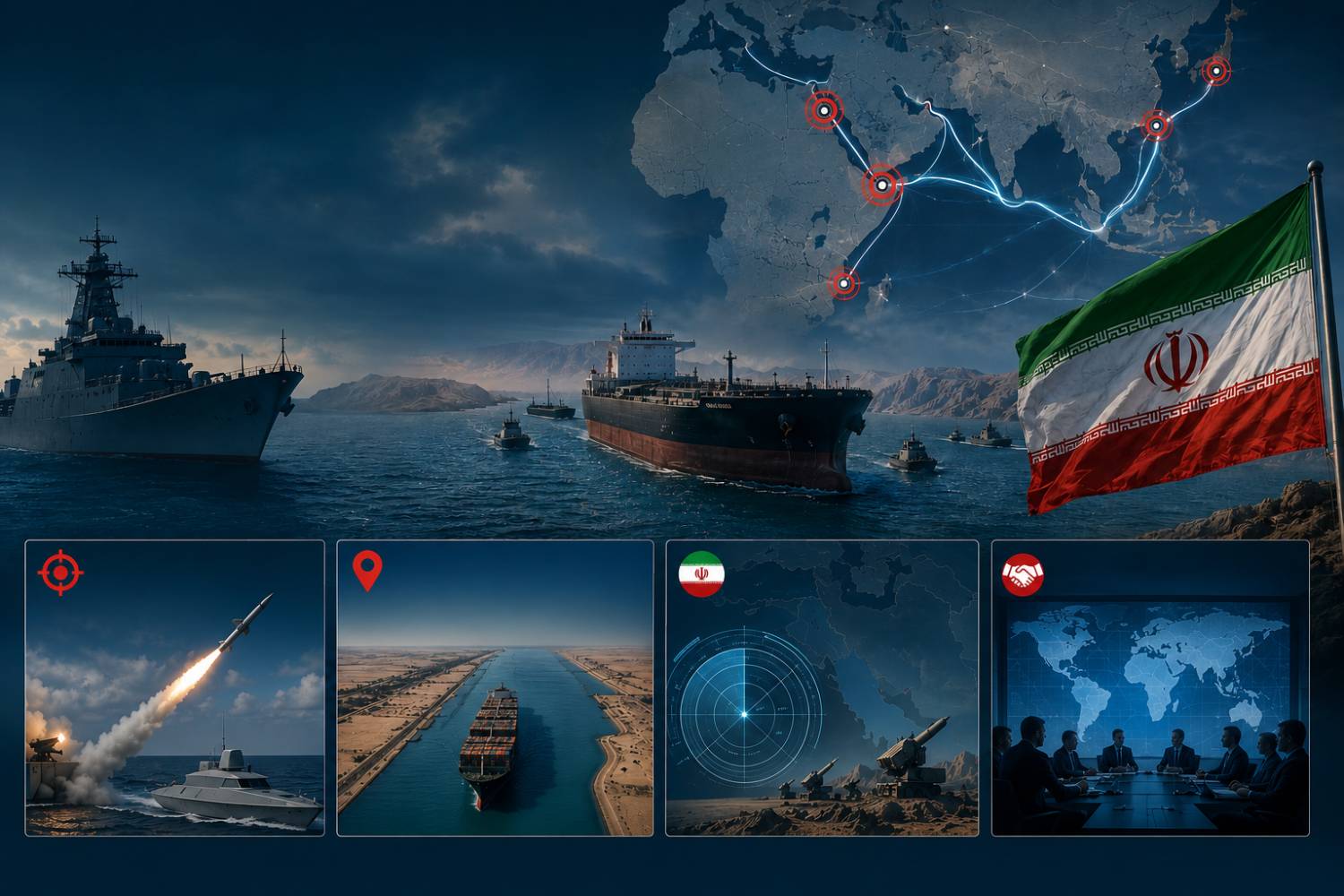
Simultaneously with the transformation of the concept of maritime power, the importance of strategic chokepoints has also increased. The Strait of Hormuz, Bab el-Mandeb, the Suez Canal, the Strait of Malacca, and the Taiwan Strait are no longer merely maritime transportation routes; they have become decisive nodes for the stability of the global economy.
Any disruption in one of these passages can throw global supply chains into crisis. Experience in recent years has demonstrated that even the mere threat of disruption along these routes is sufficient to increase energy prices, maritime insurance costs, transportation expenses, and instability in financial markets.
The recent war against Iran likewise underscored this reality. Even without the complete closure of the Strait of Hormuz, the mere possibility that the passage could become insecure generated concern in global markets and altered the calculations of numerous international companies.
Within this context, experts at Chatham House have warned that even after the end of any conflict, clearing potential naval mines and fully restoring the security of maritime navigation would be a lengthy, costly, and highly complex process. This assessment indicates that, in the future, maritime security will not be limited to preventing war; managing the post-crisis consequences will itself become an integral component of competition among major powers.
Iran and the New Structure of Maritime Security
Among all the world’s strategic maritime chokepoints, the Strait of Hormuz occupies a unique position. Nearly one-fifth of global oil trade and a significant portion of the world’s liquefied natural gas exports pass through this route. This characteristic has made every security-related development in this region an issue of immediate global concern.
Nevertheless, Iran’s position in this equation derives less from its capability to completely close the Strait than from its capacity to create uncertainty regarding the assured availability of its use, which constitutes its strategic dimension. Some Western analysts believe that Iran lacks the capability to exercise complete tactical control over the Strait of Hormuz. This assessment is open to debate from a military perspective. The important point, however, is that in the new geopolitical environment, creating uncertainty may at times be as significant as exercising complete control.
Today, maritime deterrence is based on the principle that if no party can guarantee the complete security of maritime routes, all actors will be compelled to bear higher costs to protect their trade. Under such circumstances, even the major powers cannot manage maritime security unilaterally. This very reality has elevated Iran’s position from that of a merely littoral state to one of the influential actors in safeguarding the global economy.
From Maritime Power to Maritime Governance
Another major transformation highlighted by the recent war is the shift in the concept of maritime security from “maritime power” to “maritime governance.” In the past, possessing a larger navy was regarded as synonymous with greater security. Today, however, maritime security also depends upon multilateral cooperation, information sharing, crisis management, the protection of maritime infrastructure, and the establishment of confidence-building mechanisms.
For this reason, the future architecture of maritime security is likely to rely less on the exclusive presence of a single major power and more on regional and multilateral arrangements. The experience of the recent war demonstrated that even the world’s most powerful naval fleets cannot guarantee the sustainable security of maritime routes without the cooperation of regional actors.
For Iran, this transformation creates a significant geopolitical opportunity. Rather than being perceived solely as a deterrent actor, Tehran can also assume a more active role in designing regional maritime security arrangements. Participation in regional initiatives, security dialogues, and crisis-management mechanisms can elevate Iran’s position from that of a security variable to that of a security partner.
Developments in recent years demonstrate that the great competition of the twenty-first century will revolve less around the conquest of territory than around controlling—or preventing the control of—the vital routes of global trade. From the Strait of Hormuz to the Strait of Malacca, and from Bab el-Mandeb to the Taiwan Strait, the seas have once again become the principal engine of global geopolitics. Nevertheless, the nature of this competition differs fundamentally from that of the past. The era of absolute maritime dominance is drawing to a close and has given way to an order in which deterrence, restricting access, crisis management, and shared governance have assumed greater importance.
Within this emerging order, Iran is not merely a country situated alongside the Strait of Hormuz; rather, it is regarded as one of the key actors shaping the future of global maritime security. Tehran’s ability to combine military deterrence with diplomatic initiatives and collective security arrangements will determine whether this geopolitical position is transformed into a lasting strategic advantage or remains merely a temporary lever during periods of crisis.









0 Comments