UN Inaction Regarding Attack on Iranian Ship in Red Sea

2021/04/19 | interview, Politics, Top News

Strategic Council Online - An international law professor, referring to the attempt of the Zionist regime boats in threatening the Iranian ship and also attaching mines on its hull, called this attempt an example of act of terrorism and said: the UN was expected to declare the action and attack as a terrorist act and a threat to peace.

Dr. Gholamreza Khaji, in an interview with the website of the Strategic Council on Foreign Relations, referred to the attack on the Iranian ship Saviz in the Red Sea and causing an accident for it and said: According to the 1982 Convention on the Law of the Sea, there are rules for warships as well as for government and private merchant ships. Of course, Iran has also signed the 1982 Convention, but it has not yet been finally ratified by the parliament; however, the Zionist regime did not accept the 1982 Convention at all, and therefore, in terms of the law of the sea, the Zionist regime’s attempts are traditionally considered as violation.

Attack on Iranian ship has been illegal and terrorist

Saying that the Zionist regime does not observe any rules, he emphasized: the Zionist regime’s attack on the Iranian ship was terrorism and illegal. The fact that the vessels of the Zionist regime have besieged and then encroached on the vessels of a country that first has a maritime law and then peacefully crosses the sea route with the permission of the countries is a threat to peace because the tranquility of shipping and security on highways and waterways has been violated.

The international law professor, referring to the role of international organizations in pursuing and condemning the Zionist regime, added: The Secretariat of the Convention on the Law of the Sea should pursue and condemn the action, but since this secretariat is under the supervision of the UN Secretary General, he should take that step; but the fact that he has unfortunately called on Iran to exercise restraint and even announced that it should avoid taking stand, has greatly diminished the credibility of the United Nations.

UN had to announce its official position

Khaji explained that according to what had been announced, Iran Savis had been stationed in the Red Sea for the past few years to escort merchant vessels, adding: The United Nations should have explicitly stated its official position in this regard that the attack on a ship which has been registered and was moving on a waterway and has complied with the maritime laws of the organization and no violation has been registered, has no other meaning than a terrorist act.

Recalling that the latest definition of terrorist acts in the international legal system is the insecurity of the marine and land environment or passenger environments such as aircraft, he said: The expectation from the United Nations was to consider this act and attack as a terrorist act and declare it in line with a threat to peace.

The university professor, saying that Iran has not recognized the Zionist regime and considers it as an occupier, he continued: even if this ship crosses the Gaza Strip through the waterway, it has no legal connection with the Zionist regime. The United Nations also knows that we have not recognized that regime.

Referring to the rules regarding the presence and movement of ships and submarines in territorial waters, Khaji said: No violation had been reported by that ship, and if there was any violation, the Americans who addressed this issue would also point out the violations; therefore, any attack on a ship, whether public, military, private or commercial, that has not violated the inland waters of the adjacent land or open waters is against international law and there are a number of international responsibilities about it.

Referring to the Zionist regime’s attempts in threatening the Iranian ship and also attaching a naval mine to its hull, the university professor called this action an example of terrorism and said: The United Nations, which is very sensitive to terrorism in the current situation, must have resolutely state its position in this regard. The Secretary-General or the Chairman of the Security Council should have formally stated in a statement that the attack was an example of international terrorism and condemned the aggressor and that the reasons for this should be investigated.

UN coercion-based performance

He described the UN actions as being based on coercion and said: Such measure is against international law and against international standards.

Emphasizing the need to pay attention to the legal and political aspects of the issue in the course of its legal pursuit by Iran, Khaji said: The Israelis are very deceitful and liars and seek to take advantage of those opportunities in the international arena. Certainly the Israelis want to be accepted, even under the pretext that we want to complain against them somewhere and enter into negotiations. Because, in international law there is an issue called recognition and a country can be implicitly recognized.


0 Comments

Submit a Comment

Your email address will not be published. Required fields are marked *

LATEST CONTENT

China’s Rejection of US Sanctions; Strengthening Iran’s Geopolitical Leverage

SCFR Online – Opinion: Concurrent with the official commencement of the United States’ economic war against our country, focusing on sanctions instruments, isolation, and economic pressure, what has now become increasingly important is the lack of alignment of other major global powers, especially China, with this policy.

The Makkah Pact; Reasons for its Formation and Challenges Ahead

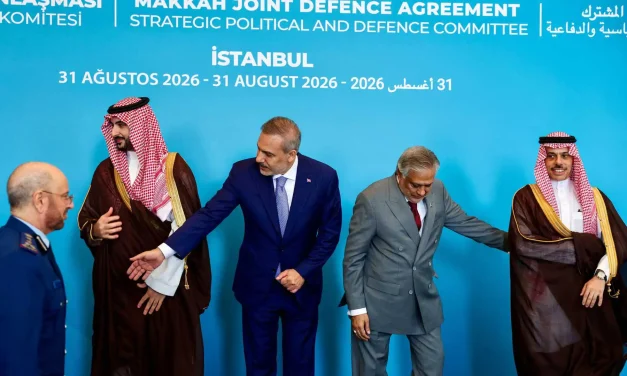
SCFR Online – Opinion: The Makkah Pact, signed between Saudi Arabia, Pakistan, and Turkey under the motto “an attack on one is an attack on all,” is viewed by some analysts less as a full-fledged military coalition and more as an attempt to reduce security dependence on an external power and to establish a regional security mechanism.

Implications of the US-Saudi Nuclear Agreement

SCFR Online – Opinion: The new US-Saudi nuclear agreement, despite legal and political ambiguities, could alter previous non-proliferation standards in West Asia and intensify nuclear competition, ushering it into a new phase.

An Analysis of Recent Turkey-Israeli Regime Tensions

SCFR Online – Opinion: Recent developments in Syria indicate an intensification of strategic rivalry between Turkey and the Israeli regime, but mutual considerations and the role of the United States have limited the likelihood of direct war.

Loading

Últimas publicaciones

China’s Rejection of US Sanctions; Strengthening Iran’s Geopolitical Leverage

SCFR Online – Opinion: Concurrent with the official commencement of the United States’ economic war against our country, focusing on sanctions instruments, isolation, and economic pressure, what has now become increasingly important is the lack of alignment of other major global powers, especially China, with this policy.

The Makkah Pact; Reasons for its Formation and Challenges Ahead

SCFR Online – Opinion: The Makkah Pact, signed between Saudi Arabia, Pakistan, and Turkey under the motto “an attack on one is an attack on all,” is viewed by some analysts less as a full-fledged military coalition and more as an attempt to reduce security dependence on an external power and to establish a regional security mechanism.

Implications of the US-Saudi Nuclear Agreement

SCFR Online – Opinion: The new US-Saudi nuclear agreement, despite legal and political ambiguities, could alter previous non-proliferation standards in West Asia and intensify nuclear competition, ushering it into a new phase.

An Analysis of Recent Turkey-Israeli Regime Tensions

SCFR Online – Opinion: Recent developments in Syria indicate an intensification of strategic rivalry between Turkey and the Israeli regime, but mutual considerations and the role of the United States have limited the likelihood of direct war.

Loading

DERNIER CONTENU

China’s Rejection of US Sanctions; Strengthening Iran’s Geopolitical Leverage

SCFR Online – Opinion: Concurrent with the official commencement of the United States’ economic war against our country, focusing on sanctions instruments, isolation, and economic pressure, what has now become increasingly important is the lack of alignment of other major global powers, especially China, with this policy.

The Makkah Pact; Reasons for its Formation and Challenges Ahead

SCFR Online – Opinion: The Makkah Pact, signed between Saudi Arabia, Pakistan, and Turkey under the motto “an attack on one is an attack on all,” is viewed by some analysts less as a full-fledged military coalition and more as an attempt to reduce security dependence on an external power and to establish a regional security mechanism.

Implications of the US-Saudi Nuclear Agreement

SCFR Online – Opinion: The new US-Saudi nuclear agreement, despite legal and political ambiguities, could alter previous non-proliferation standards in West Asia and intensify nuclear competition, ushering it into a new phase.

An Analysis of Recent Turkey-Israeli Regime Tensions

SCFR Online – Opinion: Recent developments in Syria indicate an intensification of strategic rivalry between Turkey and the Israeli regime, but mutual considerations and the role of the United States have limited the likelihood of direct war.

Loading

DERNIER CONTENU

China’s Rejection of US Sanctions; Strengthening Iran’s Geopolitical Leverage

SCFR Online – Opinion: Concurrent with the official commencement of the United States’ economic war against our country, focusing on sanctions instruments, isolation, and economic pressure, what has now become increasingly important is the lack of alignment of other major global powers, especially China, with this policy.

The Makkah Pact; Reasons for its Formation and Challenges Ahead

SCFR Online – Opinion: The Makkah Pact, signed between Saudi Arabia, Pakistan, and Turkey under the motto “an attack on one is an attack on all,” is viewed by some analysts less as a full-fledged military coalition and more as an attempt to reduce security dependence on an external power and to establish a regional security mechanism.

Implications of the US-Saudi Nuclear Agreement

SCFR Online – Opinion: The new US-Saudi nuclear agreement, despite legal and political ambiguities, could alter previous non-proliferation standards in West Asia and intensify nuclear competition, ushering it into a new phase.

An Analysis of Recent Turkey-Israeli Regime Tensions

SCFR Online – Opinion: Recent developments in Syria indicate an intensification of strategic rivalry between Turkey and the Israeli regime, but mutual considerations and the role of the United States have limited the likelihood of direct war.

Loading

DERNIER CONTENU

China’s Rejection of US Sanctions; Strengthening Iran’s Geopolitical Leverage

SCFR Online – Opinion: Concurrent with the official commencement of the United States’ economic war against our country, focusing on sanctions instruments, isolation, and economic pressure, what has now become increasingly important is the lack of alignment of other major global powers, especially China, with this policy.

The Makkah Pact; Reasons for its Formation and Challenges Ahead

SCFR Online – Opinion: The Makkah Pact, signed between Saudi Arabia, Pakistan, and Turkey under the motto “an attack on one is an attack on all,” is viewed by some analysts less as a full-fledged military coalition and more as an attempt to reduce security dependence on an external power and to establish a regional security mechanism.

Implications of the US-Saudi Nuclear Agreement

SCFR Online – Opinion: The new US-Saudi nuclear agreement, despite legal and political ambiguities, could alter previous non-proliferation standards in West Asia and intensify nuclear competition, ushering it into a new phase.

An Analysis of Recent Turkey-Israeli Regime Tensions

SCFR Online – Opinion: Recent developments in Syria indicate an intensification of strategic rivalry between Turkey and the Israeli regime, but mutual considerations and the role of the United States have limited the likelihood of direct war.

Loading