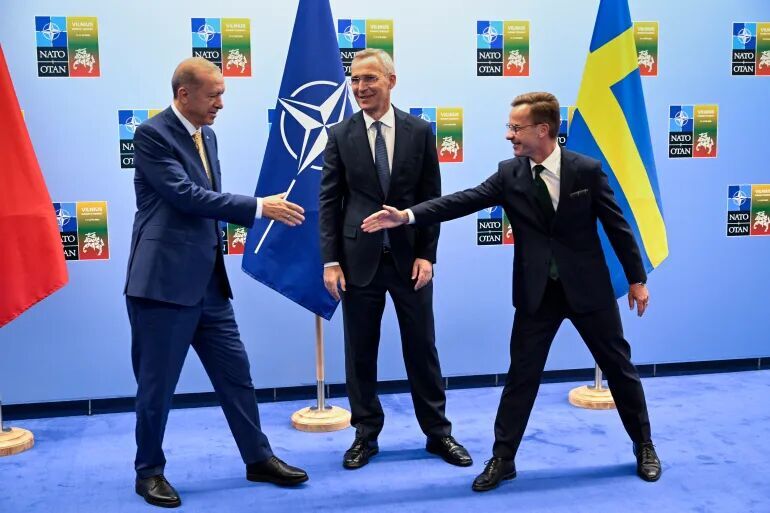
Turkey’s Expectations & Achievements after Voting for Sweden’s NATO Membership

2024/02/06 | interview, Politics, Top News

Strategic Council Online - Interview: A former Iranian Deputy Foreign Minister says it is unlikely for the Turkish government to put all its eggs in the basket of the West and NATO and jeopardize its relations with Russia at a time when Russia is involved in the Ukraine war and has close relations with Ankara. It should be seen what kind of a deal Turkey has made to persuade it to vote for Sweden's membership in NATO.

Ebrahim Rahimpour, in an interview with the Strategic Council on Foreign Relations website, referring to Turkey’s vote for Sweden, stated that governments change their policies and approaches based on international and regional interactions and their macro interests and policies at one point or another. He said: For example, the actions that Saudi Arabia has taken in the past ten years, as well as the changes in policies and projects it plans for the future, were beyond imagination, especially in connection with Israel and the issue of normalization. Therefore, Turkey’s decision to agree to Sweden’s membership in NATO should be seen in this context.

He continued: Countries make new decisions based on their general interests and trade-offs. Sometimes, this decision prevents a loss or many losses, and sometimes, it brings big benefits and concessions.

The expert on regional affairs stated that the issue of NATO membership of Sweden, Norway, and Finland has been raised very seriously after the Russia-Ukraine war and has had supporters and opponents in the European Union and outside of it in the past year and a half. Clearly, the most important opposition to the membership of countries close to Russia’s borders in NATO is Russian President Putin, and this opposition is more focused on Finland than Sweden and Norway because it is closer to Russia’s borders. Finland is one of the countries that tried to maintain its neutral position after the Second World War when there was still a confrontation between the East and the West, and it did not even have a strong and coherent military force. Still, it has gradually moved in this direction in recent years.

The former Deputy Minister of Foreign Affairs said about the Turkish Parliament’s approval of Sweden’s membership in NATO: In the last decade, we have witnessed more and more policies based on exchange by Erdogan, and this issue is related to the Palestinians in general and the current situation. Gaza has also been seen more. At the same time that Erdogan is clashing with the Prime Minister of the Zionist regime over Gaza and its developments, some political and economic cooperation between Turkey and this regime is ongoing. Therefore, Turkey maintains its political stance in support of the people of Palestine and Gaza. Still, there is a possibility that it may even change its strategic policies for its own interests in the region or connection with the Gaza Tragedy.

He continued: It should be seen what the Turkish government is looking for with the United States and the European Union on the one hand and with Russia on the other. This decision of Turkey, while Sweden is one of the defenders of the Kurds in Turkey and follows human rights issues seriously, how Turkey agreed to vote positively for Sweden’s membership in NATO, the future benefits for Turkey, and the future developments of the region are related. In addition, we know that Turkey has serious concerns about the activities of the Kurds in Syria and Iraq near its borders, so it remains to be seen what trade-offs will be made with Russia in this regard.

Rahimpour said: In the last ten years, Turkey has played an artistic game between Russia and NATO for its own benefit, and this is not a simple decision at all, and various equations must be taken into account in order not to be harmed in this interaction. Therefore, I believe that the recent decision of the Turkish Parliament is also within the framework of this artistic game.

The former deputy foreign minister said about Russia’s reaction to Turkey’s decision: I doubt that the Turkish government would put all its eggs in the basket of the West and NATO and will get into a fight with Russia over this issue. It should be seen what developments will happen in Iraq and Syria in the near future; Ankara will definitely not take this decision without considering Russia’s concerns. In the Nagorno-Karabakh developments, Russia and Turkey showed they were willing to compromise. By the way, their compromise in that relationship ended to the detriment of Iran, so it should be seen what goals and policies should be taken to bring Turkey closer to the region and the world.

He pointed out that, of course, the approval of the Turkish Parliament is not enough, and it needs Erdogan’s signature. In addition, Sweden’s membership in NATO requires the consent of all member states of the union, including Hungary, which is opposed to the continuation of European financial aid to Ukraine.

0 Comments

LATEST CONTENT

Consequences of Declining Trust in the Judiciary in Europe

SCFRonline – Opinion: The increase in public distrust of the French judicial system, which in recent surveys has reached approximately two-thirds of citizens, should be analyzed within a framework broader than temporary dissatisfaction or an emotional reaction to a particular criminal case.

Iran’s Potential Levers of Power

SCFRonline– Opinion: Iran’s geopolitical power is not limited solely to oil and the Strait of Hormuz; the unintended emergence of disruptions in the future global food and energy security chains can also demonstrate Iran’s strategic importance.

The Inseparability of the Lebanese Front from the Axis of Resistance

SCFR Online–Opinion: By providing an extensive network of social, healthcare, educational, and post-war reconstruction services, Hezbollah has established a strong social base for itself among Lebanon’s Shiites and Sunnis, and even beyond that, among other segments of Lebanese society, including Christians. Hezbollah has never been an external actor imposed upon Lebanon; rather, it is a phenomenon fundamentally born out of the occupation and crimes of the Zionist regime and itself influenced by popular resistance.

The Increasing Efforts of the Zionist Regime to Redefine Borders and the Regional Order and Its Consequences

SCFR Online– Opinion: Security and military developments in the region over recent months indicate that the ongoing crises and wars in Gaza, southern Lebanon, and parts of Syrian territory encompass broader dimensions of geopolitical and geostrategic transformations. In this context, the increased military presence and control of the Zionist regime over parts of the territories of these areas, along with proposals regarding the creation of buffer zones or even the expansion of security borders, have raised serious questions about the future of the regional order and its consequences for the countries of West Asia.

Loading

Últimas publicaciones

Consequences of Declining Trust in the Judiciary in Europe

SCFRonline – Opinion: The increase in public distrust of the French judicial system, which in recent surveys has reached approximately two-thirds of citizens, should be analyzed within a framework broader than temporary dissatisfaction or an emotional reaction to a particular criminal case.

Iran’s Potential Levers of Power

SCFRonline– Opinion: Iran’s geopolitical power is not limited solely to oil and the Strait of Hormuz; the unintended emergence of disruptions in the future global food and energy security chains can also demonstrate Iran’s strategic importance.

The Inseparability of the Lebanese Front from the Axis of Resistance

SCFR Online–Opinion: By providing an extensive network of social, healthcare, educational, and post-war reconstruction services, Hezbollah has established a strong social base for itself among Lebanon’s Shiites and Sunnis, and even beyond that, among other segments of Lebanese society, including Christians. Hezbollah has never been an external actor imposed upon Lebanon; rather, it is a phenomenon fundamentally born out of the occupation and crimes of the Zionist regime and itself influenced by popular resistance.

The Increasing Efforts of the Zionist Regime to Redefine Borders and the Regional Order and Its Consequences

SCFR Online– Opinion: Security and military developments in the region over recent months indicate that the ongoing crises and wars in Gaza, southern Lebanon, and parts of Syrian territory encompass broader dimensions of geopolitical and geostrategic transformations. In this context, the increased military presence and control of the Zionist regime over parts of the territories of these areas, along with proposals regarding the creation of buffer zones or even the expansion of security borders, have raised serious questions about the future of the regional order and its consequences for the countries of West Asia.

Loading

DERNIER CONTENU

Consequences of Declining Trust in the Judiciary in Europe

SCFRonline – Opinion: The increase in public distrust of the French judicial system, which in recent surveys has reached approximately two-thirds of citizens, should be analyzed within a framework broader than temporary dissatisfaction or an emotional reaction to a particular criminal case.

Iran’s Potential Levers of Power

SCFRonline– Opinion: Iran’s geopolitical power is not limited solely to oil and the Strait of Hormuz; the unintended emergence of disruptions in the future global food and energy security chains can also demonstrate Iran’s strategic importance.

The Inseparability of the Lebanese Front from the Axis of Resistance

SCFR Online–Opinion: By providing an extensive network of social, healthcare, educational, and post-war reconstruction services, Hezbollah has established a strong social base for itself among Lebanon’s Shiites and Sunnis, and even beyond that, among other segments of Lebanese society, including Christians. Hezbollah has never been an external actor imposed upon Lebanon; rather, it is a phenomenon fundamentally born out of the occupation and crimes of the Zionist regime and itself influenced by popular resistance.

The Increasing Efforts of the Zionist Regime to Redefine Borders and the Regional Order and Its Consequences

SCFR Online– Opinion: Security and military developments in the region over recent months indicate that the ongoing crises and wars in Gaza, southern Lebanon, and parts of Syrian territory encompass broader dimensions of geopolitical and geostrategic transformations. In this context, the increased military presence and control of the Zionist regime over parts of the territories of these areas, along with proposals regarding the creation of buffer zones or even the expansion of security borders, have raised serious questions about the future of the regional order and its consequences for the countries of West Asia.

Loading

DERNIER CONTENU

Consequences of Declining Trust in the Judiciary in Europe

SCFRonline – Opinion: The increase in public distrust of the French judicial system, which in recent surveys has reached approximately two-thirds of citizens, should be analyzed within a framework broader than temporary dissatisfaction or an emotional reaction to a particular criminal case.

Iran’s Potential Levers of Power

SCFRonline– Opinion: Iran’s geopolitical power is not limited solely to oil and the Strait of Hormuz; the unintended emergence of disruptions in the future global food and energy security chains can also demonstrate Iran’s strategic importance.

The Inseparability of the Lebanese Front from the Axis of Resistance

SCFR Online–Opinion: By providing an extensive network of social, healthcare, educational, and post-war reconstruction services, Hezbollah has established a strong social base for itself among Lebanon’s Shiites and Sunnis, and even beyond that, among other segments of Lebanese society, including Christians. Hezbollah has never been an external actor imposed upon Lebanon; rather, it is a phenomenon fundamentally born out of the occupation and crimes of the Zionist regime and itself influenced by popular resistance.

The Increasing Efforts of the Zionist Regime to Redefine Borders and the Regional Order and Its Consequences

SCFR Online– Opinion: Security and military developments in the region over recent months indicate that the ongoing crises and wars in Gaza, southern Lebanon, and parts of Syrian territory encompass broader dimensions of geopolitical and geostrategic transformations. In this context, the increased military presence and control of the Zionist regime over parts of the territories of these areas, along with proposals regarding the creation of buffer zones or even the expansion of security borders, have raised serious questions about the future of the regional order and its consequences for the countries of West Asia.

Loading

DERNIER CONTENU

Consequences of Declining Trust in the Judiciary in Europe

SCFRonline – Opinion: The increase in public distrust of the French judicial system, which in recent surveys has reached approximately two-thirds of citizens, should be analyzed within a framework broader than temporary dissatisfaction or an emotional reaction to a particular criminal case.

Iran’s Potential Levers of Power

SCFRonline– Opinion: Iran’s geopolitical power is not limited solely to oil and the Strait of Hormuz; the unintended emergence of disruptions in the future global food and energy security chains can also demonstrate Iran’s strategic importance.

The Inseparability of the Lebanese Front from the Axis of Resistance

SCFR Online–Opinion: By providing an extensive network of social, healthcare, educational, and post-war reconstruction services, Hezbollah has established a strong social base for itself among Lebanon’s Shiites and Sunnis, and even beyond that, among other segments of Lebanese society, including Christians. Hezbollah has never been an external actor imposed upon Lebanon; rather, it is a phenomenon fundamentally born out of the occupation and crimes of the Zionist regime and itself influenced by popular resistance.

The Increasing Efforts of the Zionist Regime to Redefine Borders and the Regional Order and Its Consequences

SCFR Online– Opinion: Security and military developments in the region over recent months indicate that the ongoing crises and wars in Gaza, southern Lebanon, and parts of Syrian territory encompass broader dimensions of geopolitical and geostrategic transformations. In this context, the increased military presence and control of the Zionist regime over parts of the territories of these areas, along with proposals regarding the creation of buffer zones or even the expansion of security borders, have raised serious questions about the future of the regional order and its consequences for the countries of West Asia.

Loading





