جدیدترین مطالب

An Analysis of the Makkah Defense Pact

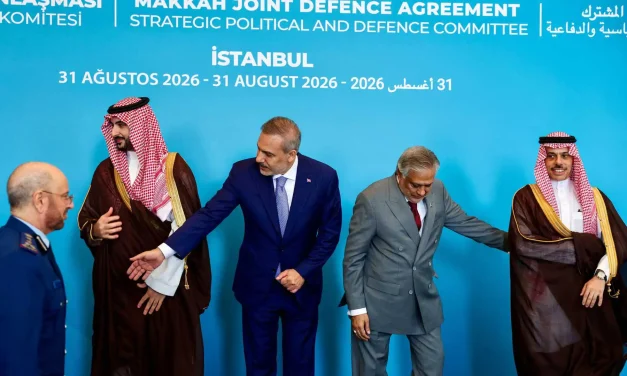
SCFR Online – Opinion: On Friday, August 7, the heads of state of three countries – Saudi Arabia, Turkey, and Pakistan – signed a text under the title “Makkah Joint Defense Agreement.”

Dimensions and challenges of the initiative to revive the Hejaz Railway

Strategic Council Online – Note: The initiative to revive the Hejaz Railway, beyond being a transportation project, constitutes an attempt to redefine geopolitics, the economy, and Turkey’s regional position; however, its realization appears to face significant financial, security, and institutional challenges.

Balancing in the chain of chokepoints; from sea-based deterrence to pluralistic diplomacy

Strategic Council Online – Note: Recent developments in the political geography of West Asia, from rising tensions in the Persian Gulf to missile and drone activities in the Red Sea and the recent warning by Kaja Kallas, the European Union’s foreign policy chief, regarding the threat to freedom of navigation, indicate a key pattern shift; the US-Iran war has moved beyond the scope of a regional and local confrontation and has linked two vital passageways for the global economy: the Strait of Hormuz and the Bab el-Mandeb Strait.

Loading

Political Rivalry

Model Ruling over Iran-Turkey Relations; Cooperation and Political Rivalry

Model Ruling over Iran-Turkey Relations; Cooperation and Political Rivalry

Strategic Council Online – Note: Iran and Turkey are the two important countries in the West Asia region and inheritors of great empires and historical hegemony that have always been in “competition and cooperation” with each other. Although the two countries have different and sometimes competitive roles and effects in the region and disagree on various issues, those differences have never meant ignoring and overshadowing the many common interests in bilateral relations.
Hamid Khoshayand – International Affairs Analyst

أحدث الوظائف

An Analysis of the Makkah Defense Pact

SCFR Online – Opinion: On Friday, August 7, the heads of state of three countries – Saudi Arabia, Turkey, and Pakistan – signed a text under the title “Makkah Joint Defense Agreement.”

Dimensions and challenges of the initiative to revive the Hejaz Railway

Strategic Council Online – Note: The initiative to revive the Hejaz Railway, beyond being a transportation project, constitutes an attempt to redefine geopolitics, the economy, and Turkey’s regional position; however, its realization appears to face significant financial, security, and institutional challenges.

Balancing in the chain of chokepoints; from sea-based deterrence to pluralistic diplomacy

Strategic Council Online – Note: Recent developments in the political geography of West Asia, from rising tensions in the Persian Gulf to missile and drone activities in the Red Sea and the recent warning by Kaja Kallas, the European Union’s foreign policy chief, regarding the threat to freedom of navigation, indicate a key pattern shift; the US-Iran war has moved beyond the scope of a regional and local confrontation and has linked two vital passageways for the global economy: the Strait of Hormuz and the Bab el-Mandeb Strait.

Loading

Political Rivalry

Model Ruling over Iran-Turkey Relations; Cooperation and Political Rivalry

Model Ruling over Iran-Turkey Relations; Cooperation and Political Rivalry

Strategic Council Online – Note: Iran and Turkey are the two important countries in the West Asia region and inheritors of great empires and historical hegemony that have always been in “competition and cooperation” with each other. Although the two countries have different and sometimes competitive roles and effects in the region and disagree on various issues, those differences have never meant ignoring and overshadowing the many common interests in bilateral relations.
Hamid Khoshayand – International Affairs Analyst

Political Rivalry

Model Ruling over Iran-Turkey Relations; Cooperation and Political Rivalry

Model Ruling over Iran-Turkey Relations; Cooperation and Political Rivalry

Strategic Council Online – Note: Iran and Turkey are the two important countries in the West Asia region and inheritors of great empires and historical hegemony that have always been in “competition and cooperation” with each other. Although the two countries have different and sometimes competitive roles and effects in the region and disagree on various issues, those differences have never meant ignoring and overshadowing the many common interests in bilateral relations.
Hamid Khoshayand – International Affairs Analyst

LATEST CONTENT

An Analysis of the Makkah Defense Pact

SCFR Online – Opinion: On Friday, August 7, the heads of state of three countries – Saudi Arabia, Turkey, and Pakistan – signed a text under the title “Makkah Joint Defense Agreement.”

Dimensions and challenges of the initiative to revive the Hejaz Railway

Strategic Council Online – Note: The initiative to revive the Hejaz Railway, beyond being a transportation project, constitutes an attempt to redefine geopolitics, the economy, and Turkey’s regional position; however, its realization appears to face significant financial, security, and institutional challenges.

Balancing in the chain of chokepoints; from sea-based deterrence to pluralistic diplomacy

Strategic Council Online – Note: Recent developments in the political geography of West Asia, from rising tensions in the Persian Gulf to missile and drone activities in the Red Sea and the recent warning by Kaja Kallas, the European Union’s foreign policy chief, regarding the threat to freedom of navigation, indicate a key pattern shift; the US-Iran war has moved beyond the scope of a regional and local confrontation and has linked two vital passageways for the global economy: the Strait of Hormuz and the Bab el-Mandeb Strait.

Loading

Political Rivalry

Model Ruling over Iran-Turkey Relations; Cooperation and Political Rivalry

Model Ruling over Iran-Turkey Relations; Cooperation and Political Rivalry

Strategic Council Online – Note: Iran and Turkey are the two important countries in the West Asia region and inheritors of great empires and historical hegemony that have always been in “competition and cooperation” with each other. Although the two countries have different and sometimes competitive roles and effects in the region and disagree on various issues, those differences have never meant ignoring and overshadowing the many common interests in bilateral relations.
Hamid Khoshayand – International Affairs Analyst

ÚLTIMAS PUBLICACIONES

An Analysis of the Makkah Defense Pact

SCFR Online – Opinion: On Friday, August 7, the heads of state of three countries – Saudi Arabia, Turkey, and Pakistan – signed a text under the title “Makkah Joint Defense Agreement.”

Dimensions and challenges of the initiative to revive the Hejaz Railway

Strategic Council Online – Note: The initiative to revive the Hejaz Railway, beyond being a transportation project, constitutes an attempt to redefine geopolitics, the economy, and Turkey’s regional position; however, its realization appears to face significant financial, security, and institutional challenges.

Balancing in the chain of chokepoints; from sea-based deterrence to pluralistic diplomacy

Strategic Council Online – Note: Recent developments in the political geography of West Asia, from rising tensions in the Persian Gulf to missile and drone activities in the Red Sea and the recent warning by Kaja Kallas, the European Union’s foreign policy chief, regarding the threat to freedom of navigation, indicate a key pattern shift; the US-Iran war has moved beyond the scope of a regional and local confrontation and has linked two vital passageways for the global economy: the Strait of Hormuz and the Bab el-Mandeb Strait.

Loading

Political Rivalry

Model Ruling over Iran-Turkey Relations; Cooperation and Political Rivalry

Model Ruling over Iran-Turkey Relations; Cooperation and Political Rivalry

Strategic Council Online – Note: Iran and Turkey are the two important countries in the West Asia region and inheritors of great empires and historical hegemony that have always been in “competition and cooperation” with each other. Although the two countries have different and sometimes competitive roles and effects in the region and disagree on various issues, those differences have never meant ignoring and overshadowing the many common interests in bilateral relations.
Hamid Khoshayand – International Affairs Analyst

ÚLTIMAS PUBLICACIONES

An Analysis of the Makkah Defense Pact

SCFR Online – Opinion: On Friday, August 7, the heads of state of three countries – Saudi Arabia, Turkey, and Pakistan – signed a text under the title “Makkah Joint Defense Agreement.”

Dimensions and challenges of the initiative to revive the Hejaz Railway

Strategic Council Online – Note: The initiative to revive the Hejaz Railway, beyond being a transportation project, constitutes an attempt to redefine geopolitics, the economy, and Turkey’s regional position; however, its realization appears to face significant financial, security, and institutional challenges.

Balancing in the chain of chokepoints; from sea-based deterrence to pluralistic diplomacy

Strategic Council Online – Note: Recent developments in the political geography of West Asia, from rising tensions in the Persian Gulf to missile and drone activities in the Red Sea and the recent warning by Kaja Kallas, the European Union’s foreign policy chief, regarding the threat to freedom of navigation, indicate a key pattern shift; the US-Iran war has moved beyond the scope of a regional and local confrontation and has linked two vital passageways for the global economy: the Strait of Hormuz and the Bab el-Mandeb Strait.

Loading

Political Rivalry

Model Ruling over Iran-Turkey Relations; Cooperation and Political Rivalry

Model Ruling over Iran-Turkey Relations; Cooperation and Political Rivalry

Strategic Council Online – Note: Iran and Turkey are the two important countries in the West Asia region and inheritors of great empires and historical hegemony that have always been in “competition and cooperation” with each other. Although the two countries have different and sometimes competitive roles and effects in the region and disagree on various issues, those differences have never meant ignoring and overshadowing the many common interests in bilateral relations.
Hamid Khoshayand – International Affairs Analyst

ÚLTIMAS PUBLICACIONES

An Analysis of the Makkah Defense Pact

SCFR Online – Opinion: On Friday, August 7, the heads of state of three countries – Saudi Arabia, Turkey, and Pakistan – signed a text under the title “Makkah Joint Defense Agreement.”

Dimensions and challenges of the initiative to revive the Hejaz Railway

Strategic Council Online – Note: The initiative to revive the Hejaz Railway, beyond being a transportation project, constitutes an attempt to redefine geopolitics, the economy, and Turkey’s regional position; however, its realization appears to face significant financial, security, and institutional challenges.

Balancing in the chain of chokepoints; from sea-based deterrence to pluralistic diplomacy

Strategic Council Online – Note: Recent developments in the political geography of West Asia, from rising tensions in the Persian Gulf to missile and drone activities in the Red Sea and the recent warning by Kaja Kallas, the European Union’s foreign policy chief, regarding the threat to freedom of navigation, indicate a key pattern shift; the US-Iran war has moved beyond the scope of a regional and local confrontation and has linked two vital passageways for the global economy: the Strait of Hormuz and the Bab el-Mandeb Strait.

Loading

Political Rivalry

Model Ruling over Iran-Turkey Relations; Cooperation and Political Rivalry

Model Ruling over Iran-Turkey Relations; Cooperation and Political Rivalry

Strategic Council Online – Note: Iran and Turkey are the two important countries in the West Asia region and inheritors of great empires and historical hegemony that have always been in “competition and cooperation” with each other. Although the two countries have different and sometimes competitive roles and effects in the region and disagree on various issues, those differences have never meant ignoring and overshadowing the many common interests in bilateral relations.
Hamid Khoshayand – International Affairs Analyst

ÚLTIMAS PUBLICACIONES

An Analysis of the Makkah Defense Pact

SCFR Online – Opinion: On Friday, August 7, the heads of state of three countries – Saudi Arabia, Turkey, and Pakistan – signed a text under the title “Makkah Joint Defense Agreement.”

Dimensions and challenges of the initiative to revive the Hejaz Railway

Strategic Council Online – Note: The initiative to revive the Hejaz Railway, beyond being a transportation project, constitutes an attempt to redefine geopolitics, the economy, and Turkey’s regional position; however, its realization appears to face significant financial, security, and institutional challenges.

Balancing in the chain of chokepoints; from sea-based deterrence to pluralistic diplomacy

Strategic Council Online – Note: Recent developments in the political geography of West Asia, from rising tensions in the Persian Gulf to missile and drone activities in the Red Sea and the recent warning by Kaja Kallas, the European Union’s foreign policy chief, regarding the threat to freedom of navigation, indicate a key pattern shift; the US-Iran war has moved beyond the scope of a regional and local confrontation and has linked two vital passageways for the global economy: the Strait of Hormuz and the Bab el-Mandeb Strait.

Loading