Greece-Libya-Turkey Tension Continues in Eastern Mediterranean Economic Zone

Strategic Council Online - Opinion: At the end of November, Greece expanded the area of activity of the vessel chartered by ExxonMobil and Hellenic Energy (former Hellenic Petroleum) to the south of the island of Crete by publishing a new instruction. This action was carried out following the pressure of the consortium on the Greek Ministry of Energy. The consortium claims that there is a possibility of discovering gas resources in that area. It is expected that through this measure, Athens intends to push the Libyan government to negotiate to delimit the maritime areas between the two countries or direct it to the option of referring it to the International Court of Justice. Mahmoud Fazeli – Analyst of international affairs

According to the Greek side, this will effectively cancel the agreement signed between Turkey and Libya regarding the delimitation of the maritime zones between the two countries. Of course, it will be possible to do it only after holding elections and forming a government in Libya. Due to Turkey’s influence in Tripoli, any negotiation with Tripoli’s transitional government is impossible, and basically the current Libyan government lacks the necessary competence and authority to sign binding agreements.

Libya, on the other hand, has expressed dissatisfaction with Greece’s exploration activities in the field of hydrocarbons in the south and southwest of Crete and accuses that country of abusing Libya’s internal crisis. Libya claims that Greece is trying to take advantage of the Libyan crisis and, by concluding contracts for hydrocarbon research in the southwest of Crete, inside the disputed areas, put Libya in front of the demarcation of maritime areas between the two countries. Following the confirmation of the information regarding the start of exploration activities of the Sanco Swift ship on behalf of foreign companies that have signed contracts with Greece, Libya emphasizes that by using all possible legal and diplomatic tools with all its might, it will continue to defend its maritime borders and sovereign rights in the maritime areas of the country.

But in response to Libya’s positions, Greece declared that ‘unlike those who conclude illegal and ineffective ‘memorandums’ that ignore and violate the basic rules of international law and the international law of the sea, Greece applies its sovereign rights with full respect for international law and the law of the seas. This is what has been done in delimiting the exclusive economic zone with Egypt and Italy. Athens has declared that the duty of the transitional government of Libya is to immediately lead that country towards elections, and that they will work within the framework of the rules of the international law of the seas, with an elected government in Libya that has the necessary legitimacy and authority to conclude valid international agreements. Agreements in line with the roadmap set by the Libyan Political Dialogue Forum (LPDF) in 2020.

While there is no sign of a reduction in the tension between Turkey and Greece, Athens has not been able to tolerate the cooperation agreement for the extraction of offshore hydrocarbon between Turkey and Libya and has sent a letter to the United Nations claiming that the agreement between Turkey and Libya violates the rights and sovereignty of Greece in the Mediterranean Sea. Athens warns that any attempt to implement the memorandum of understanding for hydrocarbon exploration activities signed between Turkey and Libya, which violates Greece’s sovereign rights, will lead to tension and instability in the region. Greece considers this memorandum of understanding as invalid as the 2019 agreement and asks Libya and Turkey to refrain from any measure that actually violates Greece’s rights regarding the continental shelf and the exclusive economic zone. From the point of view of Athens, the Libyan government does not have the authority to sign contracts that cause problems in the relations of this country with other countries and are binding for it, and signing of the memorandum of understanding between Turkey and Libya is such a contract.

On the other hand, Turkey and Libya sent a joint letter to the United Nations regarding the memorandum of understanding signed between the two parties, advising Greece to end its aggressive rhetoric and intensify its measures and respect the sovereign decisions of the two neighboring countries. The government of national unity of Libya has the necessary powers to conclude international agreements and sign agreements with other countries, and it is Greece that deliberately ignores the signing of various agreements between EU member states and the Libyan government in the field of energy, infrastructure and economic activities.

On the other hand, on behalf of Ankara, the drilling ship “Abdul Hamid Khan” has started new drilling activities in the Eastern Mediterranean region. This ship is supposed to move towards the exclusive economic zone of Libya, where seismic activity has been carried out in the past. Egypt and Greece have been seeking greater coordination in countering Ankara’s policies since Turkey signed an initial gas and maritime deal with the Tripoli-based government in October. Both countries accuse Ankara of abusing the agreement to expand its influence in the Mediterranean Sea.

Tensions between Athens and Ankara have risen since 2019, when Turkey signed an agreement with Libya’s Tripoli-based government granting Turkey access to a disputed economic zone in the Eastern Mediterranean.


0 Comments

Submit a Comment

Your email address will not be published. Required fields are marked *

LATEST CONTENT

The Makkah Pact; Reasons for its Formation and Challenges Ahead

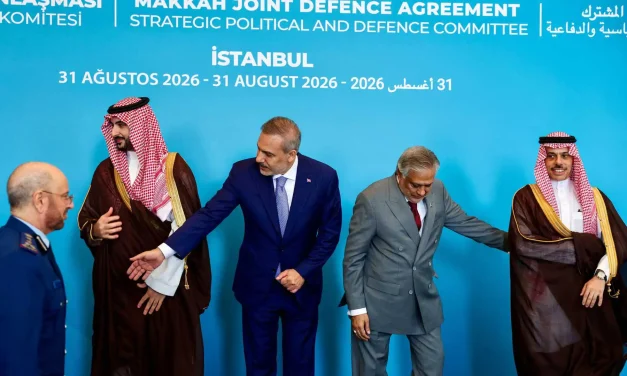
SCFR Online – Opinion: The Makkah Pact, signed between Saudi Arabia, Pakistan, and Turkey under the motto “an attack on one is an attack on all,” is viewed by some analysts less as a full-fledged military coalition and more as an attempt to reduce security dependence on an external power and to establish a regional security mechanism.

Implications of the US-Saudi Nuclear Agreement

SCFR Online – Opinion: The new US-Saudi nuclear agreement, despite legal and political ambiguities, could alter previous non-proliferation standards in West Asia and intensify nuclear competition, ushering it into a new phase.

An Analysis of Recent Turkey-Israeli Regime Tensions

SCFR Online – Opinion: Recent developments in Syria indicate an intensification of strategic rivalry between Turkey and the Israeli regime, but mutual considerations and the role of the United States have limited the likelihood of direct war.

Increasing criticism of the extensive Zionist lobby network

SCFR Online – Opinion: An examination of the mechanisms of the Israeli regime’s influence in the United States depicts a complex picture of shared interests, strategic dependencies, and the limitations of this relationship.

Realities of the Tripartite Makkah Pact

SCFR Online – Interview: The signing of the Makkah agreement between Saudi Arabia, Pakistan, and Turkey has raised questions about the future of the region’s security structure and the position of these countries in West Asian equations. Can this agreement become a genuine collective defense mechanism, or does it have more of a political and deterrent function than creating new military capacity?

Loading

Últimas publicaciones

The Makkah Pact; Reasons for its Formation and Challenges Ahead

SCFR Online – Opinion: The Makkah Pact, signed between Saudi Arabia, Pakistan, and Turkey under the motto “an attack on one is an attack on all,” is viewed by some analysts less as a full-fledged military coalition and more as an attempt to reduce security dependence on an external power and to establish a regional security mechanism.

Implications of the US-Saudi Nuclear Agreement

SCFR Online – Opinion: The new US-Saudi nuclear agreement, despite legal and political ambiguities, could alter previous non-proliferation standards in West Asia and intensify nuclear competition, ushering it into a new phase.

An Analysis of Recent Turkey-Israeli Regime Tensions

SCFR Online – Opinion: Recent developments in Syria indicate an intensification of strategic rivalry between Turkey and the Israeli regime, but mutual considerations and the role of the United States have limited the likelihood of direct war.

Increasing criticism of the extensive Zionist lobby network

SCFR Online – Opinion: An examination of the mechanisms of the Israeli regime’s influence in the United States depicts a complex picture of shared interests, strategic dependencies, and the limitations of this relationship.

Realities of the Tripartite Makkah Pact

SCFR Online – Interview: The signing of the Makkah agreement between Saudi Arabia, Pakistan, and Turkey has raised questions about the future of the region’s security structure and the position of these countries in West Asian equations. Can this agreement become a genuine collective defense mechanism, or does it have more of a political and deterrent function than creating new military capacity?

Loading

DERNIER CONTENU

The Makkah Pact; Reasons for its Formation and Challenges Ahead

SCFR Online – Opinion: The Makkah Pact, signed between Saudi Arabia, Pakistan, and Turkey under the motto “an attack on one is an attack on all,” is viewed by some analysts less as a full-fledged military coalition and more as an attempt to reduce security dependence on an external power and to establish a regional security mechanism.

Implications of the US-Saudi Nuclear Agreement

SCFR Online – Opinion: The new US-Saudi nuclear agreement, despite legal and political ambiguities, could alter previous non-proliferation standards in West Asia and intensify nuclear competition, ushering it into a new phase.

An Analysis of Recent Turkey-Israeli Regime Tensions

SCFR Online – Opinion: Recent developments in Syria indicate an intensification of strategic rivalry between Turkey and the Israeli regime, but mutual considerations and the role of the United States have limited the likelihood of direct war.

Increasing criticism of the extensive Zionist lobby network

SCFR Online – Opinion: An examination of the mechanisms of the Israeli regime’s influence in the United States depicts a complex picture of shared interests, strategic dependencies, and the limitations of this relationship.

Realities of the Tripartite Makkah Pact

SCFR Online – Interview: The signing of the Makkah agreement between Saudi Arabia, Pakistan, and Turkey has raised questions about the future of the region’s security structure and the position of these countries in West Asian equations. Can this agreement become a genuine collective defense mechanism, or does it have more of a political and deterrent function than creating new military capacity?

Loading

DERNIER CONTENU

The Makkah Pact; Reasons for its Formation and Challenges Ahead

SCFR Online – Opinion: The Makkah Pact, signed between Saudi Arabia, Pakistan, and Turkey under the motto “an attack on one is an attack on all,” is viewed by some analysts less as a full-fledged military coalition and more as an attempt to reduce security dependence on an external power and to establish a regional security mechanism.

Implications of the US-Saudi Nuclear Agreement

SCFR Online – Opinion: The new US-Saudi nuclear agreement, despite legal and political ambiguities, could alter previous non-proliferation standards in West Asia and intensify nuclear competition, ushering it into a new phase.

An Analysis of Recent Turkey-Israeli Regime Tensions

SCFR Online – Opinion: Recent developments in Syria indicate an intensification of strategic rivalry between Turkey and the Israeli regime, but mutual considerations and the role of the United States have limited the likelihood of direct war.

Increasing criticism of the extensive Zionist lobby network

SCFR Online – Opinion: An examination of the mechanisms of the Israeli regime’s influence in the United States depicts a complex picture of shared interests, strategic dependencies, and the limitations of this relationship.

Realities of the Tripartite Makkah Pact

SCFR Online – Interview: The signing of the Makkah agreement between Saudi Arabia, Pakistan, and Turkey has raised questions about the future of the region’s security structure and the position of these countries in West Asian equations. Can this agreement become a genuine collective defense mechanism, or does it have more of a political and deterrent function than creating new military capacity?

Loading

DERNIER CONTENU

The Makkah Pact; Reasons for its Formation and Challenges Ahead

SCFR Online – Opinion: The Makkah Pact, signed between Saudi Arabia, Pakistan, and Turkey under the motto “an attack on one is an attack on all,” is viewed by some analysts less as a full-fledged military coalition and more as an attempt to reduce security dependence on an external power and to establish a regional security mechanism.

Implications of the US-Saudi Nuclear Agreement

SCFR Online – Opinion: The new US-Saudi nuclear agreement, despite legal and political ambiguities, could alter previous non-proliferation standards in West Asia and intensify nuclear competition, ushering it into a new phase.

An Analysis of Recent Turkey-Israeli Regime Tensions

SCFR Online – Opinion: Recent developments in Syria indicate an intensification of strategic rivalry between Turkey and the Israeli regime, but mutual considerations and the role of the United States have limited the likelihood of direct war.

Increasing criticism of the extensive Zionist lobby network

SCFR Online – Opinion: An examination of the mechanisms of the Israeli regime’s influence in the United States depicts a complex picture of shared interests, strategic dependencies, and the limitations of this relationship.

Realities of the Tripartite Makkah Pact

SCFR Online – Interview: The signing of the Makkah agreement between Saudi Arabia, Pakistan, and Turkey has raised questions about the future of the region’s security structure and the position of these countries in West Asian equations. Can this agreement become a genuine collective defense mechanism, or does it have more of a political and deterrent function than creating new military capacity?

Loading