Implicit Decree “Preventing Attack on Rafah” – ICJ Decision in South Africa vs. Israel Lawsuit

2024/02/21 | Note, Politics, Top News

Strategic Council Online- Opinion: On February 12, the South African government once again appealed to The International Court of Justice (ICJ) to demand the indication of new measures in light of statements made by the Israeli prime minister’s office on the necessity of a military incursion into the Rafah region in the Gaza Strip and in light of subsequent operations conducted thereafter.

Reza Nasri – International Jurist

In response to South Africa’s request, the ICJ issued a statement containing its “decision” in which – citing comments by the UN secretary-general calling the humanitarian situation in Gaza “a nightmare” – reaffirmed the need for Israel to comply with the binding provisional order issued on January 26. In this regard, the Court’s response to South Africa’s request sparked various interpretations and critical reactions that for most part questionable. In this context, it is important to mention a few points on the matter:

  1. In its recent appeal, South Africa had not requested “specific” safeguard measures from the Court. Some reactions are based on the faulty assumption that South Africa – in order to prevent the Israeli regime’s military from entering Rafah – had asked the Court to issue a “ceasefire order”. The truth is that South Africa had based its request under Article 75(1) of the “Rules of Court”, which grants the ICJ the authority to examine proprio motu  the circumstances of the case and decide by itself  – rather than at the request of one party – whether it requires the indication of provisional measures.


  1. The reason South Africa referred to Article 75(1) as opposed to Article 76(1) – which would have required the Court to schedule oral hearings – seems to stem from the necessity to obtain an order in the most expedited manner, which is understandable given the imminence of an Israeli military incursion into Rafah. Of course, had South Africa made its request under Article 76(1), it could have further elaborated its arguments before the judges and asked for the indication of specific measures. However, it appears that for South African lawyers “time” was a more pertinent and pressing factor, considering unfolding conditions on the ground.


3- Since Article 75(1) of the Rules of Court gives the ICJ the authority to decide  – at its own discretion – whether the case requires the indication of provisional measures in the course of the proceedings, the submission of a “request” by one of the litigants is irrelevant under this provision. In fact, in its “observations” submitted to the Court, the Israeli regime raised this argument claiming that South Africa’s making of a “request” under Article 75(1) is a “contradiction in terms” given that Article 75(1) “concerns the indication of provisional measures by the Court proprio motu, rather that at the request of a party”. However, despite Israel’s objection, and instead of outright rejecting South Africa’s request, the Court deemed necessary to reiterate the need for Israel to comply with the binding provisional order issued on January 26, while emphasizing on the “humanitarian nightmare” that has exponentially increased due to recent developments (namely the unfolding situation in Rafah).


4 – The Court’s decision not to indicate new measures, coupled with the Court’s decision to “formally” reiterate Israel’s obligation to comply with the current interim order despite South Africa’s reliance on Article 75(1), indicates that the ICJ considers the existing provisional measures as legally “sufficient” to bar an Israeli incursion into Rafah, which would undoubtedly exasperate the humanitarian crisis.


In other words, considering the fact that the Court could have ignored a rather unusual request made under Article 75(1) by one of the parties, it is fair to say that – by recalling the binding nature of the existing provisional measures and by stressing the urgency for Israel to comply with them – the Court effectively took position in favour of South Africa’s demand in view of the exceptionally catastrophic humanitarian situation in Gaza.

Aside from the fact that South Africa’s request — along with the Court’s subsequent response — will eventually prove to be detrimental to the Israeli regime’s stance in the merit phase of the proceedings, it is necessary – in view of the Court’s remarkable approach– to support the position that the current [January 26] provisional order is amply sufficient to legally prohibit Israel from deteriorating the humanitarian crisis by entering Rafah.
0 Comments

LATEST CONTENT

Realities of the Tripartite Makkah Pact

SCFR Online – Interview: The signing of the Makkah agreement between Saudi Arabia, Pakistan, and Turkey has raised questions about the future of the region’s security structure and the position of these countries in West Asian equations. Can this agreement become a genuine collective defense mechanism, or does it have more of a political and deterrent function than creating new military capacity?

Strategic Implications of the Reduction of US Weapons Stockpiles

SCFR Online – Opinion: The continuation of the US war against Iran, in addition to increasing operational costs, has called into question the actual capacity of the American arsenal to simultaneously fulfill security commitments on multiple fronts; an issue that affects deterrence, defense production capacity, and Washington’s resource prioritization.

The Formation of a New Order in Relations Between Powers

SCFR Online – Opinion: The Russia-Ukraine war and the war of the United States and the Israeli regime against Iran have been formed with different objectives and actors, but field and political developments indicate that they are not entirely separate from one another.

An Analysis of the Makkah Defense Pact

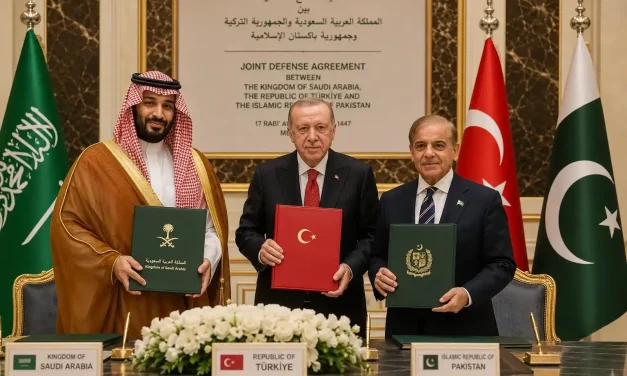
SCFR Online – Opinion: On Friday, August 7, the heads of state of three countries – Saudi Arabia, Turkey, and Pakistan – signed a text under the title “Makkah Joint Defense Agreement.”

Dimensions and challenges of the initiative to revive the Hejaz Railway

Strategic Council Online – Note: The initiative to revive the Hejaz Railway, beyond being a transportation project, constitutes an attempt to redefine geopolitics, the economy, and Turkey’s regional position; however, its realization appears to face significant financial, security, and institutional challenges.

Loading

Últimas publicaciones

Realities of the Tripartite Makkah Pact

SCFR Online – Interview: The signing of the Makkah agreement between Saudi Arabia, Pakistan, and Turkey has raised questions about the future of the region’s security structure and the position of these countries in West Asian equations. Can this agreement become a genuine collective defense mechanism, or does it have more of a political and deterrent function than creating new military capacity?

Strategic Implications of the Reduction of US Weapons Stockpiles

SCFR Online – Opinion: The continuation of the US war against Iran, in addition to increasing operational costs, has called into question the actual capacity of the American arsenal to simultaneously fulfill security commitments on multiple fronts; an issue that affects deterrence, defense production capacity, and Washington’s resource prioritization.

The Formation of a New Order in Relations Between Powers

SCFR Online – Opinion: The Russia-Ukraine war and the war of the United States and the Israeli regime against Iran have been formed with different objectives and actors, but field and political developments indicate that they are not entirely separate from one another.

An Analysis of the Makkah Defense Pact

SCFR Online – Opinion: On Friday, August 7, the heads of state of three countries – Saudi Arabia, Turkey, and Pakistan – signed a text under the title “Makkah Joint Defense Agreement.”

Dimensions and challenges of the initiative to revive the Hejaz Railway

Strategic Council Online – Note: The initiative to revive the Hejaz Railway, beyond being a transportation project, constitutes an attempt to redefine geopolitics, the economy, and Turkey’s regional position; however, its realization appears to face significant financial, security, and institutional challenges.

Loading

DERNIER CONTENU

Realities of the Tripartite Makkah Pact

SCFR Online – Interview: The signing of the Makkah agreement between Saudi Arabia, Pakistan, and Turkey has raised questions about the future of the region’s security structure and the position of these countries in West Asian equations. Can this agreement become a genuine collective defense mechanism, or does it have more of a political and deterrent function than creating new military capacity?

Strategic Implications of the Reduction of US Weapons Stockpiles

SCFR Online – Opinion: The continuation of the US war against Iran, in addition to increasing operational costs, has called into question the actual capacity of the American arsenal to simultaneously fulfill security commitments on multiple fronts; an issue that affects deterrence, defense production capacity, and Washington’s resource prioritization.

The Formation of a New Order in Relations Between Powers

SCFR Online – Opinion: The Russia-Ukraine war and the war of the United States and the Israeli regime against Iran have been formed with different objectives and actors, but field and political developments indicate that they are not entirely separate from one another.

An Analysis of the Makkah Defense Pact

SCFR Online – Opinion: On Friday, August 7, the heads of state of three countries – Saudi Arabia, Turkey, and Pakistan – signed a text under the title “Makkah Joint Defense Agreement.”

Dimensions and challenges of the initiative to revive the Hejaz Railway

Strategic Council Online – Note: The initiative to revive the Hejaz Railway, beyond being a transportation project, constitutes an attempt to redefine geopolitics, the economy, and Turkey’s regional position; however, its realization appears to face significant financial, security, and institutional challenges.

Loading

DERNIER CONTENU

Realities of the Tripartite Makkah Pact

SCFR Online – Interview: The signing of the Makkah agreement between Saudi Arabia, Pakistan, and Turkey has raised questions about the future of the region’s security structure and the position of these countries in West Asian equations. Can this agreement become a genuine collective defense mechanism, or does it have more of a political and deterrent function than creating new military capacity?

Strategic Implications of the Reduction of US Weapons Stockpiles

SCFR Online – Opinion: The continuation of the US war against Iran, in addition to increasing operational costs, has called into question the actual capacity of the American arsenal to simultaneously fulfill security commitments on multiple fronts; an issue that affects deterrence, defense production capacity, and Washington’s resource prioritization.

The Formation of a New Order in Relations Between Powers

SCFR Online – Opinion: The Russia-Ukraine war and the war of the United States and the Israeli regime against Iran have been formed with different objectives and actors, but field and political developments indicate that they are not entirely separate from one another.

An Analysis of the Makkah Defense Pact

SCFR Online – Opinion: On Friday, August 7, the heads of state of three countries – Saudi Arabia, Turkey, and Pakistan – signed a text under the title “Makkah Joint Defense Agreement.”

Dimensions and challenges of the initiative to revive the Hejaz Railway

Strategic Council Online – Note: The initiative to revive the Hejaz Railway, beyond being a transportation project, constitutes an attempt to redefine geopolitics, the economy, and Turkey’s regional position; however, its realization appears to face significant financial, security, and institutional challenges.

Loading

DERNIER CONTENU

Realities of the Tripartite Makkah Pact

SCFR Online – Interview: The signing of the Makkah agreement between Saudi Arabia, Pakistan, and Turkey has raised questions about the future of the region’s security structure and the position of these countries in West Asian equations. Can this agreement become a genuine collective defense mechanism, or does it have more of a political and deterrent function than creating new military capacity?

Strategic Implications of the Reduction of US Weapons Stockpiles

SCFR Online – Opinion: The continuation of the US war against Iran, in addition to increasing operational costs, has called into question the actual capacity of the American arsenal to simultaneously fulfill security commitments on multiple fronts; an issue that affects deterrence, defense production capacity, and Washington’s resource prioritization.

The Formation of a New Order in Relations Between Powers

SCFR Online – Opinion: The Russia-Ukraine war and the war of the United States and the Israeli regime against Iran have been formed with different objectives and actors, but field and political developments indicate that they are not entirely separate from one another.

An Analysis of the Makkah Defense Pact

SCFR Online – Opinion: On Friday, August 7, the heads of state of three countries – Saudi Arabia, Turkey, and Pakistan – signed a text under the title “Makkah Joint Defense Agreement.”

Dimensions and challenges of the initiative to revive the Hejaz Railway

Strategic Council Online – Note: The initiative to revive the Hejaz Railway, beyond being a transportation project, constitutes an attempt to redefine geopolitics, the economy, and Turkey’s regional position; however, its realization appears to face significant financial, security, and institutional challenges.

Loading