
Hamid Khoshayand – Expert on regional affairs
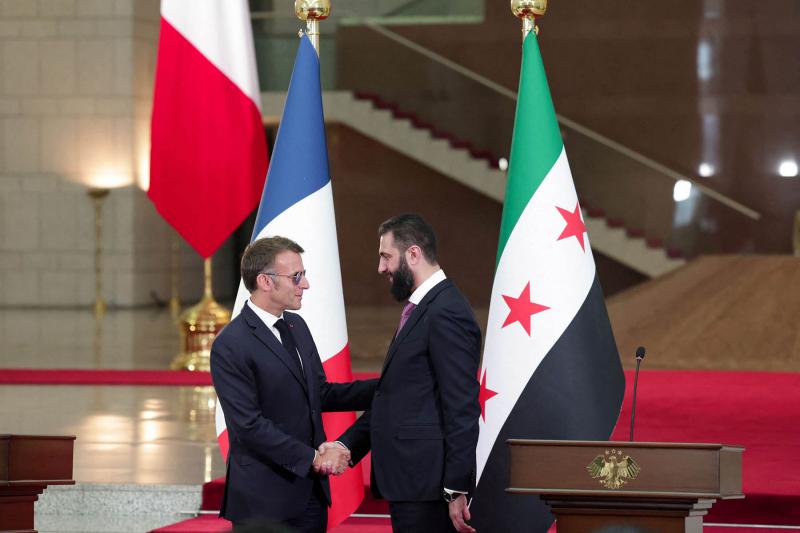
Emmanuel Macron’s unexpected visit to Damascus is the first visit by France’s highest-ranking official in 18 years and the first presence of a Western leader since the fall of Bashar al-Assad in December 2024. While Macron speaks of “support for a unified Syria,” the field reality of this country, due to insecurity, occupation, and controversial leadership, is deeply at odds with these idealistic slogans.
In the underlying layers, the main objective of this visit is Paris’s attempt to break out of isolation and reclaim its lost strategic position in West Asia. France, which inherits historical influence in Syria and Lebanon following the Sykes-Picot agreement, is now marginalized in the region’s major equations, such as the files of Lebanon, Palestine, and the Persian Gulf, and the country’s president, through his visit, seeks to revive France’s role in the new equations.
With this visit, Macron sought to appear as an independent actor in West Asia. The agreement to exchange ambassadors after 14 years and the signing of a diverse package of economic, security, and infrastructure agreements indicate Paris’s determination to play a pivotal role in Syria’s future. Through this initiative, France, while consolidating its position against rivals such as Turkey and Russia, seeks to play a more prominent role in the region’s new security architecture.
France’s geopolitical competition to return to Syria
Macron’s visit to Damascus, accompanied by French commercial giants such as “Total” and “CMA CGM,” demonstrates Paris’s effort to economically exploit Syria’s reconstruction. With an estimated $216 billion for reconstruction, French companies have signed contracts in the fields of ports, energy, and banking. Macron also promised to return frozen assets to solidify France’s economic influence.
However, the realization of these agreements faces serious obstacles; international sanctions remain in place, and widespread insecurity, which was evident in the explosions coinciding with Macron’s visit, has drastically increased investment risk and cast a shadow of uncertainty over the future of these economic cooperations.
The explosions coinciding with Macron’s visit near the Four Seasons Hotel, where he was staying, indicate the fragility of the security situation in Syria. These explosions sent a clear message: the new rulers of Syria are still unable to provide complete security.
Since May, Damascus has witnessed nine bombings. Macron’s emphasis that “Syria must not become destabilized” and the Syrian president’s request for France to play a role in halting the Zionist regime’s aggressions indicate that security cooperation between Paris and Damascus could become one of the main axes of bilateral relations.
Nevertheless, the French leadership’s dependence on the considerations of the Zionist regime has cast serious doubt on the realization of such a demand. During this visit, although Macron condemned the Zionist regime’s aggressions, he refrained from taking any practical decision to halt the occupation.
Nevertheless, this visit took place just before the NATO summit in Ankara, a meeting where U.S. President Donald Trump met with Ahmad al-Shara (al-Julani) and even praised him as an “incredible” and “very respected” leader. At the same meeting, the United States announced that it would remove Syria from the list of state sponsors of terrorism. These developments indicate that Macron’s visit was largely related to France’s concern about being completely sidelined from the Syrian equations.
Perhaps the most controversial aspect of this visit is the complete disregard for the background of Ahmad al-Shara (al-Julani). Al-Julani, who is now recognized as the interim president of Syria, previously led “Hay’at Tahrir al-Sham,” a group that was an offshoot of Al-Qaeda in Syria and has been on the U.S. terrorist list since at least 2013. He established an Al-Qaeda branch in Syria that carried out suicide attacks and armed assaults. Of course, al-Julani distanced himself from Al-Qaeda in 2016, but this distancing never meant the erasure of his violent record.
Nevertheless, Macron not only refrained from mentioning these records but also warmly received al-Julani and referred to him as an equal partner in a “new chapter in Syria-France relations.” This approach reveals the gap between the West’s deceptive human rights claims and its political calculations. France, which has always claimed to defend human rights and combat terrorism, is now, within the framework of its geopolitical economic interests, engaging with an actor who has a history of being part of an extremist armed movement.
This contradiction becomes even more evident when we remember that during the Syrian civil war, France supported some opposition groups to Bashar al-Assad’s government but had never engaged so openly with al-Julani and the group under his leadership. Now that the power equations have changed and Paris’s economic and political interests necessitate it, the past of these actors is forgotten.
The refugee crisis as a challenge for Paris
Meanwhile, the issue of Syrian refugees was another important focus of this visit. Macron, who faces serious challenges on the domestic political scene in France, including declining popularity and competition with right-wing currents such as Marine Le Pen, seeks to gain a political achievement domestically by showcasing the management of the refugee crisis and planning for their voluntary return.
The issue of migration for France is not merely a humanitarian or security matter but has become one of the main axes of domestic political competition. From this perspective, engagement with Damascus can serve as a tool for Paris to demonstrate that it plays an active role in managing the consequences of the Syrian crisis and reducing the pressures resulting from the presence of refugees.
Ultimately, this visit is more an attempt to contain domestic crises and restore Paris’s weakened position than a sign of France’s real return to its strategic position in West Asia. The field reality of Syria, which is divided among foreign powers and lacks unified sovereignty, along with the decline of France’s traditional influence in the region, indicates that this meeting faces serious limitations in becoming a strategic turning point in bilateral relations.
France is interested in defining a position for itself in the competition among the United States, Turkey, Russia, and other regional actors, but its ability to decisively influence Syria’s future still depends on its real influence, economic capacity, and political power in the new equations. Therefore, Macron’s visit should be assessed, above all, as an attempt to prevent the country’s complete exclusion from the process of shaping Syria’s future.






0 Comments