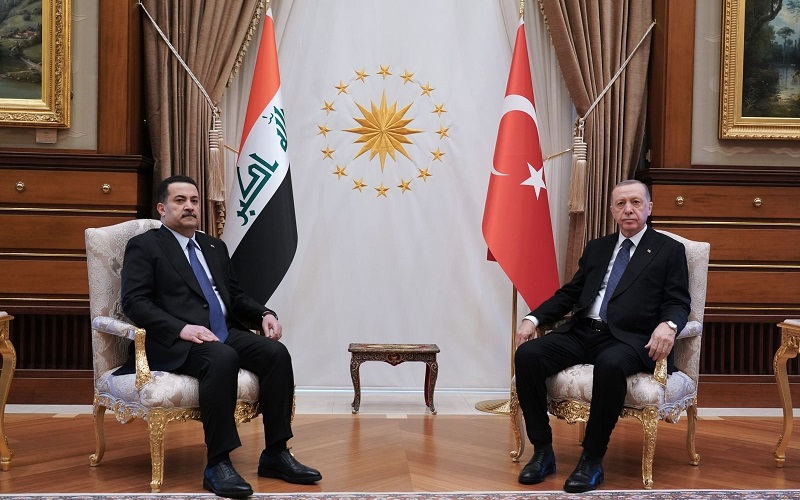
Dimensions and Consequences of Erdoğan’s Visit to Iraq

2024/05/05 | Note, Politics, Top News

Strategic Council Online - Note: Turkish President Recep Tayyip Erdogan's recent trip to Iraq, after his last visit to Baghdad 13 years ago, is considered one of the most important political, economic, and security developments in the relations between the two countries. Hamid Khoshayand- an expert on regional issues

The visit of the President of Turkey to Iraq was carried out while in recent years, especially since 2019, we have seen many Turkish attacks on northern Iraq under the pretext of fighting terrorism. Each of these attacks could cause a “crisis” in the relations between the two countries.

Strengthening economic, security, and energy cooperation were the three main topics of the talks between the leaders of the two countries in Baghdad. Last year, the Iraqi government launched a 17-billion-dollar project to develop overland trade routes and transport goods; the aim was to connect the port of Faw in the south of the country with Turkish territory, which was discussed between the Turkish and Iraqi authorities.

It is worth mentioning that in the last ten years, the share of Turkey’s exports to Iraq in general exports has always been 5% or higher. The value of Turkish exports to Iraq is 15 billion dollars, which will reach 20 billion dollars with the completion of the “Development Road” project in 2030.

Several goals can be identified and noted regarding Erdoğan’s visit to Iraq and the expansion of cooperation between the two countries. Although security goals and agendas and intelligence cooperation are highlighted in Turkey’s media and political circles, this issue is of secondary importance compared to “economic, energy, and transportation” issues.

Iraq is important for Turkey in two ways: First, it is a “strong point” for Turkey regarding economy and energy. Iraq, which has half the population of Turkey, is very rich in terms of energy resources, which can be a good option to improve part of Turkey’s economic problems, which is actually Erdogan’s “Achilles Heel” and one of the main principles of the Justice and Development Party and the country’s foreign policy. From this point of view, Turkey, not in the region but in the world, cannot find a better country than Iraq in terms of “easy and low-cost” access to underground resources and its economy.

Secondly, Iraq is one of the main and important pillars of the joint transportation project called “Development Road” of Turkey, which will enable the land route connecting the Persian Gulf countries to Europe by creating a 1200 km rail and road network from Basra Port to Mersin Port. This project, known as the “Dry Canal” in Iraq, was named the “Change Development Road Project” during the meeting between Erdogan and Mohammad Shia al-Sudani in March 2024. This project, in which Qatar and the United Arab Emirates are present as partners and financiers, is scheduled to be implemented by 2030.

Improving bilateral relations between Turkey and Iraq and expanding regional cooperation are among the main “requirements” for advancing and realizing the mentioned project. In this regard, knowing that despite the tension in relations with Iraq, it is not possible to complete the Development Road Project as the main priority of Ankara in the region, Erdogan put on agenda facilitation and acceleration of the implementation of this grand plan and, resolve differences with the Iraqi government, especially in the field of energy, water, and security were put on the agenda of this trip. Therefore, in his recent trip to Iraq, he reached good agreements with Baghdad on this

field, the promotion and implementation of which will definitely play an effective role in realizing the Development Road Project.

In any case, improving bilateral relations with Iraq and resolving existing disputes with this country can be considered a political “achievement” for Erdogan, who is already eyeing the 2028 presidential elections.

In addition to the ambitious regional goals, Erdogan has lost a part of his popular base in his new presidential term compared to previous years. In the recent municipal elections, the political position of the Justice and Development Party, especially in Ankara, Istanbul, and Izmir, suffered serious defeat. Meanwhile, Turkey has put “de-escalation” with Iraq, one of its important neighbors, on the agenda.

While “zero tension with neighbors” was the Justice and Development Party’s most important foreign policy headline in the past years, this approach was forgotten with the country’s “unconventional interventions” in Syria, Iraq, and Libya. This issue not only shook Erdogan’s political position inside Turkey but also led to the aggravation of internal problems and the country’s foreign policy.

In this framework, the expansion of bilateral cooperation with Iraq, especially in the field of economy, in a situation where Iraq has good economic capacities and is considered one of the “largest markets for the consumption of Turkish goods” in the region, can bring positive achievements in both domestic and foreign policy sectors.


0 Comments

LATEST CONTENT

Consequences of Declining Trust in the Judiciary in Europe

SCFRonline – Opinion: The increase in public distrust of the French judicial system, which in recent surveys has reached approximately two-thirds of citizens, should be analyzed within a framework broader than temporary dissatisfaction or an emotional reaction to a particular criminal case.

Iran’s Potential Levers of Power

SCFRonline– Opinion: Iran’s geopolitical power is not limited solely to oil and the Strait of Hormuz; the unintended emergence of disruptions in the future global food and energy security chains can also demonstrate Iran’s strategic importance.

The Inseparability of the Lebanese Front from the Axis of Resistance

SCFR Online–Opinion: By providing an extensive network of social, healthcare, educational, and post-war reconstruction services, Hezbollah has established a strong social base for itself among Lebanon’s Shiites and Sunnis, and even beyond that, among other segments of Lebanese society, including Christians. Hezbollah has never been an external actor imposed upon Lebanon; rather, it is a phenomenon fundamentally born out of the occupation and crimes of the Zionist regime and itself influenced by popular resistance.

The Increasing Efforts of the Zionist Regime to Redefine Borders and the Regional Order and Its Consequences

SCFR Online– Opinion: Security and military developments in the region over recent months indicate that the ongoing crises and wars in Gaza, southern Lebanon, and parts of Syrian territory encompass broader dimensions of geopolitical and geostrategic transformations. In this context, the increased military presence and control of the Zionist regime over parts of the territories of these areas, along with proposals regarding the creation of buffer zones or even the expansion of security borders, have raised serious questions about the future of the regional order and its consequences for the countries of West Asia.

Loading

Últimas publicaciones

Consequences of Declining Trust in the Judiciary in Europe

SCFRonline – Opinion: The increase in public distrust of the French judicial system, which in recent surveys has reached approximately two-thirds of citizens, should be analyzed within a framework broader than temporary dissatisfaction or an emotional reaction to a particular criminal case.

Iran’s Potential Levers of Power

SCFRonline– Opinion: Iran’s geopolitical power is not limited solely to oil and the Strait of Hormuz; the unintended emergence of disruptions in the future global food and energy security chains can also demonstrate Iran’s strategic importance.

The Inseparability of the Lebanese Front from the Axis of Resistance

SCFR Online–Opinion: By providing an extensive network of social, healthcare, educational, and post-war reconstruction services, Hezbollah has established a strong social base for itself among Lebanon’s Shiites and Sunnis, and even beyond that, among other segments of Lebanese society, including Christians. Hezbollah has never been an external actor imposed upon Lebanon; rather, it is a phenomenon fundamentally born out of the occupation and crimes of the Zionist regime and itself influenced by popular resistance.

The Increasing Efforts of the Zionist Regime to Redefine Borders and the Regional Order and Its Consequences

SCFR Online– Opinion: Security and military developments in the region over recent months indicate that the ongoing crises and wars in Gaza, southern Lebanon, and parts of Syrian territory encompass broader dimensions of geopolitical and geostrategic transformations. In this context, the increased military presence and control of the Zionist regime over parts of the territories of these areas, along with proposals regarding the creation of buffer zones or even the expansion of security borders, have raised serious questions about the future of the regional order and its consequences for the countries of West Asia.

Loading

DERNIER CONTENU

Consequences of Declining Trust in the Judiciary in Europe

SCFRonline – Opinion: The increase in public distrust of the French judicial system, which in recent surveys has reached approximately two-thirds of citizens, should be analyzed within a framework broader than temporary dissatisfaction or an emotional reaction to a particular criminal case.

Iran’s Potential Levers of Power

SCFRonline– Opinion: Iran’s geopolitical power is not limited solely to oil and the Strait of Hormuz; the unintended emergence of disruptions in the future global food and energy security chains can also demonstrate Iran’s strategic importance.

The Inseparability of the Lebanese Front from the Axis of Resistance

SCFR Online–Opinion: By providing an extensive network of social, healthcare, educational, and post-war reconstruction services, Hezbollah has established a strong social base for itself among Lebanon’s Shiites and Sunnis, and even beyond that, among other segments of Lebanese society, including Christians. Hezbollah has never been an external actor imposed upon Lebanon; rather, it is a phenomenon fundamentally born out of the occupation and crimes of the Zionist regime and itself influenced by popular resistance.

The Increasing Efforts of the Zionist Regime to Redefine Borders and the Regional Order and Its Consequences

SCFR Online– Opinion: Security and military developments in the region over recent months indicate that the ongoing crises and wars in Gaza, southern Lebanon, and parts of Syrian territory encompass broader dimensions of geopolitical and geostrategic transformations. In this context, the increased military presence and control of the Zionist regime over parts of the territories of these areas, along with proposals regarding the creation of buffer zones or even the expansion of security borders, have raised serious questions about the future of the regional order and its consequences for the countries of West Asia.

Loading

DERNIER CONTENU

Consequences of Declining Trust in the Judiciary in Europe

SCFRonline – Opinion: The increase in public distrust of the French judicial system, which in recent surveys has reached approximately two-thirds of citizens, should be analyzed within a framework broader than temporary dissatisfaction or an emotional reaction to a particular criminal case.

Iran’s Potential Levers of Power

SCFRonline– Opinion: Iran’s geopolitical power is not limited solely to oil and the Strait of Hormuz; the unintended emergence of disruptions in the future global food and energy security chains can also demonstrate Iran’s strategic importance.

The Inseparability of the Lebanese Front from the Axis of Resistance

SCFR Online–Opinion: By providing an extensive network of social, healthcare, educational, and post-war reconstruction services, Hezbollah has established a strong social base for itself among Lebanon’s Shiites and Sunnis, and even beyond that, among other segments of Lebanese society, including Christians. Hezbollah has never been an external actor imposed upon Lebanon; rather, it is a phenomenon fundamentally born out of the occupation and crimes of the Zionist regime and itself influenced by popular resistance.

The Increasing Efforts of the Zionist Regime to Redefine Borders and the Regional Order and Its Consequences

SCFR Online– Opinion: Security and military developments in the region over recent months indicate that the ongoing crises and wars in Gaza, southern Lebanon, and parts of Syrian territory encompass broader dimensions of geopolitical and geostrategic transformations. In this context, the increased military presence and control of the Zionist regime over parts of the territories of these areas, along with proposals regarding the creation of buffer zones or even the expansion of security borders, have raised serious questions about the future of the regional order and its consequences for the countries of West Asia.

Loading

DERNIER CONTENU

Consequences of Declining Trust in the Judiciary in Europe

SCFRonline – Opinion: The increase in public distrust of the French judicial system, which in recent surveys has reached approximately two-thirds of citizens, should be analyzed within a framework broader than temporary dissatisfaction or an emotional reaction to a particular criminal case.

Iran’s Potential Levers of Power

SCFRonline– Opinion: Iran’s geopolitical power is not limited solely to oil and the Strait of Hormuz; the unintended emergence of disruptions in the future global food and energy security chains can also demonstrate Iran’s strategic importance.

The Inseparability of the Lebanese Front from the Axis of Resistance

SCFR Online–Opinion: By providing an extensive network of social, healthcare, educational, and post-war reconstruction services, Hezbollah has established a strong social base for itself among Lebanon’s Shiites and Sunnis, and even beyond that, among other segments of Lebanese society, including Christians. Hezbollah has never been an external actor imposed upon Lebanon; rather, it is a phenomenon fundamentally born out of the occupation and crimes of the Zionist regime and itself influenced by popular resistance.

The Increasing Efforts of the Zionist Regime to Redefine Borders and the Regional Order and Its Consequences

SCFR Online– Opinion: Security and military developments in the region over recent months indicate that the ongoing crises and wars in Gaza, southern Lebanon, and parts of Syrian territory encompass broader dimensions of geopolitical and geostrategic transformations. In this context, the increased military presence and control of the Zionist regime over parts of the territories of these areas, along with proposals regarding the creation of buffer zones or even the expansion of security borders, have raised serious questions about the future of the regional order and its consequences for the countries of West Asia.

Loading



