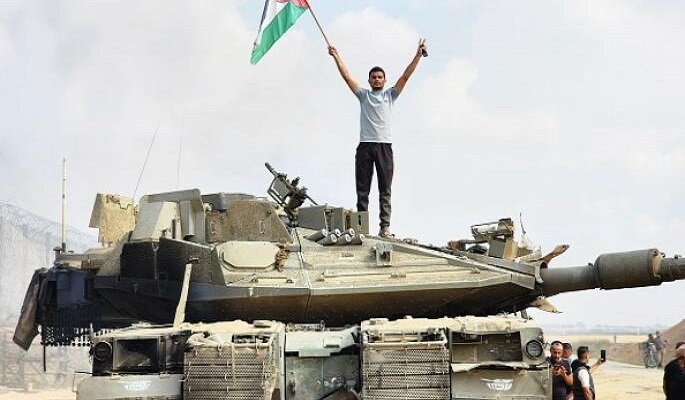
Hamas Approach to US Ceasefire Plan

2024/06/18 | interview, Politics, Top News

Strategic Council Online - Interview: An expert on Palestinian issues said: What is being discussed about the ceasefire plans is not necessarily the issue of stopping the war in Gaza and the exchange of prisoners, but the important issue of formulating the post-war status for each of the two sides.

In an interview with the Strategic Council of Foreign Relations website, Hossein Ruyvaran said about the ceasefire plan of the US and the Zionist regime: The recent ceasefire plan proposed by the US and the Zionist regime has three stages that must be completed in six weeks.

The first stage will be the release of the elderly and sick Israeli female prisoners by Hamas in exchange for the release of several Palestinian prisoners,

The second stage will be the exchange of the rest of the living prisoners and

The third stage will be the exchange of the dead bodies. Also, the daily arrival of 600 trucks of foodstuffs for the people of Gaza has been seen in this plan, while the issue of Gaza’s reconstruction has also been addressed.

He noted that two issues are still unclear in the said plan presented by the US and the Israeli regime. The first is the withdrawal of the Zionist forces from the populated areas of Gaza, which Hamas does not accept and insists that the withdrawal should be done entirely from the Gaza Strip. The second is the discussions on the ceasefire. Although the word “ceasefire” is mentioned in this plan, it does not mean “permanent truce.” Therefore, Hamas believes that they want to release the prisoners and then continue the war, citing the fact that there is no mention of a permanent ceasefire. At present, this is the main bone of contention in the proposed plan.

This expert on Palestinian issues said about Europe’s support for this plan: The Europeans, while supporting the ceasefire plan, emphasize that once the prisoners are released, there is no reason to continue the war, and Hamas can accept this part as well, but Hamas does not accept it, hoping that the Zionists will not find a reason to continue the killing and genocide of the people of Gaza and Rafah. At the same time, the leaders of Hamas consider the US and the Israeli regime criminals who have proven during the last eight months that they do not adhere to any moral principles; therefore, they are looking for a firm and transparent agreement, an explicit and clear deal free of ambiguous and interpretable terms because Hamas doubts the intentions of America and the Israeli regime.

Ruyvaran said: “The essence of the matter is that there has been a war that has lasted for eight months, nearly 40,000 people have been killed, more than 100,000 people have been wounded, half of Gaza has been destroyed, and it is a systematic genocide and terrible destruction.” It has been done against people, hospitals, schools, mosques, and human existence and humanity and life in Gaza. Therefore, the Israeli regime seeks to end this war in such a way that it preserves its reputation and, at the same time, can claim that it has not lost this war.

This expert on Palestinian issues stated that victory was not a reality for the Zionist regime because the goals it set in this war were not realized. Talking about a permanent ceasefire will not stop the war. In any case, the real winner of the war is Hamas because it has achieved its goals, and by freeing hundreds of Palestinian prisoners in the framework of the exchange that takes place, it creates hope in Palestinian society.

He added: While the release of Israeli prisoners is more to diminish the defeat and disappointment of this regime, for the Palestinians, the release of prisoners is a different matter, and it brings hope back to the people in Gaza that they can free their prisoners from the prison of the Zionist regime by force of arms.

Stating that the October 7 war and its results are the basis for drawing the future, Ruyvaran said: The challenge for the ceasefire plan is related to the issue of the future. While America says that Hamas should not rule in Gaza, Hamas will be the main actor in the future of Gaza. In addition, the Palestinian people have an indisputable right to self-determination, and they will finally clarify this issue. America says that after this operation and the announcement of a ceasefire, the discussion between the two governments should be discussed and followed up. At the same time, this issue is not accepted by the Israeli regime’s government, and the Israelis do not accept this plan either. They say that the two-state solution should not be raised under any circumstances. Therefore, the future of this region and Palestine is prone to many developments that should be expected.


0 Comments

LATEST CONTENT

Increasing criticism of the extensive Zionist lobby network

SCFR Online – Opinion: An examination of the mechanisms of the Israeli regime’s influence in the United States depicts a complex picture of shared interests, strategic dependencies, and the limitations of this relationship.

Realities of the Tripartite Makkah Pact

SCFR Online – Interview: The signing of the Makkah agreement between Saudi Arabia, Pakistan, and Turkey has raised questions about the future of the region’s security structure and the position of these countries in West Asian equations. Can this agreement become a genuine collective defense mechanism, or does it have more of a political and deterrent function than creating new military capacity?

Strategic Implications of the Reduction of US Weapons Stockpiles

SCFR Online – Opinion: The continuation of the US war against Iran, in addition to increasing operational costs, has called into question the actual capacity of the American arsenal to simultaneously fulfill security commitments on multiple fronts; an issue that affects deterrence, defense production capacity, and Washington’s resource prioritization.

The Formation of a New Order in Relations Between Powers

SCFR Online – Opinion: The Russia-Ukraine war and the war of the United States and the Israeli regime against Iran have been formed with different objectives and actors, but field and political developments indicate that they are not entirely separate from one another.

An Analysis of the Makkah Defense Pact

SCFR Online – Opinion: On Friday, August 7, the heads of state of three countries – Saudi Arabia, Turkey, and Pakistan – signed a text under the title “Makkah Joint Defense Agreement.”

Dimensions and challenges of the initiative to revive the Hejaz Railway

Strategic Council Online – Note: The initiative to revive the Hejaz Railway, beyond being a transportation project, constitutes an attempt to redefine geopolitics, the economy, and Turkey’s regional position; however, its realization appears to face significant financial, security, and institutional challenges.

Loading

Últimas publicaciones

Increasing criticism of the extensive Zionist lobby network

SCFR Online – Opinion: An examination of the mechanisms of the Israeli regime’s influence in the United States depicts a complex picture of shared interests, strategic dependencies, and the limitations of this relationship.

Realities of the Tripartite Makkah Pact

SCFR Online – Interview: The signing of the Makkah agreement between Saudi Arabia, Pakistan, and Turkey has raised questions about the future of the region’s security structure and the position of these countries in West Asian equations. Can this agreement become a genuine collective defense mechanism, or does it have more of a political and deterrent function than creating new military capacity?

Strategic Implications of the Reduction of US Weapons Stockpiles

SCFR Online – Opinion: The continuation of the US war against Iran, in addition to increasing operational costs, has called into question the actual capacity of the American arsenal to simultaneously fulfill security commitments on multiple fronts; an issue that affects deterrence, defense production capacity, and Washington’s resource prioritization.

The Formation of a New Order in Relations Between Powers

SCFR Online – Opinion: The Russia-Ukraine war and the war of the United States and the Israeli regime against Iran have been formed with different objectives and actors, but field and political developments indicate that they are not entirely separate from one another.

An Analysis of the Makkah Defense Pact

SCFR Online – Opinion: On Friday, August 7, the heads of state of three countries – Saudi Arabia, Turkey, and Pakistan – signed a text under the title “Makkah Joint Defense Agreement.”

Dimensions and challenges of the initiative to revive the Hejaz Railway

Strategic Council Online – Note: The initiative to revive the Hejaz Railway, beyond being a transportation project, constitutes an attempt to redefine geopolitics, the economy, and Turkey’s regional position; however, its realization appears to face significant financial, security, and institutional challenges.

Loading

DERNIER CONTENU

Increasing criticism of the extensive Zionist lobby network

SCFR Online – Opinion: An examination of the mechanisms of the Israeli regime’s influence in the United States depicts a complex picture of shared interests, strategic dependencies, and the limitations of this relationship.

Realities of the Tripartite Makkah Pact

SCFR Online – Interview: The signing of the Makkah agreement between Saudi Arabia, Pakistan, and Turkey has raised questions about the future of the region’s security structure and the position of these countries in West Asian equations. Can this agreement become a genuine collective defense mechanism, or does it have more of a political and deterrent function than creating new military capacity?

Strategic Implications of the Reduction of US Weapons Stockpiles

SCFR Online – Opinion: The continuation of the US war against Iran, in addition to increasing operational costs, has called into question the actual capacity of the American arsenal to simultaneously fulfill security commitments on multiple fronts; an issue that affects deterrence, defense production capacity, and Washington’s resource prioritization.

The Formation of a New Order in Relations Between Powers

SCFR Online – Opinion: The Russia-Ukraine war and the war of the United States and the Israeli regime against Iran have been formed with different objectives and actors, but field and political developments indicate that they are not entirely separate from one another.

An Analysis of the Makkah Defense Pact

SCFR Online – Opinion: On Friday, August 7, the heads of state of three countries – Saudi Arabia, Turkey, and Pakistan – signed a text under the title “Makkah Joint Defense Agreement.”

Dimensions and challenges of the initiative to revive the Hejaz Railway

Strategic Council Online – Note: The initiative to revive the Hejaz Railway, beyond being a transportation project, constitutes an attempt to redefine geopolitics, the economy, and Turkey’s regional position; however, its realization appears to face significant financial, security, and institutional challenges.

Loading

DERNIER CONTENU

Increasing criticism of the extensive Zionist lobby network

SCFR Online – Opinion: An examination of the mechanisms of the Israeli regime’s influence in the United States depicts a complex picture of shared interests, strategic dependencies, and the limitations of this relationship.

Realities of the Tripartite Makkah Pact

SCFR Online – Interview: The signing of the Makkah agreement between Saudi Arabia, Pakistan, and Turkey has raised questions about the future of the region’s security structure and the position of these countries in West Asian equations. Can this agreement become a genuine collective defense mechanism, or does it have more of a political and deterrent function than creating new military capacity?

Strategic Implications of the Reduction of US Weapons Stockpiles

SCFR Online – Opinion: The continuation of the US war against Iran, in addition to increasing operational costs, has called into question the actual capacity of the American arsenal to simultaneously fulfill security commitments on multiple fronts; an issue that affects deterrence, defense production capacity, and Washington’s resource prioritization.

The Formation of a New Order in Relations Between Powers

SCFR Online – Opinion: The Russia-Ukraine war and the war of the United States and the Israeli regime against Iran have been formed with different objectives and actors, but field and political developments indicate that they are not entirely separate from one another.

An Analysis of the Makkah Defense Pact

SCFR Online – Opinion: On Friday, August 7, the heads of state of three countries – Saudi Arabia, Turkey, and Pakistan – signed a text under the title “Makkah Joint Defense Agreement.”

Dimensions and challenges of the initiative to revive the Hejaz Railway

Strategic Council Online – Note: The initiative to revive the Hejaz Railway, beyond being a transportation project, constitutes an attempt to redefine geopolitics, the economy, and Turkey’s regional position; however, its realization appears to face significant financial, security, and institutional challenges.

Loading

DERNIER CONTENU

Increasing criticism of the extensive Zionist lobby network

SCFR Online – Opinion: An examination of the mechanisms of the Israeli regime’s influence in the United States depicts a complex picture of shared interests, strategic dependencies, and the limitations of this relationship.

Realities of the Tripartite Makkah Pact

SCFR Online – Interview: The signing of the Makkah agreement between Saudi Arabia, Pakistan, and Turkey has raised questions about the future of the region’s security structure and the position of these countries in West Asian equations. Can this agreement become a genuine collective defense mechanism, or does it have more of a political and deterrent function than creating new military capacity?

Strategic Implications of the Reduction of US Weapons Stockpiles

SCFR Online – Opinion: The continuation of the US war against Iran, in addition to increasing operational costs, has called into question the actual capacity of the American arsenal to simultaneously fulfill security commitments on multiple fronts; an issue that affects deterrence, defense production capacity, and Washington’s resource prioritization.

The Formation of a New Order in Relations Between Powers

SCFR Online – Opinion: The Russia-Ukraine war and the war of the United States and the Israeli regime against Iran have been formed with different objectives and actors, but field and political developments indicate that they are not entirely separate from one another.

An Analysis of the Makkah Defense Pact

SCFR Online – Opinion: On Friday, August 7, the heads of state of three countries – Saudi Arabia, Turkey, and Pakistan – signed a text under the title “Makkah Joint Defense Agreement.”

Dimensions and challenges of the initiative to revive the Hejaz Railway

Strategic Council Online – Note: The initiative to revive the Hejaz Railway, beyond being a transportation project, constitutes an attempt to redefine geopolitics, the economy, and Turkey’s regional position; however, its realization appears to face significant financial, security, and institutional challenges.

Loading




