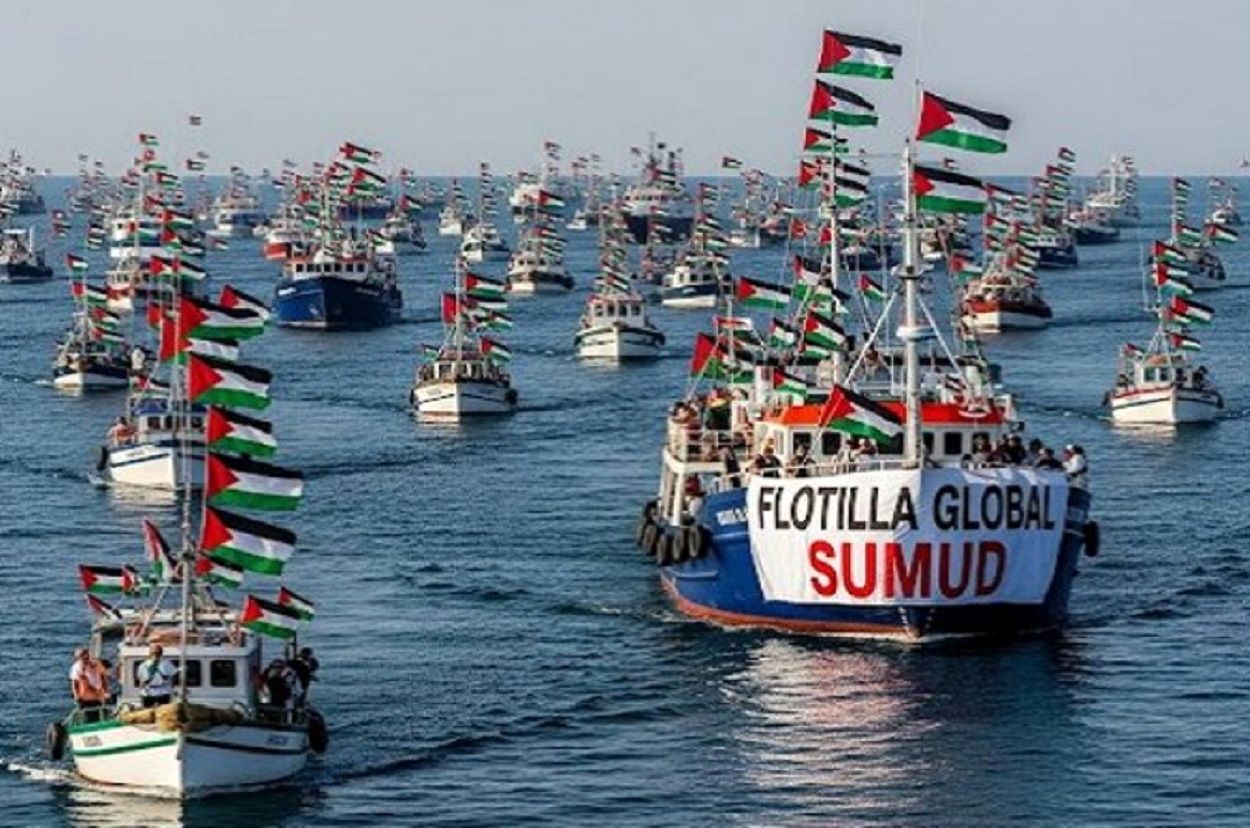
Seizure of the Samoud Flotilla: A Clear Violation of International Law

2025/10/06 | interview, Politics, top news

Online Strategic Council - Dialogue: A senior analyst of West Asian and Arab world affairs stated: The recent action by the naval forces of the Israeli regime in seizing the "Global Samoud" humanitarian ships has once again placed the world before a clear violation of international law and maritime laws.

Asghar Zarei, an expert on West Asian affairs, in an interview with the website of the Strategic Council on Foreign Relations, stated: This convoy consisted of more than 50 boats and about 500 activists and politicians from 44 countries around the world, which set out with the aim of breaking the siege of Gaza and delivering food and medical aid to the occupied territories.
He added: The seizure of these ships and the detention of international activists, including Greta Thunberg and Mandela Mandela, sparked widespread political and public reactions in Europe and other parts of the world.
Zarei emphasized: “The Israeli regime has once again shown that it has no red lines in committing crimes and violating moral and legal obligations.”
He said: “This action by the Zionist regime is a continuation of the same aggressive path that we have witnessed in Syria, Lebanon, and Yemen, and today it has reached its peak in Gaza. With the overt and covert support of the United States and some European governments, the Israeli regime brazenly carries out actions that even violate the rulings of the International Court of Justice.”

US and European Support: An Incentive for Crime
According to Zarei, “The most important factor sustaining such actions is the political and diplomatic support of the United States and some of its European allies.”
This expert reminded: “Two weeks ago, a draft resolution to stop the war and slaughter in Gaza was presented at the Security Council; but with the US veto, the inhumane and undemocratic nature of Washington was once again revealed to world public opinion.”
Zarei explained that “Under the shadow of such support, the Israeli regime not only continues to seize humanitarian convoys but, with its criminal nature, also engages in taking international activists hostage.”
He pointed out: “In the Samoud flotilla, there were journalists from reputable global media, including Al Jazeera, and their detention shows that Tel Aviv has long transgressed against freedom of speech and public enlightenment.”
According to this Arab world expert, “The seizure of this convoy was one of the most severe examples of attacks on peace flotillas in recent years; an action that not only stirred a wave of hatred and civil protests against the Israeli regime in the public opinion of the Islamic world but also in Europe and Latin America.”

Legal Dimensions and International Consequences
Zarei, in the continuation of his analysis, also addressed the incident from a legal perspective and noted: “The seizure of ships in international waters is a clear example of piracy and there is no legal justification for it. Even international human rights NGOs have condemned this action and demanded an immediate investigation.”
This senior West Asian affairs analyst stated in this regard: “Today, the Israeli regime is not in a position to claim legitimacy. Even in the United Nations General Assembly, we witnessed that during the speech of the Prime Minister of this regime, more than 70 diplomats from various countries left the hall. This shows that the Israeli regime is rapidly becoming isolated and continues its political existence solely relying on the support of the United States and a few Western countries.”
Referring to the issuance of international arrest warrants for some officials of the Israeli regime by international judicial bodies, he said: “Despite these rulings, Netanyahu still freely attends global meetings and speaks from the official UN podium. This clear contradiction has further called into question the legitimacy of international institutions and made public opinion skeptical of global justice.”
Zarei believes: “Although this situation is bitter and regrettable, it has caused the Israeli regime to become the most hated and isolated regime in the world today, and a wave of awakening has formed among nations, even in Europe and America. Many European governments, such as Spain and Ireland, under public pressure, have been forced to reconsider their relations with Tel Aviv.”
Zarei finally emphasized: “The seizure of the Samoud flotilla is not just an isolated incident, but part of a broader trend in the aggressive policies of the Israeli regime. But in response, this very action was able once again to mobilize world public opinion against occupation and genocide.”
According to this analyst, “The greatest achievement today is that the discourse of supporting Palestine has become a global demand. From Latin America to Europe and even within the United States itself, the voice of protest against the apartheid and crimes of the Israeli regime has risen, and this trend will continue to expand increasingly.”

0 Comments

LATEST CONTENT

Europe’s Enduring Dependence on Persian Gulf Energy

SCFR Online – Opinion: The dominant discourse in the field of European energy security over the past two decades has revolved around diversification of supply sources and the gradual reduction of dependence on fossil fuels. This narrative, which gained particular momentum after the Ukraine gas crisis in 2006 and its intensification in 2014 and 2022, was based on the assumption that Europe could free itself from the geopolitical vulnerabilities arising from dependence on specific suppliers through investment in renewable energy, imports of liquefied natural gas from diversified sources, and the establishment of new infrastructure. However, a closer analysis of energy trade data and the structure of the global oil and gas supply chain presents a different picture. Europe has not only failed to meaningfully reduce its dependence on the Persian Gulf, but in some sectors — particularly in liquefied natural gas imports — this dependence has deepened. This reality, which is often overlooked in public discourse, raises fundamental questions about the sustainability of Europe’s energy security strategies and their impact on regional power equations.

The Challenge of Hezbollah’s Low-Cost “FPV” Drones for the Zionist Regime

SCFR Online – Opinion: In modern warfare, it has always been assumed that the more expensive, and advanced the weapon—particularly from well-known companies—the more certain the victory will be. However, developments on the northern front of occupied Palestine in recent months have challenged this long-held belief. Here, the Zionist regime’s military, despite possessing the most advanced defense systems such as Iron Dome, David’s Sling, and Arrow, as well as fifth-generation F-35 fighter jets, Merkava tanks, and other modern equipment found in few countries worldwide, has effectively been rendered helpless against Hezbollah Lebanon’s few-hundred-dollar drones. Benjamin Netanyahu’s bitter admission regarding the inability to counter this threat, and his order to allocate an unlimited budget to find a solution, underscores the reality that the era of pure superiority through expensive technologies has come to an end.

The Impact of West Asian Developments on the Ukraine War

SCFR Online – Note: Vladimir Putin, President of Russia, recently announced—more than four years after the commencement of military aggression against Ukraine—that he believes the conflict between Russia and Ukraine is drawing to a close.

Temporary China–U.S. Trade Truce in the Shadow of Fundamental Distrust

SCFR Online – Opinion: The recent visit of the President of the United States to China is significant from various aspects; because China is recognized as the world’s second-largest economic power and a growing economy. The Chinese are also advancing in various fields, including the space sector, artificial intelligence, and military industries; to the extent that in the military sector, whereas they previously lacked an aircraft carrier, they now possess their third aircraft carrier. On the other hand, the United States, as a superpower, has always regarded China as its rival and continues to view it as such today.

Loading

Últimas publicaciones

Europe’s Enduring Dependence on Persian Gulf Energy

SCFR Online – Opinion: The dominant discourse in the field of European energy security over the past two decades has revolved around diversification of supply sources and the gradual reduction of dependence on fossil fuels. This narrative, which gained particular momentum after the Ukraine gas crisis in 2006 and its intensification in 2014 and 2022, was based on the assumption that Europe could free itself from the geopolitical vulnerabilities arising from dependence on specific suppliers through investment in renewable energy, imports of liquefied natural gas from diversified sources, and the establishment of new infrastructure. However, a closer analysis of energy trade data and the structure of the global oil and gas supply chain presents a different picture. Europe has not only failed to meaningfully reduce its dependence on the Persian Gulf, but in some sectors — particularly in liquefied natural gas imports — this dependence has deepened. This reality, which is often overlooked in public discourse, raises fundamental questions about the sustainability of Europe’s energy security strategies and their impact on regional power equations.

The Challenge of Hezbollah’s Low-Cost “FPV” Drones for the Zionist Regime

SCFR Online – Opinion: In modern warfare, it has always been assumed that the more expensive, and advanced the weapon—particularly from well-known companies—the more certain the victory will be. However, developments on the northern front of occupied Palestine in recent months have challenged this long-held belief. Here, the Zionist regime’s military, despite possessing the most advanced defense systems such as Iron Dome, David’s Sling, and Arrow, as well as fifth-generation F-35 fighter jets, Merkava tanks, and other modern equipment found in few countries worldwide, has effectively been rendered helpless against Hezbollah Lebanon’s few-hundred-dollar drones. Benjamin Netanyahu’s bitter admission regarding the inability to counter this threat, and his order to allocate an unlimited budget to find a solution, underscores the reality that the era of pure superiority through expensive technologies has come to an end.

The Impact of West Asian Developments on the Ukraine War

SCFR Online – Note: Vladimir Putin, President of Russia, recently announced—more than four years after the commencement of military aggression against Ukraine—that he believes the conflict between Russia and Ukraine is drawing to a close.

Temporary China–U.S. Trade Truce in the Shadow of Fundamental Distrust

SCFR Online – Opinion: The recent visit of the President of the United States to China is significant from various aspects; because China is recognized as the world’s second-largest economic power and a growing economy. The Chinese are also advancing in various fields, including the space sector, artificial intelligence, and military industries; to the extent that in the military sector, whereas they previously lacked an aircraft carrier, they now possess their third aircraft carrier. On the other hand, the United States, as a superpower, has always regarded China as its rival and continues to view it as such today.

Loading

DERNIER CONTENU

Europe’s Enduring Dependence on Persian Gulf Energy

SCFR Online – Opinion: The dominant discourse in the field of European energy security over the past two decades has revolved around diversification of supply sources and the gradual reduction of dependence on fossil fuels. This narrative, which gained particular momentum after the Ukraine gas crisis in 2006 and its intensification in 2014 and 2022, was based on the assumption that Europe could free itself from the geopolitical vulnerabilities arising from dependence on specific suppliers through investment in renewable energy, imports of liquefied natural gas from diversified sources, and the establishment of new infrastructure. However, a closer analysis of energy trade data and the structure of the global oil and gas supply chain presents a different picture. Europe has not only failed to meaningfully reduce its dependence on the Persian Gulf, but in some sectors — particularly in liquefied natural gas imports — this dependence has deepened. This reality, which is often overlooked in public discourse, raises fundamental questions about the sustainability of Europe’s energy security strategies and their impact on regional power equations.

The Challenge of Hezbollah’s Low-Cost “FPV” Drones for the Zionist Regime

SCFR Online – Opinion: In modern warfare, it has always been assumed that the more expensive, and advanced the weapon—particularly from well-known companies—the more certain the victory will be. However, developments on the northern front of occupied Palestine in recent months have challenged this long-held belief. Here, the Zionist regime’s military, despite possessing the most advanced defense systems such as Iron Dome, David’s Sling, and Arrow, as well as fifth-generation F-35 fighter jets, Merkava tanks, and other modern equipment found in few countries worldwide, has effectively been rendered helpless against Hezbollah Lebanon’s few-hundred-dollar drones. Benjamin Netanyahu’s bitter admission regarding the inability to counter this threat, and his order to allocate an unlimited budget to find a solution, underscores the reality that the era of pure superiority through expensive technologies has come to an end.

The Impact of West Asian Developments on the Ukraine War

SCFR Online – Note: Vladimir Putin, President of Russia, recently announced—more than four years after the commencement of military aggression against Ukraine—that he believes the conflict between Russia and Ukraine is drawing to a close.

Temporary China–U.S. Trade Truce in the Shadow of Fundamental Distrust

SCFR Online – Opinion: The recent visit of the President of the United States to China is significant from various aspects; because China is recognized as the world’s second-largest economic power and a growing economy. The Chinese are also advancing in various fields, including the space sector, artificial intelligence, and military industries; to the extent that in the military sector, whereas they previously lacked an aircraft carrier, they now possess their third aircraft carrier. On the other hand, the United States, as a superpower, has always regarded China as its rival and continues to view it as such today.

Loading

DERNIER CONTENU

Europe’s Enduring Dependence on Persian Gulf Energy

SCFR Online – Opinion: The dominant discourse in the field of European energy security over the past two decades has revolved around diversification of supply sources and the gradual reduction of dependence on fossil fuels. This narrative, which gained particular momentum after the Ukraine gas crisis in 2006 and its intensification in 2014 and 2022, was based on the assumption that Europe could free itself from the geopolitical vulnerabilities arising from dependence on specific suppliers through investment in renewable energy, imports of liquefied natural gas from diversified sources, and the establishment of new infrastructure. However, a closer analysis of energy trade data and the structure of the global oil and gas supply chain presents a different picture. Europe has not only failed to meaningfully reduce its dependence on the Persian Gulf, but in some sectors — particularly in liquefied natural gas imports — this dependence has deepened. This reality, which is often overlooked in public discourse, raises fundamental questions about the sustainability of Europe’s energy security strategies and their impact on regional power equations.

The Challenge of Hezbollah’s Low-Cost “FPV” Drones for the Zionist Regime

SCFR Online – Opinion: In modern warfare, it has always been assumed that the more expensive, and advanced the weapon—particularly from well-known companies—the more certain the victory will be. However, developments on the northern front of occupied Palestine in recent months have challenged this long-held belief. Here, the Zionist regime’s military, despite possessing the most advanced defense systems such as Iron Dome, David’s Sling, and Arrow, as well as fifth-generation F-35 fighter jets, Merkava tanks, and other modern equipment found in few countries worldwide, has effectively been rendered helpless against Hezbollah Lebanon’s few-hundred-dollar drones. Benjamin Netanyahu’s bitter admission regarding the inability to counter this threat, and his order to allocate an unlimited budget to find a solution, underscores the reality that the era of pure superiority through expensive technologies has come to an end.

The Impact of West Asian Developments on the Ukraine War

SCFR Online – Note: Vladimir Putin, President of Russia, recently announced—more than four years after the commencement of military aggression against Ukraine—that he believes the conflict between Russia and Ukraine is drawing to a close.

Temporary China–U.S. Trade Truce in the Shadow of Fundamental Distrust

SCFR Online – Opinion: The recent visit of the President of the United States to China is significant from various aspects; because China is recognized as the world’s second-largest economic power and a growing economy. The Chinese are also advancing in various fields, including the space sector, artificial intelligence, and military industries; to the extent that in the military sector, whereas they previously lacked an aircraft carrier, they now possess their third aircraft carrier. On the other hand, the United States, as a superpower, has always regarded China as its rival and continues to view it as such today.

Loading

DERNIER CONTENU

Europe’s Enduring Dependence on Persian Gulf Energy

SCFR Online – Opinion: The dominant discourse in the field of European energy security over the past two decades has revolved around diversification of supply sources and the gradual reduction of dependence on fossil fuels. This narrative, which gained particular momentum after the Ukraine gas crisis in 2006 and its intensification in 2014 and 2022, was based on the assumption that Europe could free itself from the geopolitical vulnerabilities arising from dependence on specific suppliers through investment in renewable energy, imports of liquefied natural gas from diversified sources, and the establishment of new infrastructure. However, a closer analysis of energy trade data and the structure of the global oil and gas supply chain presents a different picture. Europe has not only failed to meaningfully reduce its dependence on the Persian Gulf, but in some sectors — particularly in liquefied natural gas imports — this dependence has deepened. This reality, which is often overlooked in public discourse, raises fundamental questions about the sustainability of Europe’s energy security strategies and their impact on regional power equations.

The Challenge of Hezbollah’s Low-Cost “FPV” Drones for the Zionist Regime

SCFR Online – Opinion: In modern warfare, it has always been assumed that the more expensive, and advanced the weapon—particularly from well-known companies—the more certain the victory will be. However, developments on the northern front of occupied Palestine in recent months have challenged this long-held belief. Here, the Zionist regime’s military, despite possessing the most advanced defense systems such as Iron Dome, David’s Sling, and Arrow, as well as fifth-generation F-35 fighter jets, Merkava tanks, and other modern equipment found in few countries worldwide, has effectively been rendered helpless against Hezbollah Lebanon’s few-hundred-dollar drones. Benjamin Netanyahu’s bitter admission regarding the inability to counter this threat, and his order to allocate an unlimited budget to find a solution, underscores the reality that the era of pure superiority through expensive technologies has come to an end.

The Impact of West Asian Developments on the Ukraine War

SCFR Online – Note: Vladimir Putin, President of Russia, recently announced—more than four years after the commencement of military aggression against Ukraine—that he believes the conflict between Russia and Ukraine is drawing to a close.

Temporary China–U.S. Trade Truce in the Shadow of Fundamental Distrust

SCFR Online – Opinion: The recent visit of the President of the United States to China is significant from various aspects; because China is recognized as the world’s second-largest economic power and a growing economy. The Chinese are also advancing in various fields, including the space sector, artificial intelligence, and military industries; to the extent that in the military sector, whereas they previously lacked an aircraft carrier, they now possess their third aircraft carrier. On the other hand, the United States, as a superpower, has always regarded China as its rival and continues to view it as such today.

Loading





