
Masoumeh Taheri – Cyber Affairs Analyst
In the history of international relations, each era has been defined by its dominant technology. The Industrial Revolution shaped the power of European empires. Nuclear energy determined the balance of power during the Cold War, and the Internet transformed the global information order. Today, artificial intelligence is becoming the decisive technology capable of rewriting the rules of power in the twenty-first century. The central question is no longer which country will build the best AI model, but which country will define the rules of its use, data ownership, and global standards.
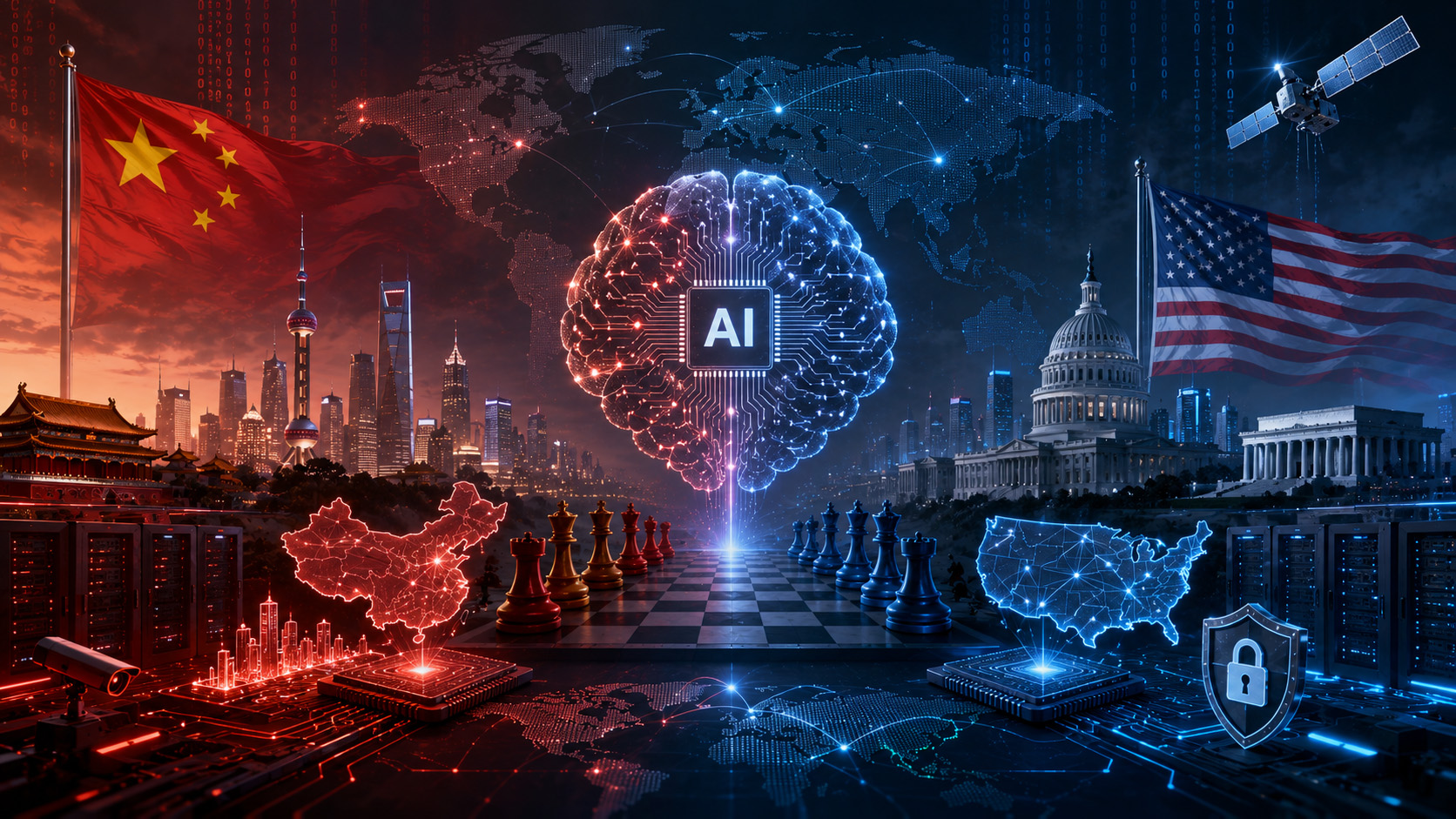
For this reason, competition over artificial intelligence is no longer purely technological; it has become one of the most important dimensions of national security, foreign policy, and geopolitics. Both China and the United States recognize this reality, but they have chosen different paths to achieve superiority. One relies on market capacity, private companies, and open innovation, while the other is based on state planning, centralized investment, and data governance. The result of this competition will be a world in which political power is more closely tied than ever to computational power.
Artificial Intelligence as the New Pillar of National Security
In the past, national security was mainly assessed through the number of military forces, missile arsenals, or economic capacity. Today, however, artificial intelligence is rapidly becoming one of the most important components of national power. Algorithms capable of analyzing data, detecting cyberattacks, guiding military operations, managing financial networks, and even influencing public opinion are considered part of countries’ security infrastructure.
For this reason, governments are making unprecedented investments in developing indigenous AI models, data processing centers, semiconductors, and cloud infrastructure. Competition over advanced chips, restrictions on technology exports, control of semiconductor supply chains, and the attraction of scientific talent are all part of this major struggle.
Artificial intelligence is no longer merely a tool for economic efficiency; it has become an element of strategic deterrence. A country that can analyze faster, predict more accurately, and make smarter decisions will hold the advantage in many future crises.
Data Is Not the New Oil; It Is the New Sovereignty
For years, data was called “the new oil,” but this metaphor is no longer sufficient. Oil is an economic commodity, whereas data constitutes the foundation of sovereignty in the digital age. The more data a country possesses, the greater its ability to train AI models, develop intelligent services, and shape economic and social behavior.
Therefore, data governance has become one of the most important arenas of geopolitical competition. Disputes between China and the West over cross-border data flows, citizen data protection, cybersecurity, and digital sovereignty are not merely legal disagreements; they reflect two fundamentally different visions of the future of power.
In the American model, private companies are the main engine of innovation, while the state plays a regulatory role. In contrast, China considers data a strategic state asset and organizes AI development within the framework of national strategic objectives. This difference has created two distinct structures for global technological governance.
Washington–Beijing Rivalry Beyond Technology
The competition between China and the United States over AI appears at first to be a race for more advanced models, but in reality, it is a struggle to define the rules of the future world. Any country that defines international standards for artificial intelligence, cybersecurity, data ownership, and digital infrastructure will gain influence beyond military power.
In recent years, China has sought to expand its influence by developing indigenous ecosystems, extensive state support, and technological cooperation with countries of the Global South. In contrast, the United States seeks to maintain its advantage through export restrictions, technological alliances, and investment in advanced industries.
As a result, the world is gradually moving toward the formation of two major technological ecosystems, each with its own standards, infrastructure, and rules. This trend may deepen the technological divide between countries and affect trade, education, healthcare, media, and diplomacy.
Humans Remain the Most Important Strategic Advantage
Despite all technological progress, one of the most important warnings in contemporary strategic literature is that artificial intelligence will not replace human judgment. Major political, military, and diplomatic decisions still require cultural understanding, insight into human motivations, and the ability to analyze political complexity.
Recent studies also show that as AI systems become more advanced, the value of human capital, elite education, and strategic decision-making quality increases as well. Technology can enhance speed and accuracy, but responsibility, ethics, and final judgment remain human domains. Therefore, future competition will not only be about building larger language models or faster processors, but also about training human resources, creating efficient institutions, and establishing responsible governance frameworks for this technology.
Artificial intelligence is becoming the most important arena of great power competition, because it is not merely an economic or scientific tool, but the foundation of national security, governance, military power, cultural influence, and future geopolitical rivalry. The competition between China and the United States is less about producing a technological product and more about designing the digital architecture of the global order. Each seeks to extend its model of data governance, standard-setting, smart infrastructure, and technological regulation to other countries.
The world is entering an era in which power will be measured not only by economic size or military capability, but also by algorithmic production capacity, data ownership, human capital quality, and the ability to define global rules. In such an order, artificial intelligence is no longer an emerging technology; it has become the most important geopolitical component of the twenty-first century.









0 Comments