
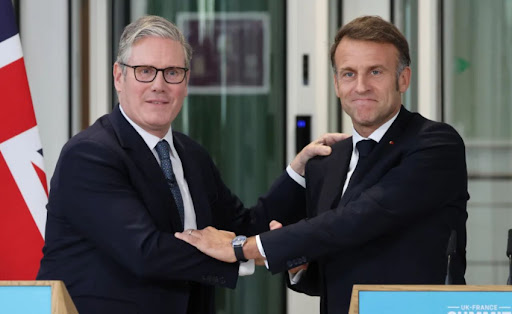
Ali Rezvanpour, in an interview with the Strategic Council on Foreign Relations’ website, noted that according to the UK Ministry of Defense, Prime Minister Keir Starmer and French President Emmanuel Macron agreed to deepen their nuclear cooperation and enhance coordination on nuclear deterrence. This agreement, under the Lancaster House Treaty (2010), strengthens a new “industrial alliance.” The latest declaration emphasizes for the first time that the two countries’ independent yet interoperable nuclear deterrents will jointly respond to any “severe threat against Europe.” Paris and London also pledged to increase production of Storm Shadow cruise missiles and develop their replacements.
Starmer, citing rising nuclear threats, cyberattacks, and war in Europe—particularly the Russia-Ukraine conflict—described this cooperation as vital for Europe’s security. He emphasized that Britain and France, as close NATO partners, would utilize their combined strength to enhance defense capabilities for decades. The agreement not only secures both nations but also supports thousands of jobs in the UK and enhances Europe’s role in deterring escalating threats.
Northwood Declaration: A Pledge for Joint Nuclear Response
Ali Rezvanpour described the signing of the “Northwood Declaration” as a milestone in UK-France defense relations. He stated, “This pact, which ensures both nations’ commitment to a joint nuclear response against threats to their vital interests, sends a firm message to potential adversaries.” From the perspective of the senior European analyst, “This agreement shows that Britain and France, as Europe’s only nuclear powers, are ready to defend the continent in full coordination.”
He emphasized: “This pact is framed within the Lancaster House Treaty (2010) and elevates industrial and military cooperation between the two countries to unprecedented levels.” He added: “Macron, referencing geopolitical shifts—especially the Russia-Ukraine war—sees this cooperation as necessary to reduce Europe’s reliance on the U.S. nuclear umbrella.”
Rezvanpour believes the Northwood Declaration not only strengthens nuclear deterrence but also signals to adversaries that any aggression against one nation will trigger a response from both.
Addressing Emerging Threats
Ali Rezvanpour noted: “The rise in nuclear threats, cyberattacks, and conventional conflicts in Europe has been the primary motivation for this agreement.” The European expert recalled Starmer’s remarks, which cited the Russia-Ukraine war as an example of such threats, causing widespread concern among European nations. He explained: “The UK’s purchase of 12 F-35A nuclear-capable fighter jets is the biggest step in strengthening its nuclear posture in a generation. These jets, capable of carrying nuclear bombs, will be stationed in some NATO countries, reinforcing the alliance’s deterrence.”
Rezvanpour stressed: “This move responds to pressure from U.S. President Donald Trump for European defense self-sufficiency, as he repeatedly urged European nations to increase defense spending.” The senior European analyst added: “Trump even threatened to leave NATO, potentially, forcing Europe to reconsider its defense strategies.” He argued that Britain and France, as leading nuclear powers, have taken responsibility for steering this transformation.
Lancaster House 2.0: An Industrial and Military Alliance for the Future
Ali Rezvanpour views UK-France cooperation under “Lancaster House 2.0” as a strategic project modernizing their defense collaboration. He explained: “The two nations aim to boost Storm Shadow cruise missile production and replenish their weapons stockpiles.” In his view, “The launch of a joint hybrid force, capable of operating in cyber, space, and land domains, demonstrates their resolve to build large-scale combined combat power.”
Rezvanpour sees this force as complementing the existing Joint Expeditionary Force, positioning it at the forefront of the “Coalition of the Will” planning. The senior European expert also highlighted the two nations’ agreement to develop next-generation Deep Strike and air-to-air missiles as part of their joint military enhancement strategy. He emphasized: “This cooperation not only complements NATO’s role but also strengthens the UK’s engagement with the EU on security and defense.” He believes: “These measures make Europe more resilient against deep security threats, particularly from Russia.”
Brexit’s Legacy and the Need for Trust-Building
Ali Rezvanpour pointed to challenges in this cooperation, stating: “Post-Brexit tensions, disputes over fishing rights, and the submarine deal with Australia have severely damaged trust between Britain and France.” He sees Macron’s visit to the UK—the first by a French president since 2008—as an effort to mend ties. According to him, Macron previously called Brexit the result of “lies and false promises,” a sentiment that still shadows bilateral relations.
Rezvanpour added: “The success of this pact hinges on the two nations’ ability to overcome past differences and forge a cohesive alliance against shared threats.” The senior European analyst believes “cooperation with Germany and other European partners is also essential to strengthening the Euro-Atlantic security framework.”
Support for Ukraine and NATO’s Role
Rezvanpour also noted the establishment of a new Ukraine support coalition headquarters in Paris, announced during a virtual “Coalition of the Will” meeting with Ukrainian President Volodymyr Zelensky. He sees this as evidence of Britain and France’s commitment to backing Ukraine against Russian military aggression.
According to the European analyst, “Strengthening nuclear deterrence and boosting UK-France military capabilities sends a clear message to Moscow that Europe will remain united against military expansionism.” Rezvanpour also cited NATO Secretary-General Mark Rutte, who called the agreement a “strong UK contribution to NATO.” He believes deploying F-35A jets in NATO countries will bolster the alliance’s deterrence against hostile threats.









0 Comments