The Strategic Significance of Syria-Turkey-Azerbaijan Gas Project

2025/08/19 | Economy, interview, Top News

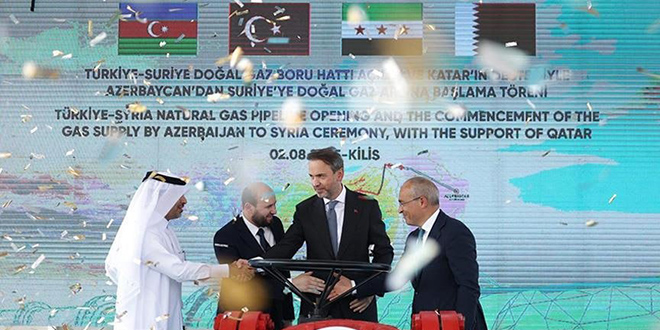
Strategic Council Online - Interview: A West Asia affairs analyst stated: The Syria-Turkey-Azerbaijan gas project goes beyond simple energy cooperation and must be evaluated within the context of regional power competition, efforts to redefine the political order in Syria, and the strengthening of the Turkish-Qatari-Azerbaijani axis in West Asia. An order whose future will largely depend on the stability of the Damascus government and Turkey's ability to manage security, economic, and geopolitical crises simultaneously. At a time when Syria is still grappling with extensive infrastructure problems and an energy crisis, the inauguration of the gas pipeline from Azerbaijan to Syria via Turkey, with Qatar's financial support, has drawn the attention of regional analysts. This project, which in its first phase will transfer 3.4 million cubic meters of gas per day and will eventually reach a capacity of 6 million cubic meters per day, could add approximately 750 megawatts to Syria's electricity generation capacity.

Consolidating a Turkey-Centric Security Order in Syria

Ardeshir Pashang, in an interview with the Foreign Relations Strategic Council website, stated: The Azerbaijan-Syria gas transfer project is set to become operational. At the same time, the region still faces instability, the continuation of Turkey’s war with Syrian Kurds, and security conflicts. In his view, “Turkey is on the path of trying to consolidate a new security order in Syria, which is based on strengthening the nascent government of Ahmad al-Shara in Damascus.” According to the West Asia affairs analyst, “Ankara sees this government as its potential ally; a government that has strategic convergence with Turkey and can simultaneously prevent the realization of the scenario of forming an autonomous Kurdish region.”

This analyst emphasizes that “Turkey, by employing diplomatic, security, and economic tools, is seeking to establish a desired order in Syria.” From his perspective, “The recent gas project is part of this grand strategy, which allows Ankara to deepen its influence by strengthening energy infrastructure and economic stability in Syria, while simultaneously preventing rival actors from gaining power on Syrian soil.”

Azerbaijan’s Multifaceted Role in West Asia

Ardeshir Pashang further points to the role of the Republic of Azerbaijan, seeing it as part of Baku’s scenario for expanding geopolitical influence. According to him, “Although Azerbaijan is a small country with limited capabilities, it strives to elevate its status beyond the South Caucasus level using its energy resources. This country also benefits from military and security cooperation with the Israeli regime and the United States and leverages the discourse of Pan-Turkism in the region.”

He notes that “part of Azerbaijan’s policies could be directed towards Iran, in that this country, if possible, will seek to prepare identity tools to increase its influence in the Turkic-speaking regions of Iran.” However, the West Asia affairs analyst reminds that “Azerbaijan’s structural limitations prevent it from becoming a regional power with lasting influence.”

Turkey in Search of Regional Leadership

Analyzing Turkey’s long-term goals, Pashang focuses on Recep Tayyip Erdoğan’s “Neo-Ottomanism” project. In his opinion, “Erdoğan, by combining Turkish cultural elements and the Islamic discourse of the Justice and Development Party, seeks to revive a kind of regional leadership that encompasses both the Caucasus, West Asia, and Central Asia.”

This analyst refers to Turkey’s pivotal role in supporting Azerbaijan in the Karabakh war and efforts to potentially create the Zangezur corridor, evaluating it as being in line with the cultural-identity linkage of Turks in the region. In the Islamic dimension, Turkey has also tried to present its Muslim Brotherhood discourse as a model for other Muslim countries. However, Pashang acknowledges that “the experience of the Arab Spring has questioned the feasibility of achieving this goal. However, Ankara still pursues this project seriously and employs security and diplomatic solutions simultaneously to reduce its vulnerability concerning the Kurds.”

Qatar: A Small Player with Big Ambitions

From another perspective, Ardeshir Pashang, analyzing Qatar’s role in this equation, says: “Qatar, as a country with small territory, has been able to play an effective role in regional political and security processes through energy wealth, media networks, and active diplomacy.” According to him, “Qatar, relying on its strategic relations with the United States and Turkey and even de facto with the Israeli regime, has been able to implement a balanced and multifaceted policy in the region.”

This analyst believes that “Qatar, on one hand, seeks de-escalation with Saudi Arabia and establishing a balance with Iran, and on the other hand, acts in projects like the Syria gas pipeline in such a way that both Turkey’s interests are secured and it benefits from its position as a facilitator and financial provider.” In his view, “Qatar has managed to form a kind of flexible and diverse coalition with actors who are not necessarily compatible with each other.”

Consolidating Power in Damascus: The Common Goal of Turkey and Allies

Ardeshir Pashang emphasizes that “increasing energy capacity in Syria, alongside the gradual rebuilding of its shattered economy, could lead to the consolidation of Ahmad al-Shara’s government.” Because he believes: “This process is not only vital for the Syrian government, but Turkey also benefits from this stability, as it can consolidate its position as a guiding power and the spiritual father of Syria’s post-Assad new order.”

From the perspective of this West Asia affairs analyst, “The possible cooperation of Syrian Kurds with the Turkish government, about which rumors have recently been published, is a sign of the profound impact of recent geopolitical changes. In a situation where Western support for the Kurds has diminished and regional equations have changed in Turkey’s favor, it is possible that the Kurds, for survival, may also lean towards an agreement with Ankara.”

Overall, Ardeshir Pashang’s analysis of the recent gas project indicates that “this plan goes beyond simple energy cooperation and must be evaluated within the context of regional power competition, efforts to redefine the political order in Syria, and the strengthening of the Turkish-Qatari-Azerbaijani axis in West Asia. An order whose future will largely depend on the stability of the Damascus government and Turkey’s ability to manage security, economic, and geopolitical crises simultaneously.”
0 Comments

LATEST CONTENT

Consequences of Declining Trust in the Judiciary in Europe

SCFRonline – Opinion: The increase in public distrust of the French judicial system, which in recent surveys has reached approximately two-thirds of citizens, should be analyzed within a framework broader than temporary dissatisfaction or an emotional reaction to a particular criminal case.

Iran’s Potential Levers of Power

SCFRonline– Opinion: Iran’s geopolitical power is not limited solely to oil and the Strait of Hormuz; the unintended emergence of disruptions in the future global food and energy security chains can also demonstrate Iran’s strategic importance.

The Inseparability of the Lebanese Front from the Axis of Resistance

SCFR Online–Opinion: By providing an extensive network of social, healthcare, educational, and post-war reconstruction services, Hezbollah has established a strong social base for itself among Lebanon’s Shiites and Sunnis, and even beyond that, among other segments of Lebanese society, including Christians. Hezbollah has never been an external actor imposed upon Lebanon; rather, it is a phenomenon fundamentally born out of the occupation and crimes of the Zionist regime and itself influenced by popular resistance.

The Increasing Efforts of the Zionist Regime to Redefine Borders and the Regional Order and Its Consequences

SCFR Online– Opinion: Security and military developments in the region over recent months indicate that the ongoing crises and wars in Gaza, southern Lebanon, and parts of Syrian territory encompass broader dimensions of geopolitical and geostrategic transformations. In this context, the increased military presence and control of the Zionist regime over parts of the territories of these areas, along with proposals regarding the creation of buffer zones or even the expansion of security borders, have raised serious questions about the future of the regional order and its consequences for the countries of West Asia.

Loading

Últimas publicaciones

Consequences of Declining Trust in the Judiciary in Europe

SCFRonline – Opinion: The increase in public distrust of the French judicial system, which in recent surveys has reached approximately two-thirds of citizens, should be analyzed within a framework broader than temporary dissatisfaction or an emotional reaction to a particular criminal case.

Iran’s Potential Levers of Power

SCFRonline– Opinion: Iran’s geopolitical power is not limited solely to oil and the Strait of Hormuz; the unintended emergence of disruptions in the future global food and energy security chains can also demonstrate Iran’s strategic importance.

The Inseparability of the Lebanese Front from the Axis of Resistance

SCFR Online–Opinion: By providing an extensive network of social, healthcare, educational, and post-war reconstruction services, Hezbollah has established a strong social base for itself among Lebanon’s Shiites and Sunnis, and even beyond that, among other segments of Lebanese society, including Christians. Hezbollah has never been an external actor imposed upon Lebanon; rather, it is a phenomenon fundamentally born out of the occupation and crimes of the Zionist regime and itself influenced by popular resistance.

The Increasing Efforts of the Zionist Regime to Redefine Borders and the Regional Order and Its Consequences

SCFR Online– Opinion: Security and military developments in the region over recent months indicate that the ongoing crises and wars in Gaza, southern Lebanon, and parts of Syrian territory encompass broader dimensions of geopolitical and geostrategic transformations. In this context, the increased military presence and control of the Zionist regime over parts of the territories of these areas, along with proposals regarding the creation of buffer zones or even the expansion of security borders, have raised serious questions about the future of the regional order and its consequences for the countries of West Asia.

Loading

DERNIER CONTENU

Consequences of Declining Trust in the Judiciary in Europe

SCFRonline – Opinion: The increase in public distrust of the French judicial system, which in recent surveys has reached approximately two-thirds of citizens, should be analyzed within a framework broader than temporary dissatisfaction or an emotional reaction to a particular criminal case.

Iran’s Potential Levers of Power

SCFRonline– Opinion: Iran’s geopolitical power is not limited solely to oil and the Strait of Hormuz; the unintended emergence of disruptions in the future global food and energy security chains can also demonstrate Iran’s strategic importance.

The Inseparability of the Lebanese Front from the Axis of Resistance

SCFR Online–Opinion: By providing an extensive network of social, healthcare, educational, and post-war reconstruction services, Hezbollah has established a strong social base for itself among Lebanon’s Shiites and Sunnis, and even beyond that, among other segments of Lebanese society, including Christians. Hezbollah has never been an external actor imposed upon Lebanon; rather, it is a phenomenon fundamentally born out of the occupation and crimes of the Zionist regime and itself influenced by popular resistance.

The Increasing Efforts of the Zionist Regime to Redefine Borders and the Regional Order and Its Consequences

SCFR Online– Opinion: Security and military developments in the region over recent months indicate that the ongoing crises and wars in Gaza, southern Lebanon, and parts of Syrian territory encompass broader dimensions of geopolitical and geostrategic transformations. In this context, the increased military presence and control of the Zionist regime over parts of the territories of these areas, along with proposals regarding the creation of buffer zones or even the expansion of security borders, have raised serious questions about the future of the regional order and its consequences for the countries of West Asia.

Loading

DERNIER CONTENU

Consequences of Declining Trust in the Judiciary in Europe

SCFRonline – Opinion: The increase in public distrust of the French judicial system, which in recent surveys has reached approximately two-thirds of citizens, should be analyzed within a framework broader than temporary dissatisfaction or an emotional reaction to a particular criminal case.

Iran’s Potential Levers of Power

SCFRonline– Opinion: Iran’s geopolitical power is not limited solely to oil and the Strait of Hormuz; the unintended emergence of disruptions in the future global food and energy security chains can also demonstrate Iran’s strategic importance.

The Inseparability of the Lebanese Front from the Axis of Resistance

SCFR Online–Opinion: By providing an extensive network of social, healthcare, educational, and post-war reconstruction services, Hezbollah has established a strong social base for itself among Lebanon’s Shiites and Sunnis, and even beyond that, among other segments of Lebanese society, including Christians. Hezbollah has never been an external actor imposed upon Lebanon; rather, it is a phenomenon fundamentally born out of the occupation and crimes of the Zionist regime and itself influenced by popular resistance.

The Increasing Efforts of the Zionist Regime to Redefine Borders and the Regional Order and Its Consequences

SCFR Online– Opinion: Security and military developments in the region over recent months indicate that the ongoing crises and wars in Gaza, southern Lebanon, and parts of Syrian territory encompass broader dimensions of geopolitical and geostrategic transformations. In this context, the increased military presence and control of the Zionist regime over parts of the territories of these areas, along with proposals regarding the creation of buffer zones or even the expansion of security borders, have raised serious questions about the future of the regional order and its consequences for the countries of West Asia.

Loading

DERNIER CONTENU

Consequences of Declining Trust in the Judiciary in Europe

SCFRonline – Opinion: The increase in public distrust of the French judicial system, which in recent surveys has reached approximately two-thirds of citizens, should be analyzed within a framework broader than temporary dissatisfaction or an emotional reaction to a particular criminal case.

Iran’s Potential Levers of Power

SCFRonline– Opinion: Iran’s geopolitical power is not limited solely to oil and the Strait of Hormuz; the unintended emergence of disruptions in the future global food and energy security chains can also demonstrate Iran’s strategic importance.

The Inseparability of the Lebanese Front from the Axis of Resistance

SCFR Online–Opinion: By providing an extensive network of social, healthcare, educational, and post-war reconstruction services, Hezbollah has established a strong social base for itself among Lebanon’s Shiites and Sunnis, and even beyond that, among other segments of Lebanese society, including Christians. Hezbollah has never been an external actor imposed upon Lebanon; rather, it is a phenomenon fundamentally born out of the occupation and crimes of the Zionist regime and itself influenced by popular resistance.

The Increasing Efforts of the Zionist Regime to Redefine Borders and the Regional Order and Its Consequences

SCFR Online– Opinion: Security and military developments in the region over recent months indicate that the ongoing crises and wars in Gaza, southern Lebanon, and parts of Syrian territory encompass broader dimensions of geopolitical and geostrategic transformations. In this context, the increased military presence and control of the Zionist regime over parts of the territories of these areas, along with proposals regarding the creation of buffer zones or even the expansion of security borders, have raised serious questions about the future of the regional order and its consequences for the countries of West Asia.

Loading