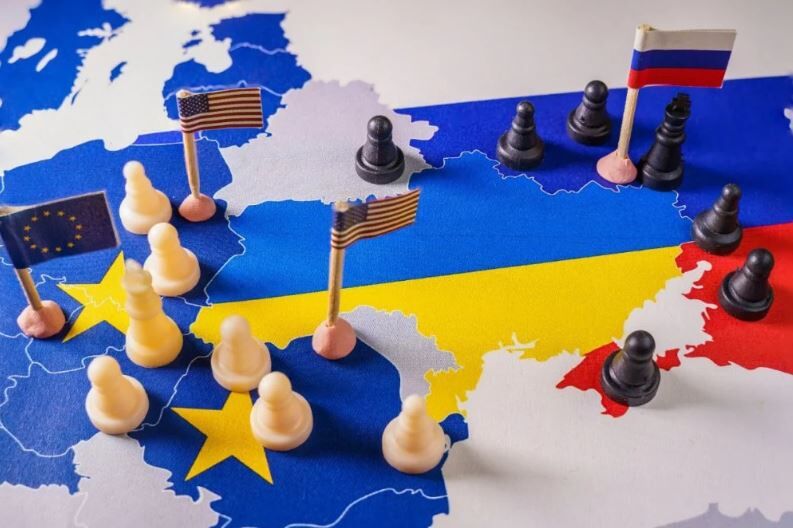
Analysis: Ongoing Hybrid Warfare Between the West and Russia in the Ukraine War

Online Strategic Council - Interview: A foreign policy expert stated that a direct confrontation and war between Russia and the West under the shadow of the Ukraine war appears unlikely. He noted that the conflicting parties have placed the method of hybrid warfare on the agenda at the highest level with the support of their allies. The reality is that a world war is underway, and many countries are directly and indirectly involved in it, but this is not a nuclear war.

Amirali Abolfath, in an interview with the website of the Strategic Council on Foreign Relations, stated: “The West has decided to prevent Russia’s victory in the Ukraine war under any circumstances except for direct confrontation and war with the Russians. Direct war with Russia is the West’s red line. Still, aside from that, the West has brought to the field everything within its power and capacity, both economically by intensifying sanctions against Russia and imposing tariffs on its allies, and militarily by providing financial and armament support to Ukraine, as well as conducting proxy operations.”


Avoiding direct war in Ukraine, the Red Line of the West and Russia

The foreign policy expert continued: “Of course, all the West’s actions are taken while they are still careful not to let this procedure lead to direct confrontation and war with Russia. Although Russia also has no desire for direct war with the West.”

Abolfath, stated that “the military power and economic capacity of the West on paper and based on statistics and figures are much stronger than the Russian army and economic capacity,” and added: “Russia’s nuclear capability has prevented the war between the West and Russia from turning into a direct confrontation. If Russia did not have nuclear capability, it might have suffered the fate of countries like Iraq or Yugoslavia. Therefore, Russia and the West are currently careful about their actions and positions regarding the Ukraine war to prevent a direct war from occurring.”

Abolfath explained: “During the Ukraine war, the West and Russia are gauging each other’s resolve and will. The fact that the Americans provide long-range missiles to Ukraine to target Russian positions deep inside its territory indicates this issue.”

He added: “The fact that Russian drones enter Polish airspace or Russian aircraft violate the airspace of European countries indicates that Russia is also constantly testing the West’s capability, especially NATO.”

This expert, stating that “direct confrontation and war between Russia and the West seems unlikely,” said: “For now, the warring parties have placed the method of hybrid warfare on the agenda at the highest level with the support of their allies. The reality is that a world war is underway, and many countries are directly and indirectly involved in it, but this is not a nuclear war.”

Abolfath, also in response to the question of whether economic or military parameters will ultimately determine the end of this war, explained: “Ultimately, neither military parameters nor economic parameters, but rather political parameters, will be effective in ending the war. The parties, in the end, are forced to find a political solution to end this war.”

This foreign policy expert, referring to the fact that “the West cannot defeat Russia with economic tools,” said: “Russia is a superpower in various economic fields such as energy, agriculture, and minerals, including ores. A significant portion of the world’s most important ores are located in Russian territory, and another part is in Ukrainian territory. During the current war, these areas are under Russian control. Furthermore, Russia enjoys a kind of coalition with China, Iran, and recently India, which tips the balance in favor of Moscow.”

He continued: “The West hopes that Russia, due to the war becoming prolonged and attritional over a period of 5 or 10 years, will be forced to accept an end to the war or peace.”

Abolfath, stating that “there is a difference of opinion between the US and Europe regarding how the Ukraine war should end,” said: “The Americans emphasize ending the war and peace and want at least that Russia does not attempt further advances into Ukrainian territory. Meanwhile, Europeans believe that borders should return to pre-war conditions, but the Americans do not really believe in this. Current conditions also indicate that Putin’s acceptance of ending the war due to economic parameters and issues is unlikely.”

This expert, also in response to the question of what the outcome of the Ukraine war will be, said: “A clear and precise prediction cannot be provided about this war, because ending the war or peace is not in Ukraine’s hands, and the West, in the current situation, does not allow Ukraine to have peace. Therefore, Ukraine is forced to continue the war as long as the West asks it to.”

He continued: “Moreover, the Russian front has not yet been weakened, and the West also has high resilience militarily and economically, and based on this, the parties can continue this war for years.”

Abolfath, stating that “the Americans have gained good economic income from the Ukraine war due to various issues,” said: “Therefore, the Americans wanting to end the war and lose their sources of income weakens the probability of peace. While the Europeans have borne heavy costs during this war, the Americans earned a good income from selling weapons to Europe. In fact, the Americans view the Ukraine war as a business.”

The expert said, “All of these events mean that there is no prospect of achieving peace. Of course, there is a possibility that the battlefront will erode, and in some areas, the situation will remain unchanged, becoming frozen. Under these conditions, both sides, particularly Russia, will generally refrain from advancing and conducting large-scale operations, except in specific cases. Russia has so far captured important areas of Ukraine, and these results, at least until today, are probably sufficient for Moscow.”

He added: “It seems that in the future, a line of contact will be established between the parties, and no further territorial changes or fall of large cities will occur.”


0 Comments

LATEST CONTENT

Iran’s Potential Levers of Power

SCFRonline– Opinion: Iran’s geopolitical power is not limited solely to oil and the Strait of Hormuz; the unintended emergence of disruptions in the future global food and energy security chains can also demonstrate Iran’s strategic importance.

The Inseparability of the Lebanese Front from the Axis of Resistance

SCFR Online–Opinion: By providing an extensive network of social, healthcare, educational, and post-war reconstruction services, Hezbollah has established a strong social base for itself among Lebanon’s Shiites and Sunnis, and even beyond that, among other segments of Lebanese society, including Christians. Hezbollah has never been an external actor imposed upon Lebanon; rather, it is a phenomenon fundamentally born out of the occupation and crimes of the Zionist regime and itself influenced by popular resistance.

The Increasing Efforts of the Zionist Regime to Redefine Borders and the Regional Order and Its Consequences

SCFR Online– Opinion: Security and military developments in the region over recent months indicate that the ongoing crises and wars in Gaza, southern Lebanon, and parts of Syrian territory encompass broader dimensions of geopolitical and geostrategic transformations. In this context, the increased military presence and control of the Zionist regime over parts of the territories of these areas, along with proposals regarding the creation of buffer zones or even the expansion of security borders, have raised serious questions about the future of the regional order and its consequences for the countries of West Asia.

The Components of Iran’s Deterrence Power

SCFR Online – Opinion: At a time when regional security equations have reached a sensitive stage under the influence of Iran’s strategic confrontation with the United States and the Zionist regime, the question of the nature of Tehran’s defensive power has gained greater significance than ever before. While Washington and Tel Aviv rely on their technological superiority, the Islamic Republic of Iran has presented a model of deterrence that extends beyond the material calculations of the world’s classical militaries. This power, rooted in the connection between “the field” and “the people,” has not only altered the balance of power in recent conflicts but has also disrupted adversaries’ calculations when confronting Iran’s strategic depth.

Loading

Últimas publicaciones

Iran’s Potential Levers of Power

SCFRonline– Opinion: Iran’s geopolitical power is not limited solely to oil and the Strait of Hormuz; the unintended emergence of disruptions in the future global food and energy security chains can also demonstrate Iran’s strategic importance.

The Inseparability of the Lebanese Front from the Axis of Resistance

SCFR Online–Opinion: By providing an extensive network of social, healthcare, educational, and post-war reconstruction services, Hezbollah has established a strong social base for itself among Lebanon’s Shiites and Sunnis, and even beyond that, among other segments of Lebanese society, including Christians. Hezbollah has never been an external actor imposed upon Lebanon; rather, it is a phenomenon fundamentally born out of the occupation and crimes of the Zionist regime and itself influenced by popular resistance.

The Increasing Efforts of the Zionist Regime to Redefine Borders and the Regional Order and Its Consequences

SCFR Online– Opinion: Security and military developments in the region over recent months indicate that the ongoing crises and wars in Gaza, southern Lebanon, and parts of Syrian territory encompass broader dimensions of geopolitical and geostrategic transformations. In this context, the increased military presence and control of the Zionist regime over parts of the territories of these areas, along with proposals regarding the creation of buffer zones or even the expansion of security borders, have raised serious questions about the future of the regional order and its consequences for the countries of West Asia.

The Components of Iran’s Deterrence Power

SCFR Online – Opinion: At a time when regional security equations have reached a sensitive stage under the influence of Iran’s strategic confrontation with the United States and the Zionist regime, the question of the nature of Tehran’s defensive power has gained greater significance than ever before. While Washington and Tel Aviv rely on their technological superiority, the Islamic Republic of Iran has presented a model of deterrence that extends beyond the material calculations of the world’s classical militaries. This power, rooted in the connection between “the field” and “the people,” has not only altered the balance of power in recent conflicts but has also disrupted adversaries’ calculations when confronting Iran’s strategic depth.

Loading

DERNIER CONTENU

Iran’s Potential Levers of Power

SCFRonline– Opinion: Iran’s geopolitical power is not limited solely to oil and the Strait of Hormuz; the unintended emergence of disruptions in the future global food and energy security chains can also demonstrate Iran’s strategic importance.

The Inseparability of the Lebanese Front from the Axis of Resistance

SCFR Online–Opinion: By providing an extensive network of social, healthcare, educational, and post-war reconstruction services, Hezbollah has established a strong social base for itself among Lebanon’s Shiites and Sunnis, and even beyond that, among other segments of Lebanese society, including Christians. Hezbollah has never been an external actor imposed upon Lebanon; rather, it is a phenomenon fundamentally born out of the occupation and crimes of the Zionist regime and itself influenced by popular resistance.

The Increasing Efforts of the Zionist Regime to Redefine Borders and the Regional Order and Its Consequences

SCFR Online– Opinion: Security and military developments in the region over recent months indicate that the ongoing crises and wars in Gaza, southern Lebanon, and parts of Syrian territory encompass broader dimensions of geopolitical and geostrategic transformations. In this context, the increased military presence and control of the Zionist regime over parts of the territories of these areas, along with proposals regarding the creation of buffer zones or even the expansion of security borders, have raised serious questions about the future of the regional order and its consequences for the countries of West Asia.

The Components of Iran’s Deterrence Power

SCFR Online – Opinion: At a time when regional security equations have reached a sensitive stage under the influence of Iran’s strategic confrontation with the United States and the Zionist regime, the question of the nature of Tehran’s defensive power has gained greater significance than ever before. While Washington and Tel Aviv rely on their technological superiority, the Islamic Republic of Iran has presented a model of deterrence that extends beyond the material calculations of the world’s classical militaries. This power, rooted in the connection between “the field” and “the people,” has not only altered the balance of power in recent conflicts but has also disrupted adversaries’ calculations when confronting Iran’s strategic depth.

Loading

DERNIER CONTENU

Iran’s Potential Levers of Power

SCFRonline– Opinion: Iran’s geopolitical power is not limited solely to oil and the Strait of Hormuz; the unintended emergence of disruptions in the future global food and energy security chains can also demonstrate Iran’s strategic importance.

The Inseparability of the Lebanese Front from the Axis of Resistance

SCFR Online–Opinion: By providing an extensive network of social, healthcare, educational, and post-war reconstruction services, Hezbollah has established a strong social base for itself among Lebanon’s Shiites and Sunnis, and even beyond that, among other segments of Lebanese society, including Christians. Hezbollah has never been an external actor imposed upon Lebanon; rather, it is a phenomenon fundamentally born out of the occupation and crimes of the Zionist regime and itself influenced by popular resistance.

The Increasing Efforts of the Zionist Regime to Redefine Borders and the Regional Order and Its Consequences

SCFR Online– Opinion: Security and military developments in the region over recent months indicate that the ongoing crises and wars in Gaza, southern Lebanon, and parts of Syrian territory encompass broader dimensions of geopolitical and geostrategic transformations. In this context, the increased military presence and control of the Zionist regime over parts of the territories of these areas, along with proposals regarding the creation of buffer zones or even the expansion of security borders, have raised serious questions about the future of the regional order and its consequences for the countries of West Asia.

The Components of Iran’s Deterrence Power

SCFR Online – Opinion: At a time when regional security equations have reached a sensitive stage under the influence of Iran’s strategic confrontation with the United States and the Zionist regime, the question of the nature of Tehran’s defensive power has gained greater significance than ever before. While Washington and Tel Aviv rely on their technological superiority, the Islamic Republic of Iran has presented a model of deterrence that extends beyond the material calculations of the world’s classical militaries. This power, rooted in the connection between “the field” and “the people,” has not only altered the balance of power in recent conflicts but has also disrupted adversaries’ calculations when confronting Iran’s strategic depth.

Loading

DERNIER CONTENU

Iran’s Potential Levers of Power

SCFRonline– Opinion: Iran’s geopolitical power is not limited solely to oil and the Strait of Hormuz; the unintended emergence of disruptions in the future global food and energy security chains can also demonstrate Iran’s strategic importance.

The Inseparability of the Lebanese Front from the Axis of Resistance

SCFR Online–Opinion: By providing an extensive network of social, healthcare, educational, and post-war reconstruction services, Hezbollah has established a strong social base for itself among Lebanon’s Shiites and Sunnis, and even beyond that, among other segments of Lebanese society, including Christians. Hezbollah has never been an external actor imposed upon Lebanon; rather, it is a phenomenon fundamentally born out of the occupation and crimes of the Zionist regime and itself influenced by popular resistance.

The Increasing Efforts of the Zionist Regime to Redefine Borders and the Regional Order and Its Consequences

SCFR Online– Opinion: Security and military developments in the region over recent months indicate that the ongoing crises and wars in Gaza, southern Lebanon, and parts of Syrian territory encompass broader dimensions of geopolitical and geostrategic transformations. In this context, the increased military presence and control of the Zionist regime over parts of the territories of these areas, along with proposals regarding the creation of buffer zones or even the expansion of security borders, have raised serious questions about the future of the regional order and its consequences for the countries of West Asia.

The Components of Iran’s Deterrence Power

SCFR Online – Opinion: At a time when regional security equations have reached a sensitive stage under the influence of Iran’s strategic confrontation with the United States and the Zionist regime, the question of the nature of Tehran’s defensive power has gained greater significance than ever before. While Washington and Tel Aviv rely on their technological superiority, the Islamic Republic of Iran has presented a model of deterrence that extends beyond the material calculations of the world’s classical militaries. This power, rooted in the connection between “the field” and “the people,” has not only altered the balance of power in recent conflicts but has also disrupted adversaries’ calculations when confronting Iran’s strategic depth.

Loading



