
Hossein Mohammadnezhad – Cultural Affairs Expert
From the Battlefield to the Field of Meaning: The Transformation of Warfare’s Nature
Recent developments in international conflicts demonstrate that war is no longer defined merely in the hard, military domain but increasingly unfolds in the cognitive and perceptual sphere. Within this framework, the Iran-U.S. conflict should be regarded as a prominent example of a “battle of narratives,” in which controlling the minds and perceptions of public opinion has become as significant as dominating the military battlefield.
Analyses published by the Australian Strategic Policy Institute clearly indicate that Iran has performed beyond expectations in this domain, succeeding in disseminating its narratives on a broad scale by utilizing simple yet effective tools. This transformation reflects a shift in the nature of power within the international system, wherein the ability to shape perceptions has become a vital source of power.
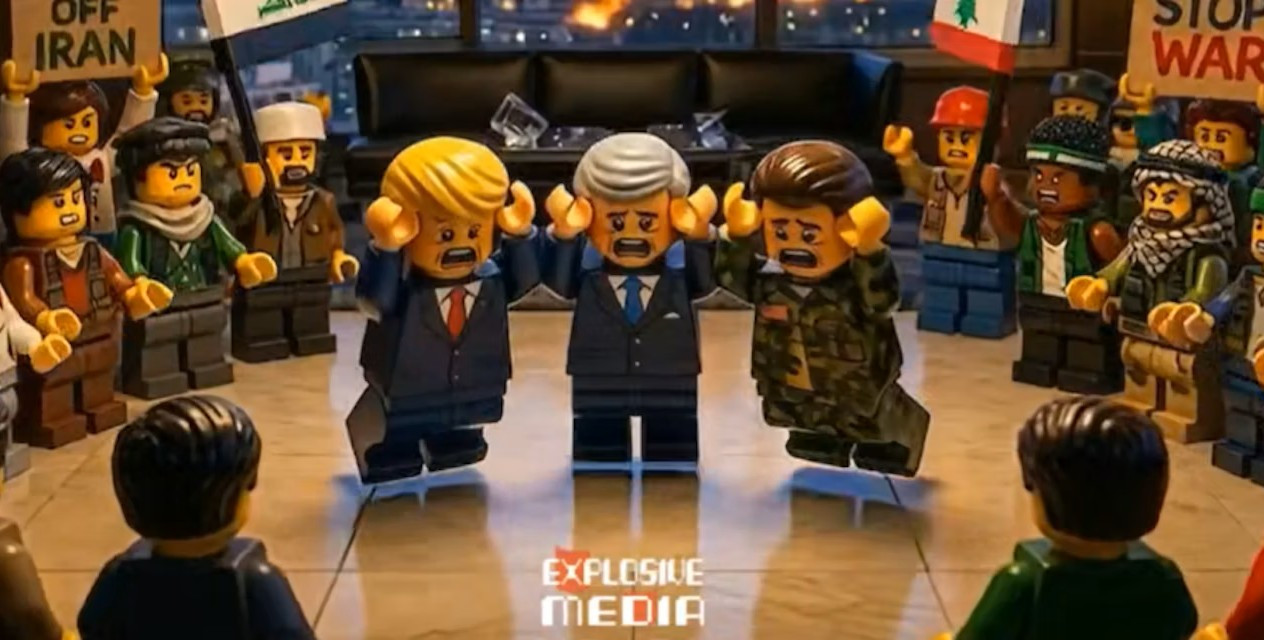
Within this framework, memes—as seemingly simple yet profoundly impactful tools—have become one of the most important instruments of cognitive warfare. These tools, by combining humor, symbolism, and condensed messages, are capable of conveying complex political concepts in a manner that is comprehensible and shareable for wide audiences.
Meme-Making as a Tool of Public Diplomacy
One notable feature of this battle has been the active role of official institutions, particularly Iranian embassies, in producing and disseminating memes. This approach signifies an important transformation in public diplomacy, wherein the boundary between formal and informal communication has been largely erased.
The memes produced—particularly those designed using Lego characters—have been able to rapidly go viral in cyberspace and attract the attention of global audiences. These memes, by leveraging the universal language of humor and imagery, have conveyed political messages in a manner that is not only comprehensible but also engaging and shareable.
Unlike traditional approaches to public diplomacy that rely on official statements and diplomatic speeches, this form of communication engages directly with the general public and consequently achieves greater impact. This transformation indicates that in the age of social media, soft power is no longer produced solely through formal institutions but is shaped through interaction with digital culture.
Superiority in the Battle of Narratives: Why Iran Performed More Successfully
Analysis of both sides’ performance in this battle indicates that Iran has been able to leverage several key advantages: First, a precise understanding of the logic of cyberspace. While many Western actors still rely on traditional communication patterns, Iran has succeeded in transmitting its messages more effectively by utilizing informal and creative formats.
Second, the use of simple yet effective narratives. Memes, by reducing political complexities to images and short messages, enable the rapid and widespread transmission of narratives. This feature is particularly significant in conditions where audience attention is limited.
Third, the utilization of humor and satire, which can convey political messages without triggering psychological resistance in the audience. This approach has enabled Iran to maintain an effective presence even in media environments traditionally dominated by the West.
In contrast, the United States and its allies have, in many instances, been unable to compete effectively with this form of communication. Dependence on formal frameworks and institutional constraints has prevented these actors from responding to developments in cyberspace with the necessary speed and flexibility.
Geopolitical Consequences: From Hard Power to Perceptual Power
Superiority in the battle of narratives is not merely a media success but carries broad geopolitical consequences. In a world where public opinion plays an increasingly significant role in shaping foreign policy, the ability to influence such opinion has become a strategic tool.
Viral memes—particularly those produced by official institutions—can directly affect public perception of a conflict and, consequently, alter the political decision-making environment. This matter gains particular significance in democratic societies where politicians are accountable to public opinion. Within this framework, the battle of narratives must be considered an inseparable component of modern warfare. This battle not only influences the legitimacy of military actions but can also affect the ultimate outcomes of a conflict.
Iran’s performance in this domain demonstrates a profound understanding of transformations in the communication sphere and intelligent utilization thereof. This experience contains an important lesson for other actors as well: in the digital age, neglecting the battle of narratives can lead to the loss of strategic superiority.
This text was translated using artificial intelligence and may contain errors. If you notice a clear error that makes the text incomprehensible, please inform the website editors.









0 Comments