Trump’s Trip to India; Pitched for Elections with Little Achievement

2020/03/07 | Note, Politics, top news

Strategic Council Online: In new US documents, India has been mentioned to be part of the Pacific in order to lessen China's role in the region; so Washington seeks to highlight New Delhi's role in order to pit India against China on the one hand and contain Pakistan on the other. Amir Ali Abolfatah – Experts on American Affairs

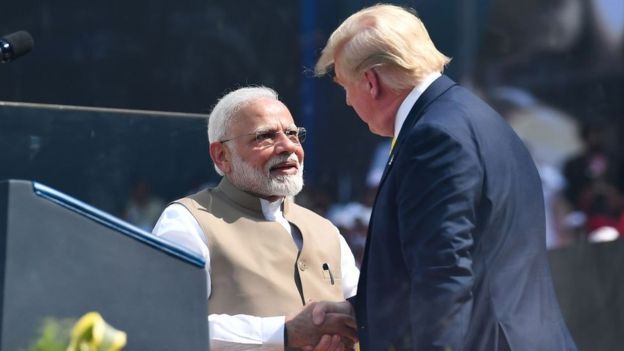
US President Donald Trump arrived in New Delhi last Monday on his first official visit to India; a trip that despite Trump’s efforts to show it was important did not bear much fruit for Washington.

It should be said on the significance of this trip that India is an important country for the United States and has a billion-dollar market. India has also recently become the world’s fifth-biggest power, surpassing Britain and France. It has great potential for economic and trade cooperation.  Meanwhile, India can play a balancing role against China; a country the US considers an immediate and significant threat. Indeed, the United States seeks to harness China using all its capabilities, and one of its tools is to strengthen India’s regional and international role versus China.

In new US documents, India has been mentioned to be part of Pacific to lessen China’s role in the region; so Washington seeks to underline New Delhi’s role to pit India against China on the one hand and contain Pakistan on the other.

This is while for many years Pakistan had been the US security priority and Washington pursued Islamabad’s demands and aspirations. However, since Trump entered the White House, the US has adopted a critical attitude towards Pakistan and regarded it as a country supporting terrorists and extremists. Trump has also repeatedly threatened to cut off aid to Islamabad. Along with it, during Trump’s visit, there was talk on cooperation with India against terrorism, which could also beef up pressure on Pakistan.

However, it remains to be able to assess how effective these plans and orientations are and whether they can contain what India and the US call extremism. In the meantime, the US is also very important to India and has great potential for New Delhi. Moreover, the visit is of importance to both sides from other dimensions; first, India can enjoy Washington’s economic cooperation in the face of US rivalry against China and the US dependence on Pakistan’s politics may be reduced, too.

It should be noted, however, that as Donald Trump and his advisers proclaimed before paying the visit to India that there would be a fundamental breakthrough in the bilateral relations; we did not see any particular development. At the same time, despite Mr Narendra Modi’s widespread and unprecedented welcome rendered to Trump, the outcomes of the visit were not as good as the publicity launched before the trip showed.

No trade deal was signed during Trump’s visit to India, promising it would happen after the 2020 election; whether that deal could be reached is questionable.

The visit included an arms deal that is insignificant in proportion to the two countries’ share of the arms market; a $3 billion deal is not a significant figure for the United States, which is one of the world’s largest arms exporters, and India, one of the largest arms buyers.

This is while the figures released during US officials visits to Arab countries or vice versa are very high, reaching $110 billion during Trump’s trip to Riyadh.

So it can be said that the trip was not practically a remarkable achievement, yet it was politically and pragmatically important for Trump. Trump’s widespread welcome in Delhi and the use of the podium at the Motera Cricket Stadium in Ahmedabad, India, were as if he was speaking at an election rally.
0 Comments

Submit a Comment

Your email address will not be published. Required fields are marked *

LATEST CONTENT

The Impact of West Asian Developments on the Ukraine War

SCFR Online – Note: Vladimir Putin, President of Russia, recently announced—more than four years after the commencement of military aggression against Ukraine—that he believes the conflict between Russia and Ukraine is drawing to a close.

Temporary China–U.S. Trade Truce in the Shadow of Fundamental Distrust

SCFR Online – Opinion: The recent visit of the President of the United States to China is significant from various aspects; because China is recognized as the world’s second-largest economic power and a growing economy. The Chinese are also advancing in various fields, including the space sector, artificial intelligence, and military industries; to the extent that in the military sector, whereas they previously lacked an aircraft carrier, they now possess their third aircraft carrier. On the other hand, the United States, as a superpower, has always regarded China as its rival and continues to view it as such today.

Iran’s Success in the Narrative Battle in Cyberspace

SCFR Online – Opinion: In the war between Iran and the United States, the main battlefield was not defined solely in the military domain; rather, the battle of narratives in cyberspace—particularly through memes—reached a decisive level.

The Global Energy Shock Situation and Future Scenarios

SCFR Online – Opinion: Only one month after the beginning of the Ramadan War, maritime traffic in the Strait of Hormuz decreased dramatically, with Bloomberg announcing a reduction of 103 vessels; Brent oil prices rose by more than 50 percent, and gasoline prices in the United States increased by 31.4 percent. Additionally, benchmark gas prices in Europe showed a 73.4 percent increase.

Loading

Últimas publicaciones

The Impact of West Asian Developments on the Ukraine War

SCFR Online – Note: Vladimir Putin, President of Russia, recently announced—more than four years after the commencement of military aggression against Ukraine—that he believes the conflict between Russia and Ukraine is drawing to a close.

Temporary China–U.S. Trade Truce in the Shadow of Fundamental Distrust

SCFR Online – Opinion: The recent visit of the President of the United States to China is significant from various aspects; because China is recognized as the world’s second-largest economic power and a growing economy. The Chinese are also advancing in various fields, including the space sector, artificial intelligence, and military industries; to the extent that in the military sector, whereas they previously lacked an aircraft carrier, they now possess their third aircraft carrier. On the other hand, the United States, as a superpower, has always regarded China as its rival and continues to view it as such today.

Iran’s Success in the Narrative Battle in Cyberspace

SCFR Online – Opinion: In the war between Iran and the United States, the main battlefield was not defined solely in the military domain; rather, the battle of narratives in cyberspace—particularly through memes—reached a decisive level.

The Global Energy Shock Situation and Future Scenarios

SCFR Online – Opinion: Only one month after the beginning of the Ramadan War, maritime traffic in the Strait of Hormuz decreased dramatically, with Bloomberg announcing a reduction of 103 vessels; Brent oil prices rose by more than 50 percent, and gasoline prices in the United States increased by 31.4 percent. Additionally, benchmark gas prices in Europe showed a 73.4 percent increase.

Loading

DERNIER CONTENU

The Impact of West Asian Developments on the Ukraine War

SCFR Online – Note: Vladimir Putin, President of Russia, recently announced—more than four years after the commencement of military aggression against Ukraine—that he believes the conflict between Russia and Ukraine is drawing to a close.

Temporary China–U.S. Trade Truce in the Shadow of Fundamental Distrust

SCFR Online – Opinion: The recent visit of the President of the United States to China is significant from various aspects; because China is recognized as the world’s second-largest economic power and a growing economy. The Chinese are also advancing in various fields, including the space sector, artificial intelligence, and military industries; to the extent that in the military sector, whereas they previously lacked an aircraft carrier, they now possess their third aircraft carrier. On the other hand, the United States, as a superpower, has always regarded China as its rival and continues to view it as such today.

Iran’s Success in the Narrative Battle in Cyberspace

SCFR Online – Opinion: In the war between Iran and the United States, the main battlefield was not defined solely in the military domain; rather, the battle of narratives in cyberspace—particularly through memes—reached a decisive level.

The Global Energy Shock Situation and Future Scenarios

SCFR Online – Opinion: Only one month after the beginning of the Ramadan War, maritime traffic in the Strait of Hormuz decreased dramatically, with Bloomberg announcing a reduction of 103 vessels; Brent oil prices rose by more than 50 percent, and gasoline prices in the United States increased by 31.4 percent. Additionally, benchmark gas prices in Europe showed a 73.4 percent increase.

Loading

DERNIER CONTENU

The Impact of West Asian Developments on the Ukraine War

SCFR Online – Note: Vladimir Putin, President of Russia, recently announced—more than four years after the commencement of military aggression against Ukraine—that he believes the conflict between Russia and Ukraine is drawing to a close.

Temporary China–U.S. Trade Truce in the Shadow of Fundamental Distrust

SCFR Online – Opinion: The recent visit of the President of the United States to China is significant from various aspects; because China is recognized as the world’s second-largest economic power and a growing economy. The Chinese are also advancing in various fields, including the space sector, artificial intelligence, and military industries; to the extent that in the military sector, whereas they previously lacked an aircraft carrier, they now possess their third aircraft carrier. On the other hand, the United States, as a superpower, has always regarded China as its rival and continues to view it as such today.

Iran’s Success in the Narrative Battle in Cyberspace

SCFR Online – Opinion: In the war between Iran and the United States, the main battlefield was not defined solely in the military domain; rather, the battle of narratives in cyberspace—particularly through memes—reached a decisive level.

The Global Energy Shock Situation and Future Scenarios

SCFR Online – Opinion: Only one month after the beginning of the Ramadan War, maritime traffic in the Strait of Hormuz decreased dramatically, with Bloomberg announcing a reduction of 103 vessels; Brent oil prices rose by more than 50 percent, and gasoline prices in the United States increased by 31.4 percent. Additionally, benchmark gas prices in Europe showed a 73.4 percent increase.

Loading

DERNIER CONTENU

The Impact of West Asian Developments on the Ukraine War

SCFR Online – Note: Vladimir Putin, President of Russia, recently announced—more than four years after the commencement of military aggression against Ukraine—that he believes the conflict between Russia and Ukraine is drawing to a close.

Temporary China–U.S. Trade Truce in the Shadow of Fundamental Distrust

SCFR Online – Opinion: The recent visit of the President of the United States to China is significant from various aspects; because China is recognized as the world’s second-largest economic power and a growing economy. The Chinese are also advancing in various fields, including the space sector, artificial intelligence, and military industries; to the extent that in the military sector, whereas they previously lacked an aircraft carrier, they now possess their third aircraft carrier. On the other hand, the United States, as a superpower, has always regarded China as its rival and continues to view it as such today.

Iran’s Success in the Narrative Battle in Cyberspace

SCFR Online – Opinion: In the war between Iran and the United States, the main battlefield was not defined solely in the military domain; rather, the battle of narratives in cyberspace—particularly through memes—reached a decisive level.

The Global Energy Shock Situation and Future Scenarios

SCFR Online – Opinion: Only one month after the beginning of the Ramadan War, maritime traffic in the Strait of Hormuz decreased dramatically, with Bloomberg announcing a reduction of 103 vessels; Brent oil prices rose by more than 50 percent, and gasoline prices in the United States increased by 31.4 percent. Additionally, benchmark gas prices in Europe showed a 73.4 percent increase.

Loading