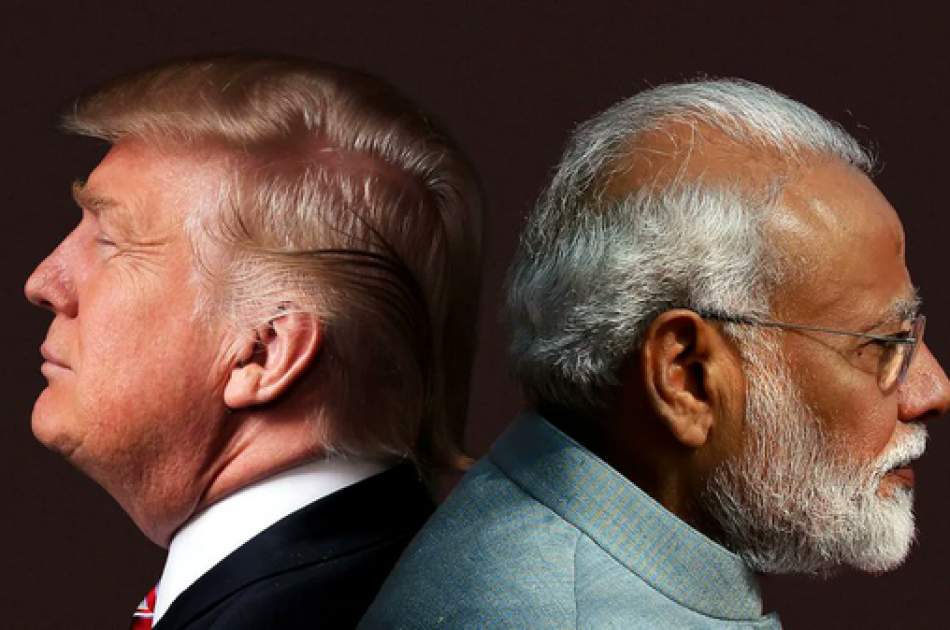
India-US Relations: Strategic Distance or Tactical?

2025/09/17 | interview, Politics, top news

Strategic Council Online – Interview: A former Iranian diplomat stated that India will keep its differences with the United States limited and at the bilateral level, and will not join any power bloc against other powers.

Seyed Rasoul Mousavi, in an interview with the website of the Strategic Council on Foreign Relations, in response to the question of whether a strategic change has taken place in India-US relations or whether the differences and distance between the two sides should be considered merely tactical and temporary under the influence of US tariff policies, said: In the current developments in the international arena, a significant issue must be taken into account; today, except in rare cases, the stability of policies in relations between countries and their foreign policy towards international issues is relative, and in many cases, strategies, alliances and coalitions are influenced by various factors and events; so much so that it can be called the era of “tactical strategies”.

He continued: From the end of World War II to the end of the Cold War, there was a kind of relative stability in the strategies and policies of governments regarding coalitions and relations with each other, because the two superpowers and their allies saw the stability of the bipolar order in line with their interests. But with the collapse of the former Soviet Union and the US emphasis on a unipolar system, the world moved towards disorder, and the United States, which introduced itself as the guardian of the post-World War II global order, itself became the main factor in disrupting regional and global institutions in the field of international rules and law. With the coming to power of Trump, who raised the slogan “America First”, this global disorder and the denial of international law and global regulations have reached their peak.

The international affairs expert emphasized: Therefore, it can be said with certainty that the friendship and distance of countries with each other, including in US-India relations, follows the above rule; just as until recently, the ties between the two countries were an example of friendship between two countries, but due to India’s inattention to Trump’s desire, who is very eager to introduce himself as the ender of the war between India and Pakistan, it cooled down, and it is possible that in the near future their relations will warm up again and Trump and Modi will make statements as if they had no differences with each other. Of course, this situation depends on both sides revising some of their demands.

Regarding the cancellation of Trump’s trip to India to attend the Quad summit, Mousavi said: Given Trump’s slogan of ‘America First’, it seems that the United States can no longer easily participate in any multilateral forum such as the G7 or the Quad summit of the US, Japan, Australia, and India. The US’s unusual behavior with the heads of European countries who had traveled to Washington to accompany Ukrainian President Zelensky to strengthen his position can be understood in the same context.

He added that Trump considers himself and the United States superior to all and cannot consider his position equal to others in multilateral forums; therefore, he can only be present in bilateral relations, provided that the other party accepts the superiority of Trump’s personality. Therefore, Trump’s absence from the Quad summit in India is not related to his differences with the statesmen of one or more countries, even strategically, but rather stems from Trump’s “America First” slogan, which prevents him from behaving equally with other members. However, in bilateral relations, whether with his counterpart being Putin, Macron, or any other political figure, he presents himself as a superior president and displays his personality cult.

The former Iranian diplomat, in response to the question of whether India has a serious strategic decision to get closer to China and Russia, said that India’s policy of connecting with other countries is based on “strategic autonomy.” In implementing this strategy, India emphasizes that it does not commit itself to any particular power or international organization and prioritizes India’s national interests over the interests of international organizations. Within the framework of this strategy, participation in the Shanghai Cooperation Organization, BRICS, or any other organization is important as long as it serves India’s national interests. Based on this strategy, India will not join any anti-Western bloc or front, just as Modi, the Prime Minister of this country, has cleverly avoided any hidden alliance with the United States against China. India also considers its differences with Pakistan and China as bilateral differences and avoids joining coalitions that increase the scope of tension and crisis.

Mousavi emphasized the future of India’s relations with major powers within the framework of its strategic autonomy strategy: India will neither ally with the United States against China and Russia, nor will it form a coalition with China and Russia against the United States. Just as India has kept its differences with Pakistan limited to the bilateral level, it will also keep its differences with the United States limited to the bilateral level. It will not join any power bloc against other powers.


0 Comments

LATEST CONTENT

Europe’s Enduring Dependence on Persian Gulf Energy

SCFR Online – Opinion: The dominant discourse in the field of European energy security over the past two decades has revolved around diversification of supply sources and the gradual reduction of dependence on fossil fuels. This narrative, which gained particular momentum after the Ukraine gas crisis in 2006 and its intensification in 2014 and 2022, was based on the assumption that Europe could free itself from the geopolitical vulnerabilities arising from dependence on specific suppliers through investment in renewable energy, imports of liquefied natural gas from diversified sources, and the establishment of new infrastructure. However, a closer analysis of energy trade data and the structure of the global oil and gas supply chain presents a different picture. Europe has not only failed to meaningfully reduce its dependence on the Persian Gulf, but in some sectors — particularly in liquefied natural gas imports — this dependence has deepened. This reality, which is often overlooked in public discourse, raises fundamental questions about the sustainability of Europe’s energy security strategies and their impact on regional power equations.

The Challenge of Hezbollah’s Low-Cost “FPV” Drones for the Zionist Regime

SCFR Online – Opinion: In modern warfare, it has always been assumed that the more expensive, and advanced the weapon—particularly from well-known companies—the more certain the victory will be. However, developments on the northern front of occupied Palestine in recent months have challenged this long-held belief. Here, the Zionist regime’s military, despite possessing the most advanced defense systems such as Iron Dome, David’s Sling, and Arrow, as well as fifth-generation F-35 fighter jets, Merkava tanks, and other modern equipment found in few countries worldwide, has effectively been rendered helpless against Hezbollah Lebanon’s few-hundred-dollar drones. Benjamin Netanyahu’s bitter admission regarding the inability to counter this threat, and his order to allocate an unlimited budget to find a solution, underscores the reality that the era of pure superiority through expensive technologies has come to an end.

The Impact of West Asian Developments on the Ukraine War

SCFR Online – Note: Vladimir Putin, President of Russia, recently announced—more than four years after the commencement of military aggression against Ukraine—that he believes the conflict between Russia and Ukraine is drawing to a close.

Temporary China–U.S. Trade Truce in the Shadow of Fundamental Distrust

SCFR Online – Opinion: The recent visit of the President of the United States to China is significant from various aspects; because China is recognized as the world’s second-largest economic power and a growing economy. The Chinese are also advancing in various fields, including the space sector, artificial intelligence, and military industries; to the extent that in the military sector, whereas they previously lacked an aircraft carrier, they now possess their third aircraft carrier. On the other hand, the United States, as a superpower, has always regarded China as its rival and continues to view it as such today.

Loading

Últimas publicaciones

Europe’s Enduring Dependence on Persian Gulf Energy

SCFR Online – Opinion: The dominant discourse in the field of European energy security over the past two decades has revolved around diversification of supply sources and the gradual reduction of dependence on fossil fuels. This narrative, which gained particular momentum after the Ukraine gas crisis in 2006 and its intensification in 2014 and 2022, was based on the assumption that Europe could free itself from the geopolitical vulnerabilities arising from dependence on specific suppliers through investment in renewable energy, imports of liquefied natural gas from diversified sources, and the establishment of new infrastructure. However, a closer analysis of energy trade data and the structure of the global oil and gas supply chain presents a different picture. Europe has not only failed to meaningfully reduce its dependence on the Persian Gulf, but in some sectors — particularly in liquefied natural gas imports — this dependence has deepened. This reality, which is often overlooked in public discourse, raises fundamental questions about the sustainability of Europe’s energy security strategies and their impact on regional power equations.

The Challenge of Hezbollah’s Low-Cost “FPV” Drones for the Zionist Regime

SCFR Online – Opinion: In modern warfare, it has always been assumed that the more expensive, and advanced the weapon—particularly from well-known companies—the more certain the victory will be. However, developments on the northern front of occupied Palestine in recent months have challenged this long-held belief. Here, the Zionist regime’s military, despite possessing the most advanced defense systems such as Iron Dome, David’s Sling, and Arrow, as well as fifth-generation F-35 fighter jets, Merkava tanks, and other modern equipment found in few countries worldwide, has effectively been rendered helpless against Hezbollah Lebanon’s few-hundred-dollar drones. Benjamin Netanyahu’s bitter admission regarding the inability to counter this threat, and his order to allocate an unlimited budget to find a solution, underscores the reality that the era of pure superiority through expensive technologies has come to an end.

The Impact of West Asian Developments on the Ukraine War

SCFR Online – Note: Vladimir Putin, President of Russia, recently announced—more than four years after the commencement of military aggression against Ukraine—that he believes the conflict between Russia and Ukraine is drawing to a close.

Temporary China–U.S. Trade Truce in the Shadow of Fundamental Distrust

SCFR Online – Opinion: The recent visit of the President of the United States to China is significant from various aspects; because China is recognized as the world’s second-largest economic power and a growing economy. The Chinese are also advancing in various fields, including the space sector, artificial intelligence, and military industries; to the extent that in the military sector, whereas they previously lacked an aircraft carrier, they now possess their third aircraft carrier. On the other hand, the United States, as a superpower, has always regarded China as its rival and continues to view it as such today.

Loading

DERNIER CONTENU

Europe’s Enduring Dependence on Persian Gulf Energy

SCFR Online – Opinion: The dominant discourse in the field of European energy security over the past two decades has revolved around diversification of supply sources and the gradual reduction of dependence on fossil fuels. This narrative, which gained particular momentum after the Ukraine gas crisis in 2006 and its intensification in 2014 and 2022, was based on the assumption that Europe could free itself from the geopolitical vulnerabilities arising from dependence on specific suppliers through investment in renewable energy, imports of liquefied natural gas from diversified sources, and the establishment of new infrastructure. However, a closer analysis of energy trade data and the structure of the global oil and gas supply chain presents a different picture. Europe has not only failed to meaningfully reduce its dependence on the Persian Gulf, but in some sectors — particularly in liquefied natural gas imports — this dependence has deepened. This reality, which is often overlooked in public discourse, raises fundamental questions about the sustainability of Europe’s energy security strategies and their impact on regional power equations.

The Challenge of Hezbollah’s Low-Cost “FPV” Drones for the Zionist Regime

SCFR Online – Opinion: In modern warfare, it has always been assumed that the more expensive, and advanced the weapon—particularly from well-known companies—the more certain the victory will be. However, developments on the northern front of occupied Palestine in recent months have challenged this long-held belief. Here, the Zionist regime’s military, despite possessing the most advanced defense systems such as Iron Dome, David’s Sling, and Arrow, as well as fifth-generation F-35 fighter jets, Merkava tanks, and other modern equipment found in few countries worldwide, has effectively been rendered helpless against Hezbollah Lebanon’s few-hundred-dollar drones. Benjamin Netanyahu’s bitter admission regarding the inability to counter this threat, and his order to allocate an unlimited budget to find a solution, underscores the reality that the era of pure superiority through expensive technologies has come to an end.

The Impact of West Asian Developments on the Ukraine War

SCFR Online – Note: Vladimir Putin, President of Russia, recently announced—more than four years after the commencement of military aggression against Ukraine—that he believes the conflict between Russia and Ukraine is drawing to a close.

Temporary China–U.S. Trade Truce in the Shadow of Fundamental Distrust

SCFR Online – Opinion: The recent visit of the President of the United States to China is significant from various aspects; because China is recognized as the world’s second-largest economic power and a growing economy. The Chinese are also advancing in various fields, including the space sector, artificial intelligence, and military industries; to the extent that in the military sector, whereas they previously lacked an aircraft carrier, they now possess their third aircraft carrier. On the other hand, the United States, as a superpower, has always regarded China as its rival and continues to view it as such today.

Loading

DERNIER CONTENU

Europe’s Enduring Dependence on Persian Gulf Energy

SCFR Online – Opinion: The dominant discourse in the field of European energy security over the past two decades has revolved around diversification of supply sources and the gradual reduction of dependence on fossil fuels. This narrative, which gained particular momentum after the Ukraine gas crisis in 2006 and its intensification in 2014 and 2022, was based on the assumption that Europe could free itself from the geopolitical vulnerabilities arising from dependence on specific suppliers through investment in renewable energy, imports of liquefied natural gas from diversified sources, and the establishment of new infrastructure. However, a closer analysis of energy trade data and the structure of the global oil and gas supply chain presents a different picture. Europe has not only failed to meaningfully reduce its dependence on the Persian Gulf, but in some sectors — particularly in liquefied natural gas imports — this dependence has deepened. This reality, which is often overlooked in public discourse, raises fundamental questions about the sustainability of Europe’s energy security strategies and their impact on regional power equations.

The Challenge of Hezbollah’s Low-Cost “FPV” Drones for the Zionist Regime

SCFR Online – Opinion: In modern warfare, it has always been assumed that the more expensive, and advanced the weapon—particularly from well-known companies—the more certain the victory will be. However, developments on the northern front of occupied Palestine in recent months have challenged this long-held belief. Here, the Zionist regime’s military, despite possessing the most advanced defense systems such as Iron Dome, David’s Sling, and Arrow, as well as fifth-generation F-35 fighter jets, Merkava tanks, and other modern equipment found in few countries worldwide, has effectively been rendered helpless against Hezbollah Lebanon’s few-hundred-dollar drones. Benjamin Netanyahu’s bitter admission regarding the inability to counter this threat, and his order to allocate an unlimited budget to find a solution, underscores the reality that the era of pure superiority through expensive technologies has come to an end.

The Impact of West Asian Developments on the Ukraine War

SCFR Online – Note: Vladimir Putin, President of Russia, recently announced—more than four years after the commencement of military aggression against Ukraine—that he believes the conflict between Russia and Ukraine is drawing to a close.

Temporary China–U.S. Trade Truce in the Shadow of Fundamental Distrust

SCFR Online – Opinion: The recent visit of the President of the United States to China is significant from various aspects; because China is recognized as the world’s second-largest economic power and a growing economy. The Chinese are also advancing in various fields, including the space sector, artificial intelligence, and military industries; to the extent that in the military sector, whereas they previously lacked an aircraft carrier, they now possess their third aircraft carrier. On the other hand, the United States, as a superpower, has always regarded China as its rival and continues to view it as such today.

Loading

DERNIER CONTENU

Europe’s Enduring Dependence on Persian Gulf Energy

SCFR Online – Opinion: The dominant discourse in the field of European energy security over the past two decades has revolved around diversification of supply sources and the gradual reduction of dependence on fossil fuels. This narrative, which gained particular momentum after the Ukraine gas crisis in 2006 and its intensification in 2014 and 2022, was based on the assumption that Europe could free itself from the geopolitical vulnerabilities arising from dependence on specific suppliers through investment in renewable energy, imports of liquefied natural gas from diversified sources, and the establishment of new infrastructure. However, a closer analysis of energy trade data and the structure of the global oil and gas supply chain presents a different picture. Europe has not only failed to meaningfully reduce its dependence on the Persian Gulf, but in some sectors — particularly in liquefied natural gas imports — this dependence has deepened. This reality, which is often overlooked in public discourse, raises fundamental questions about the sustainability of Europe’s energy security strategies and their impact on regional power equations.

The Challenge of Hezbollah’s Low-Cost “FPV” Drones for the Zionist Regime

SCFR Online – Opinion: In modern warfare, it has always been assumed that the more expensive, and advanced the weapon—particularly from well-known companies—the more certain the victory will be. However, developments on the northern front of occupied Palestine in recent months have challenged this long-held belief. Here, the Zionist regime’s military, despite possessing the most advanced defense systems such as Iron Dome, David’s Sling, and Arrow, as well as fifth-generation F-35 fighter jets, Merkava tanks, and other modern equipment found in few countries worldwide, has effectively been rendered helpless against Hezbollah Lebanon’s few-hundred-dollar drones. Benjamin Netanyahu’s bitter admission regarding the inability to counter this threat, and his order to allocate an unlimited budget to find a solution, underscores the reality that the era of pure superiority through expensive technologies has come to an end.

The Impact of West Asian Developments on the Ukraine War

SCFR Online – Note: Vladimir Putin, President of Russia, recently announced—more than four years after the commencement of military aggression against Ukraine—that he believes the conflict between Russia and Ukraine is drawing to a close.

Temporary China–U.S. Trade Truce in the Shadow of Fundamental Distrust

SCFR Online – Opinion: The recent visit of the President of the United States to China is significant from various aspects; because China is recognized as the world’s second-largest economic power and a growing economy. The Chinese are also advancing in various fields, including the space sector, artificial intelligence, and military industries; to the extent that in the military sector, whereas they previously lacked an aircraft carrier, they now possess their third aircraft carrier. On the other hand, the United States, as a superpower, has always regarded China as its rival and continues to view it as such today.

Loading




