Canada’s Strategic Diversification in Countering Trump’s Imposed Tariffs

2025/11/01 | Note, Politics, Top News

Online Strategic Council – Opinion: In a world where the international economy has become more than ever a network of interdependencies, even an old radio advertisement can spark a diplomatic-commercial crisis between two traditional allies.

Sina Raymand – International Relations Analyst
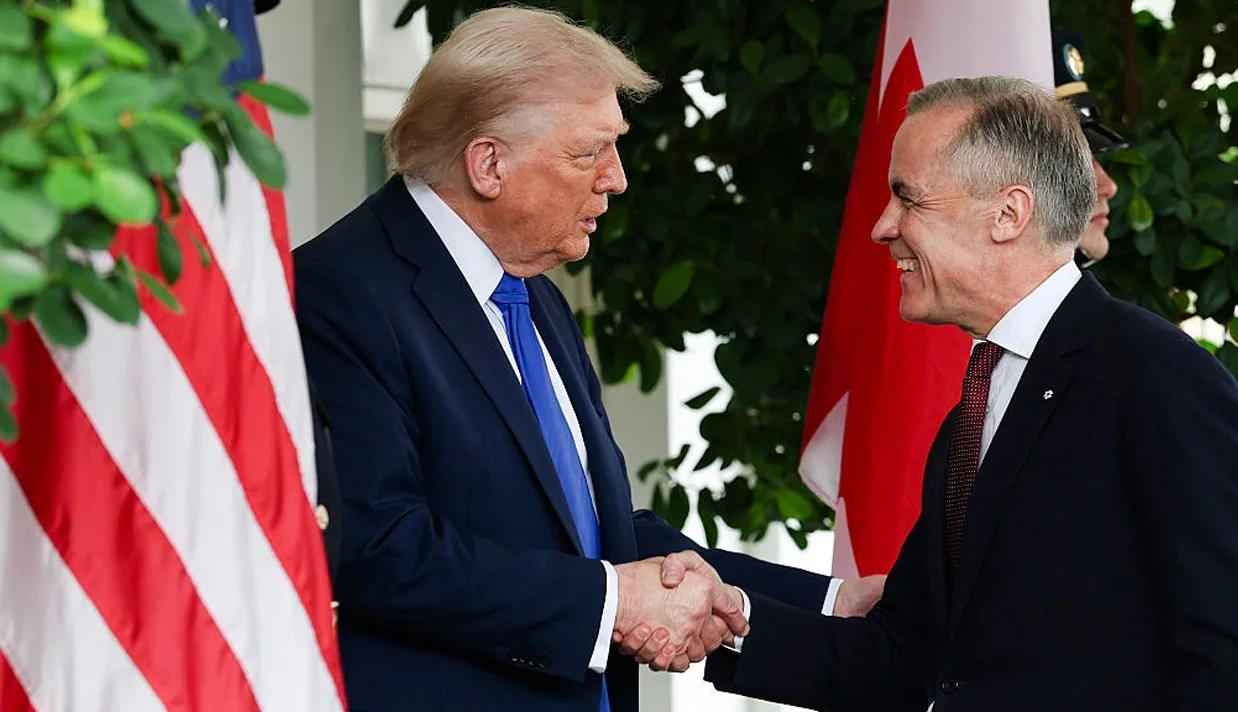
The Canadian government’s use of Ronald Reagan’s statements against protectionist policies has provoked Donald Trump’s anger and led to the suspension of trade negotiations. However, this crisis is not merely a media misstep; it symbolizes a fundamental shift in Canada’s strategic calculations amid unpredictable US behavior. Under these circumstances, Mark Carney, Canada’s new Prime Minister, is attempting to step out of America’s shadow and forge a more multipolar future for his country’s economy by traveling to Asia.
Trump’s tariff policy is not merely an economic measure but a strategic tool to redefine trade relations in line with the US’s unilateral interests. Trump, who has consistently championed the “America First” slogan, employs tariffs not as a negotiating lever but as a weapon to impose Washington’s will on its trade partners. From his perspective, Canada’s dependence on the US market, which accounts for approximately 75% of its exports, is a weakness to be exploited. Therefore, the suspension of negotiations following a media advertisement essentially conveys the message that Washington is prepared to respond harshly with economic tools to any action it perceives as a “challenge” to its policies. This approach, transcending mere trade disputes, signifies an identity crisis in America’s relations with its close allies.
In response, Canada, under the leadership of Carney, an economist with a background at the central bank, has adopted a smart and long-term strategy. Instead of direct confrontation or capitulation, he emphasizes “strategic diversification.” His travels to Asia and efforts to expand trade links with Japan, South Korea, Malaysia, the Philippines, India, and even China demonstrate that Canada is redefining its place in the global economy.
The signing of a trade agreement with Indonesia, aimed at doubling non-US exports within the next decade, is part of this strategy. Carney has explicitly stated: “Many of our past strengths, based on close ties with America, have now become vulnerabilities.” This statement is not only an economic analysis but also a political admission of the end of the exclusive dependency model.
If the US continues its tariff-oriented, threatening approach, several scenarios could unfold. First, an acceleration of Canada’s distancing from the US market, which could reduce the US share in Canadian trade in the long run, even if it comes at the cost of temporarily slowed economic growth for Canada. Second, enhanced cooperation among Canada, China, and Russia, two powers aligned against the US, could alter the geopolitical balance in the northern part of the continent. Third, the potential formation of a global anti-protectionist coalition in which Canada plays a key, initiating role. Of course, this path is not without challenges; geographical distance, cultural differences, and geostrategic competitions in Asia pose serious obstacles for Canada.
These developments also hold important strategic lessons for Iran. Unilateral dependency on any power or pole always signifies increased vulnerability. Canada, despite its structural advantages of neighborhood and shared language with the US, is now redefining its relations. This trend shows that, in the era of great power competition, countries’ economic survival requires smart diversification and the creation of multidimensional trade networks. Canada does not want to be considered the “51st state” of the US, and no independent country should place itself in a position where its destiny is shaped solely by a single partner.


0 Comments

LATEST CONTENT

China’s Rejection of US Sanctions; Strengthening Iran’s Geopolitical Leverage

SCFR Online – Opinion: Concurrent with the official commencement of the United States’ economic war against our country, focusing on sanctions instruments, isolation, and economic pressure, what has now become increasingly important is the lack of alignment of other major global powers, especially China, with this policy.

The Makkah Pact; Reasons for its Formation and Challenges Ahead

SCFR Online – Opinion: The Makkah Pact, signed between Saudi Arabia, Pakistan, and Turkey under the motto “an attack on one is an attack on all,” is viewed by some analysts less as a full-fledged military coalition and more as an attempt to reduce security dependence on an external power and to establish a regional security mechanism.

Implications of the US-Saudi Nuclear Agreement

SCFR Online – Opinion: The new US-Saudi nuclear agreement, despite legal and political ambiguities, could alter previous non-proliferation standards in West Asia and intensify nuclear competition, ushering it into a new phase.

An Analysis of Recent Turkey-Israeli Regime Tensions

SCFR Online – Opinion: Recent developments in Syria indicate an intensification of strategic rivalry between Turkey and the Israeli regime, but mutual considerations and the role of the United States have limited the likelihood of direct war.

Loading

Últimas publicaciones

China’s Rejection of US Sanctions; Strengthening Iran’s Geopolitical Leverage

SCFR Online – Opinion: Concurrent with the official commencement of the United States’ economic war against our country, focusing on sanctions instruments, isolation, and economic pressure, what has now become increasingly important is the lack of alignment of other major global powers, especially China, with this policy.

The Makkah Pact; Reasons for its Formation and Challenges Ahead

SCFR Online – Opinion: The Makkah Pact, signed between Saudi Arabia, Pakistan, and Turkey under the motto “an attack on one is an attack on all,” is viewed by some analysts less as a full-fledged military coalition and more as an attempt to reduce security dependence on an external power and to establish a regional security mechanism.

Implications of the US-Saudi Nuclear Agreement

SCFR Online – Opinion: The new US-Saudi nuclear agreement, despite legal and political ambiguities, could alter previous non-proliferation standards in West Asia and intensify nuclear competition, ushering it into a new phase.

An Analysis of Recent Turkey-Israeli Regime Tensions

SCFR Online – Opinion: Recent developments in Syria indicate an intensification of strategic rivalry between Turkey and the Israeli regime, but mutual considerations and the role of the United States have limited the likelihood of direct war.

Loading

DERNIER CONTENU

China’s Rejection of US Sanctions; Strengthening Iran’s Geopolitical Leverage

SCFR Online – Opinion: Concurrent with the official commencement of the United States’ economic war against our country, focusing on sanctions instruments, isolation, and economic pressure, what has now become increasingly important is the lack of alignment of other major global powers, especially China, with this policy.

The Makkah Pact; Reasons for its Formation and Challenges Ahead

SCFR Online – Opinion: The Makkah Pact, signed between Saudi Arabia, Pakistan, and Turkey under the motto “an attack on one is an attack on all,” is viewed by some analysts less as a full-fledged military coalition and more as an attempt to reduce security dependence on an external power and to establish a regional security mechanism.

Implications of the US-Saudi Nuclear Agreement

SCFR Online – Opinion: The new US-Saudi nuclear agreement, despite legal and political ambiguities, could alter previous non-proliferation standards in West Asia and intensify nuclear competition, ushering it into a new phase.

An Analysis of Recent Turkey-Israeli Regime Tensions

SCFR Online – Opinion: Recent developments in Syria indicate an intensification of strategic rivalry between Turkey and the Israeli regime, but mutual considerations and the role of the United States have limited the likelihood of direct war.

Loading

DERNIER CONTENU

China’s Rejection of US Sanctions; Strengthening Iran’s Geopolitical Leverage

SCFR Online – Opinion: Concurrent with the official commencement of the United States’ economic war against our country, focusing on sanctions instruments, isolation, and economic pressure, what has now become increasingly important is the lack of alignment of other major global powers, especially China, with this policy.

The Makkah Pact; Reasons for its Formation and Challenges Ahead

SCFR Online – Opinion: The Makkah Pact, signed between Saudi Arabia, Pakistan, and Turkey under the motto “an attack on one is an attack on all,” is viewed by some analysts less as a full-fledged military coalition and more as an attempt to reduce security dependence on an external power and to establish a regional security mechanism.

Implications of the US-Saudi Nuclear Agreement

SCFR Online – Opinion: The new US-Saudi nuclear agreement, despite legal and political ambiguities, could alter previous non-proliferation standards in West Asia and intensify nuclear competition, ushering it into a new phase.

An Analysis of Recent Turkey-Israeli Regime Tensions

SCFR Online – Opinion: Recent developments in Syria indicate an intensification of strategic rivalry between Turkey and the Israeli regime, but mutual considerations and the role of the United States have limited the likelihood of direct war.

Loading

DERNIER CONTENU

China’s Rejection of US Sanctions; Strengthening Iran’s Geopolitical Leverage

SCFR Online – Opinion: Concurrent with the official commencement of the United States’ economic war against our country, focusing on sanctions instruments, isolation, and economic pressure, what has now become increasingly important is the lack of alignment of other major global powers, especially China, with this policy.

The Makkah Pact; Reasons for its Formation and Challenges Ahead

SCFR Online – Opinion: The Makkah Pact, signed between Saudi Arabia, Pakistan, and Turkey under the motto “an attack on one is an attack on all,” is viewed by some analysts less as a full-fledged military coalition and more as an attempt to reduce security dependence on an external power and to establish a regional security mechanism.

Implications of the US-Saudi Nuclear Agreement

SCFR Online – Opinion: The new US-Saudi nuclear agreement, despite legal and political ambiguities, could alter previous non-proliferation standards in West Asia and intensify nuclear competition, ushering it into a new phase.

An Analysis of Recent Turkey-Israeli Regime Tensions

SCFR Online – Opinion: Recent developments in Syria indicate an intensification of strategic rivalry between Turkey and the Israeli regime, but mutual considerations and the role of the United States have limited the likelihood of direct war.

Loading



