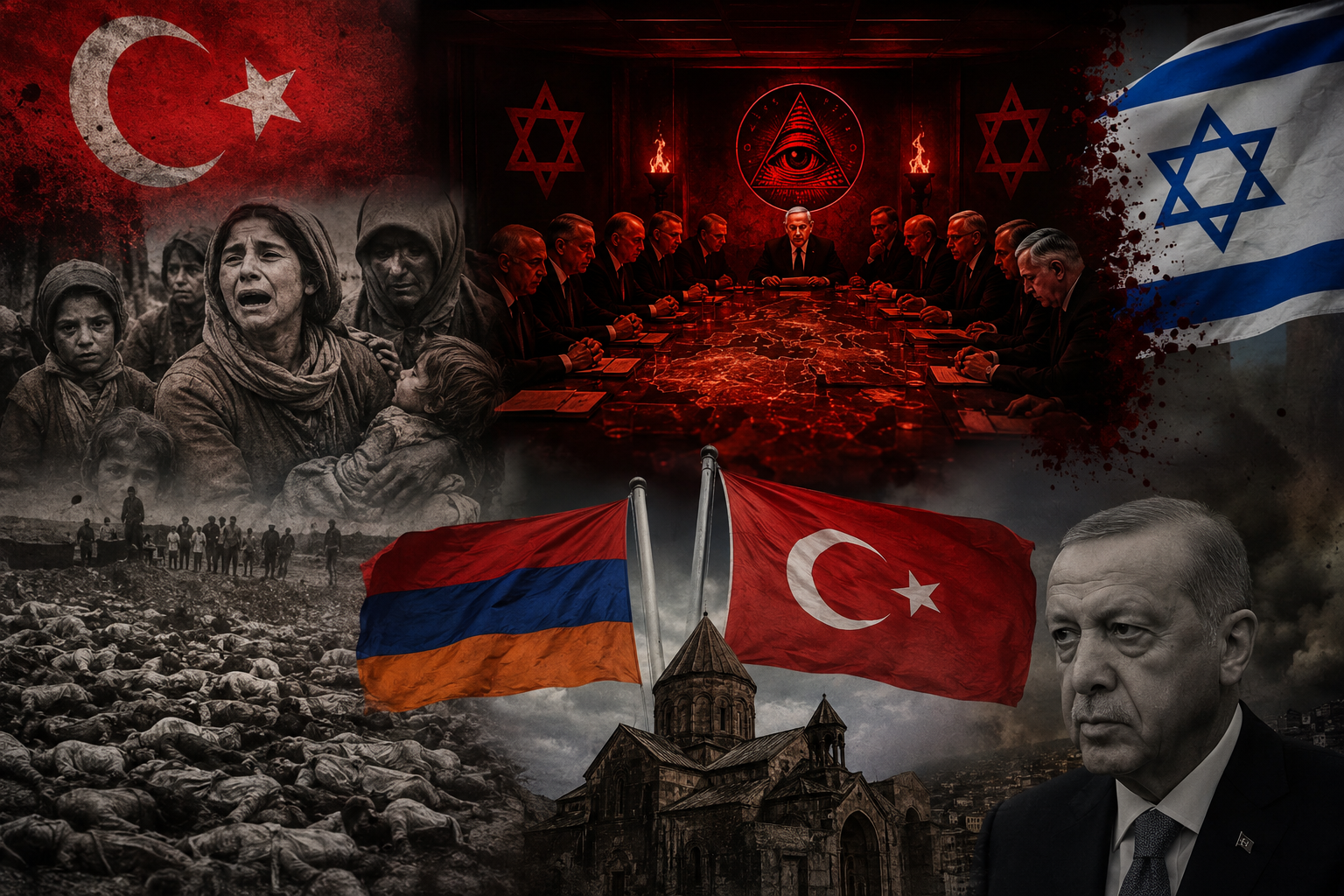
Analysis of the Recognition of the Armenian Genocide by the Zionist Regime

SCFR Online – Opinion: At a time when the West Asia region, particularly in recent months, has been undergoing the most complex political and security developments of the past half-century, the sudden decision by the cabinet of the Zionist regime to recognize the Armenian genocide committed by Turkey, which has faced strong condemnation and opposition from Ankara and Baku, raises questions.

Hamid Khosh-Ayand – Regional Affairs Analyst

The proposal introduced by Gideon Sa’ar, the regime’s foreign minister, accompanied by the slogan “It is never too late to do the right thing,” is being raised at a time when tensions between Tel Aviv and Ankara have reached their peak and Tel Aviv’s security discourse has redefined Turkey as a “regional threat.” This coincidence has made doubts regarding the real objectives of this move an unavoidable necessity, a matter that requires careful examination given Turkey’s historical sensitivity toward the Armenian issue and the significance of public opinion regarding it.

Over the past seven decades, the Zionist regime, despite extensive pressure from Armenian communities and international organizations, has consistently refrained from officially recognizing the Armenian genocide. Numerous proposals submitted to the Knesset for this purpose were often halted at various stages or failed to reach a conclusion. Analysts have consistently assessed this refusal not as stemming from historical or academic disagreements, but rather from geopolitical considerations and efforts to preserve strategic relations with Turkey and the Republic of Azerbaijan.

Turkey has always been of vital importance to the Zionist regime due to its strategic position and its role in regional equations. However, now, amid unprecedented tensions, this same regime has unanimously chosen a path within the cabinet that could irreversibly affect these relations.

Escalation of Confrontation with Turkey and Redefinition of the Security Discourse

The issue has been raised at a time when relations between the Zionist regime and Turkey are experiencing one of their most tense periods. The Gaza war and Tel Aviv’s extensive military operations in this region, as well as the regime’s attacks against Iran, which maintains good relations with Turkey, have triggered strong reactions from Recep Tayyip Erdoğan. The Turkish president has repeatedly condemned the policies of the Zionist regime and described them as blatant violations of human rights and genocide in Gaza.

Following the escalation of these tensions, Ankara imposed trade restrictions against the Zionist regime, and the political relations between the two sides entered a cold and tense phase. In such an atmosphere, Tel Aviv’s recent decision to recognize an event that carries identity-based and historical sensitivity for Turkey cannot be interpreted separately from this political context. Many observers believe that the Zionist regime, through this decision, seeks to send a clear message to Ankara: “If you accuse us of genocide in Gaza, we will also challenge your history by recognizing the perpetration of genocide.”

The Zionist regime’s perception of Turkey has undergone a noticeable change in recent years. In previous decades, relations between the two sides were considered close in the security and military fields; however, today, part of the political and security establishment of the Zionist regime describes Turkey as a serious competitor or even a potential threat. In some analytical circles and Zionist media outlets, Ankara is referred to as the “next Iran”; an expression that reflects deep concerns over Turkey’s increasing regional influence and its critical positions toward Tel Aviv’s policies, while placing Turkey’s security under threat.

Within this framework, statements by Jonathan Pollard, the former spy of the Zionist regime, who has described Turkey and Egypt as among the regime’s possible future military targets, reflect the intensification of the security discourse against regional actors. The recognition of the Armenian genocide by the Zionist regime, in this context, can be viewed as part of a more aggressive strategy to contain Turkey in the sphere of public opinion and international diplomacy, using a historical card to undermine Ankara’s image at the global level.

Historical Memory; From Justice to a Geopolitical Instrument

Perhaps the most thought-provoking aspect of this issue is the question raised by Armenians themselves and human rights activists: Is the sudden attention of the Zionist regime to the historical suffering of Armenians the result of a genuine ethical reassessment, or should it be understood as a political instrument within the framework of political and geopolitical rivalries? The answer to this question increasingly appears to lean toward the second option.

The sudden change in the perspective of Zionist leaders amid the peak of tensions carries a warning that the issue of the Armenian genocide, which is one of the red lines of Turkey’s foreign policy, has now been transformed into a tool for political pressure. Such an approach by the Zionist regime is entirely instrumental in nature.

Regional Consequences for the Caucasus and the Future of Tel Aviv’s Relations with Baku

Meanwhile, the Republic of Azerbaijan, as a close partner of the Zionist regime and Turkey, finds itself in a difficult position. Baku, which on the one hand maintains good relations with the regime in the fields of energy and security and, on the other hand, has deep cultural and political ties with Ankara, now faces a conflict of interests. If this proposal receives final approval in the Knesset, the government of the Republic of Azerbaijan will face challenges in adopting a position consistent with its interests, and this could create uncertainty regarding trilateral cooperation in the fields of energy and security. This issue demonstrates that Tel Aviv’s decision is not merely a bilateral action against Turkey; rather, it will generate a chain of regional effects that could also influence the complex balances of the South Caucasus and West Asia.

Ultimately, what emerges from this issue is a clear picture of the instrumental nature of the Zionist regime’s foreign policy. The Zionist regime, which itself faces accusations of widespread human rights violations and genocide in Gaza, is now attempting to instrumentalize Turkey’s historical memory in order to shift pressures away from itself and toward another party. However, given Turkey’s strong reaction, this move will have irreversible consequences for the Zionist regime.

0 Comments

LATEST CONTENT

Analysis of the Recognition of the Armenian Genocide by the Zionist Regime

SCFR Online – Opinion: At a time when the West Asia region, particularly in recent months, has been undergoing the most complex political and security developments of the past half-century, the sudden decision by the cabinet of the Zionist regime to recognize the Armenian genocide committed by Turkey, which has faced strong condemnation and opposition from Ankara and Baku, raises questions.

Lebanon Peace Agreement; Consolidation of Occupation

SCFR Online – Opinion: The Washington trilateral agreement, by linking the end of occupation to political and security conditions, does not establish a sustainable peace; rather, it consolidates the occupation.

China’s Effort to Recreate a New Global Order

SCFRonline – Opinion: Unlike classical powers, Beijing pursues its preferred order not through territorial occupation, but through technology, capital, standard-setting, and digital governance.

The Decline of Paris’s Traditional Influence in the Sahel

SCFR online – Opinion: The severance of diplomatic relations between Burkina Faso and France is not merely a bilateral crisis; rather, it constitutes an indication of the accelerating decline of Paris’s traditional influence in West Africa and the reconfiguration of the power balance in the Sahel region.

Loading

Últimas publicaciones

Analysis of the Recognition of the Armenian Genocide by the Zionist Regime

SCFR Online – Opinion: At a time when the West Asia region, particularly in recent months, has been undergoing the most complex political and security developments of the past half-century, the sudden decision by the cabinet of the Zionist regime to recognize the Armenian genocide committed by Turkey, which has faced strong condemnation and opposition from Ankara and Baku, raises questions.

Lebanon Peace Agreement; Consolidation of Occupation

SCFR Online – Opinion: The Washington trilateral agreement, by linking the end of occupation to political and security conditions, does not establish a sustainable peace; rather, it consolidates the occupation.

China’s Effort to Recreate a New Global Order

SCFRonline – Opinion: Unlike classical powers, Beijing pursues its preferred order not through territorial occupation, but through technology, capital, standard-setting, and digital governance.

The Decline of Paris’s Traditional Influence in the Sahel

SCFR online – Opinion: The severance of diplomatic relations between Burkina Faso and France is not merely a bilateral crisis; rather, it constitutes an indication of the accelerating decline of Paris’s traditional influence in West Africa and the reconfiguration of the power balance in the Sahel region.

Loading

DERNIER CONTENU

Analysis of the Recognition of the Armenian Genocide by the Zionist Regime

SCFR Online – Opinion: At a time when the West Asia region, particularly in recent months, has been undergoing the most complex political and security developments of the past half-century, the sudden decision by the cabinet of the Zionist regime to recognize the Armenian genocide committed by Turkey, which has faced strong condemnation and opposition from Ankara and Baku, raises questions.

Lebanon Peace Agreement; Consolidation of Occupation

SCFR Online – Opinion: The Washington trilateral agreement, by linking the end of occupation to political and security conditions, does not establish a sustainable peace; rather, it consolidates the occupation.

China’s Effort to Recreate a New Global Order

SCFRonline – Opinion: Unlike classical powers, Beijing pursues its preferred order not through territorial occupation, but through technology, capital, standard-setting, and digital governance.

The Decline of Paris’s Traditional Influence in the Sahel

SCFR online – Opinion: The severance of diplomatic relations between Burkina Faso and France is not merely a bilateral crisis; rather, it constitutes an indication of the accelerating decline of Paris’s traditional influence in West Africa and the reconfiguration of the power balance in the Sahel region.

Loading

DERNIER CONTENU

Analysis of the Recognition of the Armenian Genocide by the Zionist Regime

SCFR Online – Opinion: At a time when the West Asia region, particularly in recent months, has been undergoing the most complex political and security developments of the past half-century, the sudden decision by the cabinet of the Zionist regime to recognize the Armenian genocide committed by Turkey, which has faced strong condemnation and opposition from Ankara and Baku, raises questions.

Lebanon Peace Agreement; Consolidation of Occupation

SCFR Online – Opinion: The Washington trilateral agreement, by linking the end of occupation to political and security conditions, does not establish a sustainable peace; rather, it consolidates the occupation.

China’s Effort to Recreate a New Global Order

SCFRonline – Opinion: Unlike classical powers, Beijing pursues its preferred order not through territorial occupation, but through technology, capital, standard-setting, and digital governance.

The Decline of Paris’s Traditional Influence in the Sahel

SCFR online – Opinion: The severance of diplomatic relations between Burkina Faso and France is not merely a bilateral crisis; rather, it constitutes an indication of the accelerating decline of Paris’s traditional influence in West Africa and the reconfiguration of the power balance in the Sahel region.

Loading

DERNIER CONTENU

Analysis of the Recognition of the Armenian Genocide by the Zionist Regime

SCFR Online – Opinion: At a time when the West Asia region, particularly in recent months, has been undergoing the most complex political and security developments of the past half-century, the sudden decision by the cabinet of the Zionist regime to recognize the Armenian genocide committed by Turkey, which has faced strong condemnation and opposition from Ankara and Baku, raises questions.

Lebanon Peace Agreement; Consolidation of Occupation

SCFR Online – Opinion: The Washington trilateral agreement, by linking the end of occupation to political and security conditions, does not establish a sustainable peace; rather, it consolidates the occupation.

China’s Effort to Recreate a New Global Order

SCFRonline – Opinion: Unlike classical powers, Beijing pursues its preferred order not through territorial occupation, but through technology, capital, standard-setting, and digital governance.

The Decline of Paris’s Traditional Influence in the Sahel

SCFR online – Opinion: The severance of diplomatic relations between Burkina Faso and France is not merely a bilateral crisis; rather, it constitutes an indication of the accelerating decline of Paris’s traditional influence in West Africa and the reconfiguration of the power balance in the Sahel region.

Loading





