Winners and Losers of Recent Developments in Afghanistan

2021/09/01 | Note, Politics, top news

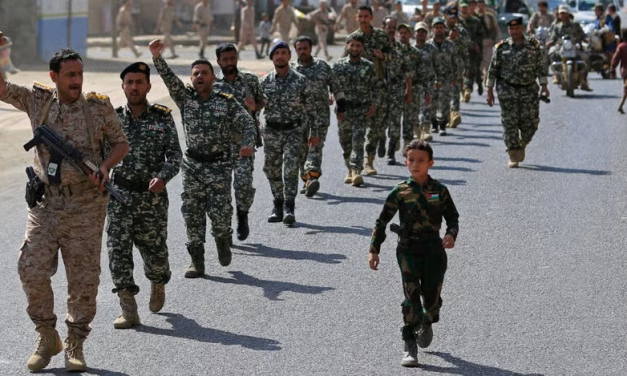
Strategic Council Online - Interview: An expert on the subcontinent affairs commenting on the winners and losers of Afghanistan’s developments and the rise of the Taliban to power, divided the case into three separate sections, first domestic winners and losers, second neighbors and countries that have defined interests in Afghanistan and third at international level.

Speaking in an interview with the website of the Strategic Council on Foreign Relations, Pir Mohammad Mollazehi referring to the situation of Afghanistan in internal dimension said: The Taliban are involved in two internal conflicts; first is the ruling Liberal Democrat and governmental trend, which emerged from the Bonn International Conference in 2001. It consisted of educated forces that had embraced liberal democracy and seized power at that time.

He continued: In the first phase, this process was designed by three sections, including the interim government, the transitional government, and then the adoption of the constitution at the invitation of Loya Jirga; on this basis, a government came to power through elections, in which Hamid Karzai was elected as the president in all three stages.

According to Mollazehi, after Karzai, Ashraf Ghani came to power, whose presidency was controversial in two stages.

The expert noted: In the first phase, with the intervention of then-US Secretary of State John Kerry, a formula was set for a president and a chief executive (Abdullah Abdullah) to rule Afghanistan. Of course, there was no such issue in the constitution, but the conditions required that they go this way.

The expert on the subcontinent affairs, noting that less than one million people participated in the second round of the Afghan elections, added: The government no longer had the legitimacy it needed, and so the liberal current that came to power after 2001 and the fall of the Taliban, was the main winner of the new developments in Afghanistan.

Mollazehi believes that determining the second winner of the recent developments depends on how the Taliban take power and how they design the power structure.

He continued: If the Taliban seek a monopoly of power, certainly they will not have tranquility, and then it is conceivable that religious groups, the Shiites, ethnic groups, including the Tajiks, Uzbeks and Hazaras, will be the losers, but if the Taliban accepts a balanced ethnic structure and form a government in which all religious and ethnic groups and currents have a share, in that case those groups will not be at least among the losers and can share power. Of course, this is conditional on the Taliban relinquishing their monopoly.

The expert of subcontinent affairs, referring to the regional dimension of the developments explained: In the regional dimension, India may be the main loser, because Pakistan has always been behind the Taliban, and today the Taliban have gained power by relying on the support of Islamabad.

Saying that India may be the main loser of those developments in the future from two angles, Mollazehi stressed: First, Delhi had made investment in Afghanistan worth billions, but to no avail, and the regime that was allied with India has been overthrown. It may even open the door to anti-Indian forces in Afghanistan, such as Lashkar-e-Taiba, the Mujahideen Party and the Jaish-e-Mohammad, and those groups will be trained and work in Kashmir, India, in the interests of Pakistan.

He described Iran as the second country where experts are skeptical about losing or winning in the face of developments in Afghanistan.

Mollazehi continued: Some believe that Iran has suffered from those developments and point to the Taliban’s ideological influence in Saudi Arabia. Since according to those people Tehran and Riyadh are facing ideological rivalries, therefore Saudi Arabia will have better relations with the Taliban in the future and Iran will not get the position it expects in Afghanistan. But apart from the ideological debate, given the great potential for economic, scientific and cultural cooperation and the geographical location of Afghanistan, Iran can make good use of existing opportunities.

The expert on the subcontinent affairs categorized Turkey and Qatar as the winners of those developments and said: It is conceivable that Turkey will continue to find a foothold in Afghanistan and among its Turkic-speaking people in terms of its neo-Ottoman pan-Turkism, and since it is a member of NATO, it can represent the US and NATO forces in Afghanistan.

He added: Turkish companies are also likely to play an important role in rebuilding Afghanistan, so they will take the initiative in trade.

As for Qatar’s role, Mollazehi explained: The money that is now in the hands of the Taliban and the deals with local commanders have been provided through Qatar, therefore, the Qataris have at least a specific place at this juncture.

The international affairs expert called the United States a conditional loser of the developments and said: If we assume that the Americans did not make a behind-the-scene deal with the Taliban in Doha, Qatar, they will be the losers. So whether Washington wins or loses in Afghanistan is a matter that will be clarified in the future.

He said: Although ideologically the United States is a definite loser, because they were forced to withdraw from the liberal democracies they wanted to implement in Afghanistan and Iraq but they failed in this regard.

According to the expert, this is a big defeat for the White House, because it opens the space for China as a rival of the United States in Afghanistan, and if Kabul signs an agreement with Beijing to rebuild the country’s vast mines, China will be the winner of the developments.

Mollazehi said this was conditional on the Taliban’s future orientation and whether it would be oriented towards China or the United States.

Mollazehi said in conclusion that Russia is also somewhat concerned about those developments; because the forces in the northern regions of Afghanistan, on the border between Central Asia and Afghanistan, are ethnic forces affiliated with the ISIS; therefore, if the Taliban open the door to the ISIS, those ethnic forces may act against Russia’s interests in Chechnya and Central Asia.


0 Comments

Submit a Comment

Your email address will not be published. Required fields are marked *

LATEST CONTENT

Temporary China–U.S. Trade Truce in the Shadow of Fundamental Distrust

SCFR Online – Opinion: The recent visit of the President of the United States to China is significant from various aspects; because China is recognized as the world’s second-largest economic power and a growing economy. The Chinese are also advancing in various fields, including the space sector, artificial intelligence, and military industries; to the extent that in the military sector, whereas they previously lacked an aircraft carrier, they now possess their third aircraft carrier. On the other hand, the United States, as a superpower, has always regarded China as its rival and continues to view it as such today.

Iran’s Success in the Narrative Battle in Cyberspace

SCFR Online – Opinion: In the war between Iran and the United States, the main battlefield was not defined solely in the military domain; rather, the battle of narratives in cyberspace—particularly through memes—reached a decisive level.

The Global Energy Shock Situation and Future Scenarios

SCFR Online – Opinion: Only one month after the beginning of the Ramadan War, maritime traffic in the Strait of Hormuz decreased dramatically, with Bloomberg announcing a reduction of 103 vessels; Brent oil prices rose by more than 50 percent, and gasoline prices in the United States increased by 31.4 percent. Additionally, benchmark gas prices in Europe showed a 73.4 percent increase.

Al-Zaydi’s Selection as Prime Minister, The Beginning of a New Chapter in Iraq

SCFR Online – Note: After approximately five months of political deadlock and institutional confusion, Ali al-Zaydi has finally been selected as Iraq’s Prime Minister. Al-Zaydi’s selection as Prime Minister represents a positive sign of the completion of the government formation process and the beginning of a new phase in Iraqi politics and governance. The emergence of a young, technocratic figure from the third generation of politicians—in a context where the country has been administered by traditional figures for decades—revives hope that Iraq may perhaps distance itself from the repetitive cycle of crises and experience a new path of stability, efficiency, and regional convergence.

Loading

Últimas publicaciones

Temporary China–U.S. Trade Truce in the Shadow of Fundamental Distrust

SCFR Online – Opinion: The recent visit of the President of the United States to China is significant from various aspects; because China is recognized as the world’s second-largest economic power and a growing economy. The Chinese are also advancing in various fields, including the space sector, artificial intelligence, and military industries; to the extent that in the military sector, whereas they previously lacked an aircraft carrier, they now possess their third aircraft carrier. On the other hand, the United States, as a superpower, has always regarded China as its rival and continues to view it as such today.

Iran’s Success in the Narrative Battle in Cyberspace

SCFR Online – Opinion: In the war between Iran and the United States, the main battlefield was not defined solely in the military domain; rather, the battle of narratives in cyberspace—particularly through memes—reached a decisive level.

The Global Energy Shock Situation and Future Scenarios

SCFR Online – Opinion: Only one month after the beginning of the Ramadan War, maritime traffic in the Strait of Hormuz decreased dramatically, with Bloomberg announcing a reduction of 103 vessels; Brent oil prices rose by more than 50 percent, and gasoline prices in the United States increased by 31.4 percent. Additionally, benchmark gas prices in Europe showed a 73.4 percent increase.

Al-Zaydi’s Selection as Prime Minister, The Beginning of a New Chapter in Iraq

SCFR Online – Note: After approximately five months of political deadlock and institutional confusion, Ali al-Zaydi has finally been selected as Iraq’s Prime Minister. Al-Zaydi’s selection as Prime Minister represents a positive sign of the completion of the government formation process and the beginning of a new phase in Iraqi politics and governance. The emergence of a young, technocratic figure from the third generation of politicians—in a context where the country has been administered by traditional figures for decades—revives hope that Iraq may perhaps distance itself from the repetitive cycle of crises and experience a new path of stability, efficiency, and regional convergence.

Loading

DERNIER CONTENU

Temporary China–U.S. Trade Truce in the Shadow of Fundamental Distrust

SCFR Online – Opinion: The recent visit of the President of the United States to China is significant from various aspects; because China is recognized as the world’s second-largest economic power and a growing economy. The Chinese are also advancing in various fields, including the space sector, artificial intelligence, and military industries; to the extent that in the military sector, whereas they previously lacked an aircraft carrier, they now possess their third aircraft carrier. On the other hand, the United States, as a superpower, has always regarded China as its rival and continues to view it as such today.

Iran’s Success in the Narrative Battle in Cyberspace

SCFR Online – Opinion: In the war between Iran and the United States, the main battlefield was not defined solely in the military domain; rather, the battle of narratives in cyberspace—particularly through memes—reached a decisive level.

The Global Energy Shock Situation and Future Scenarios

SCFR Online – Opinion: Only one month after the beginning of the Ramadan War, maritime traffic in the Strait of Hormuz decreased dramatically, with Bloomberg announcing a reduction of 103 vessels; Brent oil prices rose by more than 50 percent, and gasoline prices in the United States increased by 31.4 percent. Additionally, benchmark gas prices in Europe showed a 73.4 percent increase.

Al-Zaydi’s Selection as Prime Minister, The Beginning of a New Chapter in Iraq

SCFR Online – Note: After approximately five months of political deadlock and institutional confusion, Ali al-Zaydi has finally been selected as Iraq’s Prime Minister. Al-Zaydi’s selection as Prime Minister represents a positive sign of the completion of the government formation process and the beginning of a new phase in Iraqi politics and governance. The emergence of a young, technocratic figure from the third generation of politicians—in a context where the country has been administered by traditional figures for decades—revives hope that Iraq may perhaps distance itself from the repetitive cycle of crises and experience a new path of stability, efficiency, and regional convergence.

Loading

DERNIER CONTENU

Temporary China–U.S. Trade Truce in the Shadow of Fundamental Distrust

SCFR Online – Opinion: The recent visit of the President of the United States to China is significant from various aspects; because China is recognized as the world’s second-largest economic power and a growing economy. The Chinese are also advancing in various fields, including the space sector, artificial intelligence, and military industries; to the extent that in the military sector, whereas they previously lacked an aircraft carrier, they now possess their third aircraft carrier. On the other hand, the United States, as a superpower, has always regarded China as its rival and continues to view it as such today.

Iran’s Success in the Narrative Battle in Cyberspace

SCFR Online – Opinion: In the war between Iran and the United States, the main battlefield was not defined solely in the military domain; rather, the battle of narratives in cyberspace—particularly through memes—reached a decisive level.

The Global Energy Shock Situation and Future Scenarios

SCFR Online – Opinion: Only one month after the beginning of the Ramadan War, maritime traffic in the Strait of Hormuz decreased dramatically, with Bloomberg announcing a reduction of 103 vessels; Brent oil prices rose by more than 50 percent, and gasoline prices in the United States increased by 31.4 percent. Additionally, benchmark gas prices in Europe showed a 73.4 percent increase.

Al-Zaydi’s Selection as Prime Minister, The Beginning of a New Chapter in Iraq

SCFR Online – Note: After approximately five months of political deadlock and institutional confusion, Ali al-Zaydi has finally been selected as Iraq’s Prime Minister. Al-Zaydi’s selection as Prime Minister represents a positive sign of the completion of the government formation process and the beginning of a new phase in Iraqi politics and governance. The emergence of a young, technocratic figure from the third generation of politicians—in a context where the country has been administered by traditional figures for decades—revives hope that Iraq may perhaps distance itself from the repetitive cycle of crises and experience a new path of stability, efficiency, and regional convergence.

Loading

DERNIER CONTENU

Temporary China–U.S. Trade Truce in the Shadow of Fundamental Distrust

SCFR Online – Opinion: The recent visit of the President of the United States to China is significant from various aspects; because China is recognized as the world’s second-largest economic power and a growing economy. The Chinese are also advancing in various fields, including the space sector, artificial intelligence, and military industries; to the extent that in the military sector, whereas they previously lacked an aircraft carrier, they now possess their third aircraft carrier. On the other hand, the United States, as a superpower, has always regarded China as its rival and continues to view it as such today.

Iran’s Success in the Narrative Battle in Cyberspace

SCFR Online – Opinion: In the war between Iran and the United States, the main battlefield was not defined solely in the military domain; rather, the battle of narratives in cyberspace—particularly through memes—reached a decisive level.

The Global Energy Shock Situation and Future Scenarios

SCFR Online – Opinion: Only one month after the beginning of the Ramadan War, maritime traffic in the Strait of Hormuz decreased dramatically, with Bloomberg announcing a reduction of 103 vessels; Brent oil prices rose by more than 50 percent, and gasoline prices in the United States increased by 31.4 percent. Additionally, benchmark gas prices in Europe showed a 73.4 percent increase.

Al-Zaydi’s Selection as Prime Minister, The Beginning of a New Chapter in Iraq

SCFR Online – Note: After approximately five months of political deadlock and institutional confusion, Ali al-Zaydi has finally been selected as Iraq’s Prime Minister. Al-Zaydi’s selection as Prime Minister represents a positive sign of the completion of the government formation process and the beginning of a new phase in Iraqi politics and governance. The emergence of a young, technocratic figure from the third generation of politicians—in a context where the country has been administered by traditional figures for decades—revives hope that Iraq may perhaps distance itself from the repetitive cycle of crises and experience a new path of stability, efficiency, and regional convergence.

Loading